De kunstwerken die op deze pagina worden weergegeven, zijn beschermd door de auteursrechtwetgeving, wat betekent dat het ons wettelijk niet is toegestaan om identieke reproducties te maken of te verkopen. Deze bescherming wordt gehandhaafd onder internationale overeenkomsten zoals de Conventie van Bern en door nationale wetgeving, waaronder de bepalingen van de Amerikaanse auteurswet - Titel 17. Alle rechten voorbehouden. Reproduceren of distribueren van afbeeldingen is niet toegestaan zonder uitdrukkelijke schriftelijke toestemming van WahooArt.com en de rechthebbenden.
Deze methode voldoet volledig aan de auteursrechtwetgeving, omdat het niet gaat om het kopiëren of dupliceren van het beschermde kunstwerk. In plaats daarvan is er sprake van een creatieve herinterpretatie — een nieuw schilderij dat door het origineel wordt geïnspireerd, maar er niet identiek aan is.
Giclée- of canvasafdruk van museumkwaliteit met een snelle productie en flexibele afwerkingsmogelijkheden. ( Bestel handgeschilderde reproductie Schakel over naar digitale afbeeldingen)





























Kies uit onze vooraf ingestelde maten die overeenkomen met de originele verhoudingen van het kunstwerk.

Voer de gewenste breedte en hoogte in, passend bij uw lijst of muur. Een afdruk kan alleen worden ingekort en nooit groter worden gemaakt dan het origineel; een formaat met andere verhoudingen zal daarom een deel van de afbeelding verliezen. Wij sturen u een digitaal mockup ter goedkeuring voordat we tot drukwerk overgaan. De afbeelding op deze pagina toont niet de werkelijke uitsnede — dit is alleen te zien op het mockup.
Wereldwijde levering () binnen 2 weken in plaats van de standaard 4/5 weken. (8 november)
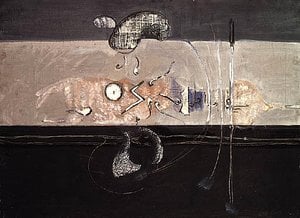
De Trial
Afmetingen reproductie
Binnen de bekende thema's van John Samuel Tunnard - modern fabric design, marine life observation, jazz aesthetic resonance, psychological exploration, british museum legacy - legt "De Trial" een eigen focus op cornish landscape, maritime scene, psychological depth, perspective play, symbolic imagery, jazz influence, dark palette.
"De Trial" door John Samuel Tunnard is te zien in British Council, London, Verenigd Koninkrijk. De vermelding van het museum heeft betrekking op het originele werk, niet op reproducties.
De auteursrechtstatus van "De Trial" - nog steeds auteursrechtelijk beschermd - is gebaseerd op het overlijden van de kunstenaar in 1971.

John Samuel Tunnard (1900-1971) was an English modernist painter and designer. Born in Sandwich, Kent, he initially studied design at the Royal College of Art from 1919 to 1923. This foundational training would prove crucial throughout his artistic career, influencing both his painting style and his later ventures into textile design.
During the 1920s, Tunnard worked in various textile design roles in Manchester. This period provided him with practical experience and an understanding of pattern, color, and form – elements that would later become prominent features of his paintings. In 1926, he married Mary May Robertson, a partnership that would significantly shape both their personal and professional lives.
By 1928, Tunnard began to focus seriously on painting. He taught design at the Central School of Arts and Crafts in London from 1929 onwards, further solidifying his engagement with artistic principles and pedagogy. His work during this time demonstrates a growing interest in modernist aesthetics. Tunnard’s style was notably influenced by Surrealism, although he never formally joined the movement. He participated in several surrealist exhibitions throughout the 1930s, including one at the Gordon Fraser Gallery in Cambridge.
In 1933, Tunnard and his wife moved to Cadgwith, Cornwall. There, they established a business producing printed silks, allowing them to combine their artistic talents with entrepreneurial endeavors. The Cornish landscape profoundly impacted Tunnard’s art, inspiring many of his later landscapes and providing a new source of visual motifs.
Tunnard's oeuvre encompasses both paintings – including notable landscapes and portraits – and textile designs. His painting style is characterized by its lyrical abstraction, dreamlike qualities, and vibrant color palettes. He often blended representational elements with abstract forms, creating a unique visual language that reflects his surrealist leanings.
Tunnard exhibited widely throughout his career. He showed work at the Royal Academy and with the London Group (which he joined in 1934). His participation in surrealist exhibitions further cemented his position within the British avant-garde.
John Samuel Tunnard is now considered one of the most important English modernist painters. His work represents a unique synthesis of Surrealism, abstraction, and landscape painting. Examples of his art can be found in prominent collections such as the National Galleries of Scotland. He contributed significantly to the development of modern British art, bridging the gap between traditional representation and abstract expression.

1900 - 1971 , United Kingdom
Explore the life & work of John Hoppner, a leading Georgian portraitist. Discover his vibrant style, influential patrons, and lasting impact on British art history. Expert insights for collectors.

Ontdek de 25 mooiste schilderijen van John Constable, meester van de Engelse Romantiek. Van idyllische landschappen tot iconische Hay Wain – bewonder zijn techniek en emotie. Museumkwaliteit reproducties & decoratie op WahooArt.com.

Explore the captivating world of John Piper, a celebrated British painter whose evocative landscapes & iconic church art captured the spirit of his time. Discover his legacy and find high-quality reproductions at WahooArt.

Ontdek de 25 mooiste meesterwerken van John Singer Sargent! Van elegante portretten tot impressionistische schilderijen – leer over zijn leven, techniek & impact. Museumkwaliteit reproducties voor uw interieur op WahooArt.com.

Explore the poignant war poetry of Wilfred Owen, a key figure in British Modernism. Discover his innovative style, themes of loss & camaraderie, and lasting impact on 20th-century literature. Analysis & historical context included.
 Voorvertoning
 Verstuur
 Delen
Delen
 Details bekijken
 Gids
Gids

 Download
 Vergelijkbare items
 Röntgenonderzoek
 Diavoorstelling
 Vraag & antwoord
 Statistieken


 Lees meer









 De optie voor glas is alleen beschikbaar bij een formaat kleiner dan 110 cm.