


De kunstwerken die op deze pagina worden weergegeven, zijn beschermd door de auteursrechtwetgeving, wat betekent dat het ons wettelijk niet is toegestaan om identieke reproducties te maken of te verkopen. Deze bescherming wordt gehandhaafd onder internationale overeenkomsten zoals de Conventie van Bern en door nationale wetgeving, waaronder de bepalingen van de Amerikaanse auteurswet - Titel 17. Alle rechten voorbehouden. Reproduceren of distribueren van afbeeldingen is niet toegestaan zonder uitdrukkelijke schriftelijke toestemming van WahooArt.com en de rechthebbenden.
Deze methode voldoet volledig aan de auteursrechtwetgeving, omdat het niet gaat om het kopiëren of dupliceren van het beschermde kunstwerk. In plaats daarvan is er sprake van een creatieve herinterpretatie — een nieuw schilderij dat door het origineel wordt geïnspireerd, maar er niet identiek aan is.
Giclée- of canvasafdruk van museumkwaliteit met een snelle productie en flexibele afwerkingsmogelijkheden. ( Bestel handgeschilderde reproductie Schakel over naar digitale afbeeldingen)
Kies uit onze vooraf ingestelde maten die overeenkomen met de originele verhoudingen van het kunstwerk.

Voer de gewenste breedte en hoogte in, passend bij uw lijst of muur. Een afdruk kan alleen worden ingekort en nooit groter worden gemaakt dan het origineel; een formaat met andere verhoudingen zal daarom een deel van de afbeelding verliezen. Wij sturen u een digitaal mockup ter goedkeuring voordat we tot drukwerk overgaan. De afbeelding op deze pagina toont niet de werkelijke uitsnede — dit is alleen te zien op het mockup.
Wereldwijde levering () binnen 2 weken in plaats van de standaard 4/5 weken. (15 november)
John Schanck
Afmetingen reproductie

The story of John James Masquerier is one inextricably linked to the dramatic shifts of the late eighteenth and early nineteenth centuries. Born in October 1778 in Chelsea, London, his very identity was a tapestry of cultural intersections; he was a British painter of French Huguenot descent, a heritage that placed him at the heart of the intellectual and political currents flowing between London and Paris. His childhood was marked by the vibrant, often perilous atmosphere of the French Revolution. Taken to Paris by his mother, Barbot, who had established a school in the prestigious Champs-Elysées, the young Masquerier found himself a witness to history in its most raw and violent forms. While studying painting under the esteemed François Vincent at the Tuileries Academy, he stood amidst the chaos of the massacre of the Swiss Guards in 1792. This early exposure to political upheaval did more than just shape his biography; it instilled in his art a profound sensitivity to the human condition during times of profound transition.
The volatility of the era eventually forced a retreat to England, but Masquerier carried the spirit of Paris with him. In 1792, he enrolled at the Royal Academy Schools, marking the beginning of a formal engagement with the British artistic establishment. His early talent was so striking that a self-portrait, executed when he was a mere fourteen years old, was presented to King George III—a testament to a precocious mastery of form and character that would define his professional trajectory.
Masquerier’s oeuvre is characterized by a remarkable ability to capture both the monumental and the intimate. While he is perhaps most celebrated for his portraiture, his work serves as a vital historical record of the era's most notable figures. His brush possessed a unique capacity for psychological depth, moving beyond mere likeness to reveal the inner essence of his subjects. This was particularly evident in his depictions of individuals such as Lady Hamilton, where he utilized masterful chiaroscuro to create a sense of drama and presence that commanded the viewer's attention.
Beyond the studio, Masquerier acted as an ocular chronicler of the French Revolution. Driven by an acute impulse to document the zeitgeist, he produced meticulous sketches from personal observation of pivotal, often harrowing, events. His drawings captured the trial of the King and the tragic demise of the Princesse de Lamballe, offering a visceral connection to the era's political tremors. This duality—the ability to execute refined, neoclassical portraiture while maintaining the gritty, observational eye of a war correspondent—distinguishes his contribution to the history of art.
As his career progressed, Masquerier’s reputation expanded through significant commissions and high-profile patronage. His work reached new heights of complexity with large-scale religious and historical compositions, such as The Incredulity of St. Thomas, which served as a monumental altar-piece in Westminster. Even as he navigated the complexities of the Napoleonic era, his connection to the French political landscape remained a source of artistic inspiration; he famously claimed to have produced a drawing of Napoleon Bonaparte during his time as First Consul.
The enduring significance of John James Masquerier lies in his role as a bridge between cultures and eras. He was an artist who did not merely paint the world around him but felt its pulse. Through his portraits, he immortalized the faces of the Enlightenment and the Napoleonic age, while his sketches preserved the fleeting, often terrifying moments of revolutionary change. His legacy remains a profound testament to the power of art to act as both a mirror to society and a vessel for historical memory.

1778 - 1855 , United Kingdom

Step into the haunting dreamscapes of Giorgio de Chirico. Explore 25 iconic Metaphysical and Surrealist masterpieces, from enigmatic shadows to timeless architecture. Find inspiration for museum-quality art reproductions and decor. Discover all masterpieces on WahooArt.com.
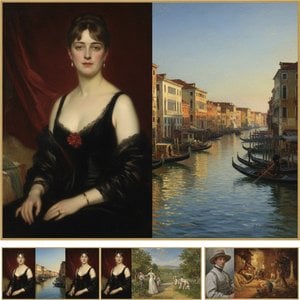
Ontdek de 25 mooiste meesterwerken van John Singer Sargent! Van elegante portretten tot impressionistische schilderijen – leer over zijn leven, techniek & impact. Museumkwaliteit reproducties voor uw interieur op WahooArt.com.

Explore the life & art of Sir James Jebusa Shannon, a leading Victorian portrait painter. Discover his elegant style, technical mastery, and lasting influence on British art. Shop high-quality reproductions at WahooArt.
 Voorvertoning
 Verstuur
 Delen
Delen
 Details bekijken
 Gids
Gids

 Download
 Vergelijkbare items
 Röntgenonderzoek
 Diavoorstelling
 Vraag & antwoord
 Statistieken
 Lees meer






































 De optie voor glas is alleen beschikbaar bij een formaat kleiner dan 110 cm.


