


 OilWallArtRomantic Landscape
 181019th Century
 71.0 x 92.0 cm
 Yale Center for British Art
Met de hand geschilderd in olieverf op canvas in uw gewenste maat en lijst, op bestelling gemaakt door onze kunstenaars. ( Bestel print Koop afbeelding)





























Kies uit onze vooraf ingestelde maten die overeenkomen met de originele verhoudingen van het kunstwerk.

U kunt uw eigen afmetingen invoeren om in een specifieke lijst of ruimte te passen. Als de door u gekozen maat niet overeenkomt met de verhoudingen van het originele beeld, zullen we het kunstwerk bijsnijden of het schilderij uitbreiden met extra handgeschilderde elementen. Een digitale mockup wordt ter goedkeuring naar u verzonden voordat de productie begint.
Houd er rekening mee dat de preview op het scherm niet de werkelijke uitsnede of uitbreiding weergeeft. Alleen de mockup toont de uiteindelijke compositie nauwkeurig.
Hoewel aangepaste afmetingen mogelijk zijn, raden we aan een maat uit de vooraf gedefinieerde lijst te selecteren om de originele verhoudingen te behouden.
Wereldwijde levering () binnen 3 tot 4 weken in plaats van de standaard 5 weken. (7 september). Zonder concessies aan de kwaliteit.


Heath Ewe and Lambs
Afmetingen reproductie
In the quietude of the English countryside, captured through the masterful lens of James Ward, Heath Ewe and Lambs emerges as a profound meditation on the rhythms of pastoral life. Painted in 1810, this evocative work transcends a mere depiction of livestock, offering instead a window into a vanished era of rustic tranquility. The composition draws the viewer immediately into a tender encounter between ewe and lamb, where the soft textures of fleece meet the rugged, weathered elements of the landscape. Through his delicate handling of light and form, Ward invites us to witness a moment of profound biological and emotional connection, set against the backdrop of an enduring, timeless countryside.
The scene is anchored by the presence of three sheep, their forms rendered with a tactile realism that makes one almost feel the warmth of their wool. A lamb, nestled closely beside its mother, serves as the emotional heartbeat of the piece, embodying innocence and the cycle of life. This intimacy is balanced by the broader landscape, where an old wooden fence and a striking splash of red cloth provide structural rhythm and a touch of human presence. The inclusion of figures in the periphery—one near the upper corner and another toward the bottom—suggests the watchful, symbiotic relationship between man and beast, hinting at a life defined by stewardship and the seasonal movements of the flock.
James Ward was a titan of the British school, particularly renowned for his ability to imbue animal subjects with a sense of dignity and individual character. In Heath Ewe and Lambs, we see the hallmarks of his evolving technique during the early 19th century. Moving away from the simpler genre scenes of his early career, Ward began to embrace a more Romantic sensibility, where the landscape is not merely a setting but an active participant in the emotional narrative. His brushwork, though precise enough to capture the coarse grain of the wooden fence and the softness of the lamb's coat, possesses a fluid grace that allows the atmosphere of the heath to breathe.
For the discerning collector or interior designer, this painting offers a sophisticated interplay of texture and tone. The muted, earthy palette—rich with mossy greens, weathered browns, and subtle ochres—creates a soothing visual harmony that is ideal for creating a focal point in a classic or farmhouse-style interior. The sudden, rhythmic accent of the red cloth serves as a brilliant compositional device, drawing the eye across the canvas and preventing the pastoral scene from becoming overly monochromatic. It is a work that commands attention through its subtlety rather than through overt spectacle.
To possess a reproduction of such a significant work is to bring a piece of British art history into one's personal sanctuary. Heath Ewe and Lambs resonates deeply with the contemporary desire for connection to nature and the restorative power of the pastoral ideal. It evokes a sense of nostalgia for a slower, more deliberate way of existence, making it an inspiring choice for spaces designed for reflection and peace. Whether placed in a sunlit study or a grand dining hall, this painting serves as a testament to Ward's enduring ability to capture the soul of the natural world, offering a timeless elegance that transcends the boundaries of its 1810 origins.

James Ward (1769-1859) was een vooraanstaande Britse schilder, die bekend staat om zijn betoverende dierenportretten, romantische landschappen en doordachte portretten. Hoewel hij vaak in de schaduw stond van zijn tijdgenoten, had zijn unieke stijl en vaardigheid een significante invloed op de ontwikkeling van de Britse kunst in de 19e eeuw.
Geboren op 23 oktober 1769 in Londen, Verenigd Koninkrijk, was James Ward de jongere broer van graveur William Ward. Zijn vroege artistieke neigingen werden gevoed binnen een creatieve familieomgeving. Hoewel hij enige formele training ontving, was zijn ontwikkeling grotendeels zelfgestuurd en sterk beïnvloed door observatie en oefening.
Ward’s carrière kan conventioneel worden verdeeld in twee duidelijke perioden met betrekking tot invloeden. In eerste instantie, tot ongeveer 1803, leken zijn werken sterk op die van zijn broer-in-law, George Morland, gekenmerkt door genretaferelen en een focus op alledaagse leven. Na deze periode werd hij diep geïnspireerd door de barokmeester Peter Paul Rubens, waarbij hij een dynamischere compositie, rijke kleurenpalet en dramatische toepassing van licht en schaduw aannam.
Ward’s unieke stijl onderscheidde hem van vele tijdgenoten. Hij excelleerde in verschillende genres, waaronder historische schilderkunst, portretten, landschapskunst en dierenportretten. Enkele van zijn meest gerespecteerde werken omvatten:
Zijn schilderijen kenmerken zich door een nauwkeurige aandacht voor detail, met name in de weergave van dieren, gecombineerd met een romantische gevoeligheid die de schoonheid en kracht van de natuur benadrukt.
Ward genoot patronage van prominente figuren zoals Theophilus Levett, wat leidde tot talrijke opdrachten. Hij exposeerde regelmatig zijn werk in de Royal Academy, waar hij erkenning kreeg voor zijn vaardigheid en originaliteit. Zijn toetreding als lid in 1811 versterkte zijn positie binnen de Britse kunstgemeenschap.
Ward bleef productief schilderen tot een beroerte in 1855, die zijn carrière beëindigde. Hij stierf op 17 november 1859 in relatieve armoede, ondanks zijn eerdere succes.
Ondanks de financiële moeilijkheden die hij later in het leven ondervond, heeft James Ward’s invloed op de Britse kunst onbetwistbaar gebleven. Zijn unieke combinatie van realisme en romantiek heeft de weg vrijgemaakt voor toekomstige generaties dierenpainters en landschapskunstenaars. Zijn werken worden nu bewaard in prestigieuze collecties, zoals Tate Britain en het Yale Center for British Art.
James Ward neemt een significante positie in zich op in de overgang van de Neoclassicisme naar de Romantiek in de Britse kunst. Hij verbond de kloof tussen traditionele genre-schilderkunst en het groeiende belang van landschapskunst en naturalisme, waardoor een nalatenschap achterbleef van betoverende werken die tot op de dag van vandaag inspireren en aansluiten.

1769 - 1859 , Verenigd Koninkrijk
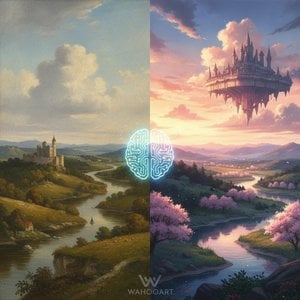
Transform your photos into high-octane action anime masterpieces with WahooArt. Our expert artists blend AI innovation with traditional oil painting to create premium, hand-painted pop culture legacies for your home. Experience museum-quality craftsmanship and a 100% satisfaction guarantee.

Step into the spotlight with WahooArt's AI-driven transformation. Turn your photos into stunning, hand-painted anime oil masterpieces. Experience the perfect fusion of cutting-edge technology and museum-grade craftsmanship to create a timeless pop-culture legacy for your home.

Explore the serene beauty of sheep in fine art history. From Dutch Golden Age realism to Impressionist landscapes, discover how masters captured pastoral tranquility through exquisite oil paintings and museum-quality reproductions for discerning collectors.

 Voorvertoning
 Verstuur
 Delen
Delen
 Details bekijken

 Download
 Vergelijkbare items
 Röntgenonderzoek
 Diavoorstelling
 Lees meer







 De optie voor glas is alleen beschikbaar bij een formaat kleiner dan 110 cm.


