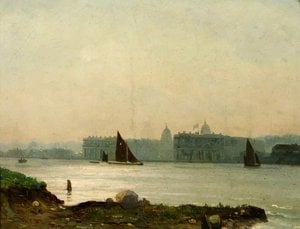
A Monochromatic Echo of the Riverbank
James Francis Danby’s “The Ferry,” rendered in a strikingly restrained monochrome pencil, isn't merely a depiction of a river crossing; it’s a profound meditation on human activity and its relationship to the natural world. Completed around 1840, this sketch, now meticulously reproduced as part of WahooArt’s collection, possesses an immediate power born from Danby’s mastery of line and his deep engagement with the Romantic sensibility. The scene unfolds with a quiet intensity – figures laboring in a small boat on a broad expanse of water, their forms subtly defined against the hazy backdrop of a distant shoreline. There's no dramatic storm or heroic gesture here; instead, we witness a commonplace event elevated to an almost spiritual level through Danby’s careful observation and artistic interpretation.
The drawing’s strength lies in its deliberate simplicity. Danby eschews the lavish use of shading typical of his contemporaries, relying instead on variations in line weight – thick strokes for the boat's structure, delicate lines for the receding shoreline – to create an illusion of depth and volume. The composition is deliberately flattened, avoiding strong vanishing points that would pull the viewer into a traditional landscape perspective. This flattening emphasizes the two-dimensionality of the sketch, lending it a timeless quality reminiscent of Renaissance drawings, while simultaneously intensifying the sense of immediacy and observation.
The Bristol School and Romantic Intensity
To fully appreciate “The Ferry,” one must understand Danby’s place within the Bristol School of landscape painting. Emerging in the early 19th century, this group of artists – including Edward Dayes, George Petrie, and crucially, Danby himself – sought to move beyond the purely topographical depictions favored by earlier generations. They were deeply influenced by the Romantic movement's emphasis on emotion, imagination, and the sublime power of nature. Danby’s work embodies these principles perfectly; he doesn’t simply record a scene but attempts to capture its emotional essence, imbuing it with a sense of melancholy and quiet contemplation.
Danby’s background as an art teacher further informs his approach. He was trained in the classical tradition, yet he embraced the Romantic spirit, incorporating elements of dramatic lighting, atmospheric perspective, and a heightened sense of drama into his work. His early life in Ireland, marked by upheaval and loss, undoubtedly contributed to this emotional intensity – a sensitivity that permeates every line of “The Ferry.” The sketch feels less like a detached observation and more like a deeply felt response to the scene before him.
Symbolism of Labor and Connection
Beyond its technical merits, "The Ferry" is rich in symbolic meaning. The figures working on the boat represent not just transportation but also labor – a fundamental aspect of human existence. Their activity connects them directly to the river, to the land, and to each other. The water itself acts as a unifying element, subtly linking the foreground figures with the distant horizon. This subtle connection speaks to the enduring relationship between humanity and nature, a theme central to Romantic thought.
Furthermore, the scene evokes a sense of journey – both literal and metaphorical. The ferry represents movement, transition, and perhaps even escape. The muted palette reinforces this feeling of quiet contemplation, inviting the viewer to reflect on their own journeys and connections within the world around them. It’s a powerful image that transcends its simple subject matter, offering a glimpse into the complexities of human experience.
A Legacy in Reproduction
WahooArt's faithful reproduction captures the essence of Danby’s original sketch with remarkable fidelity. The subtle nuances of line and tone are meticulously preserved, allowing viewers to appreciate the artist’s extraordinary skill and sensitivity. Whether displayed as a statement piece in a contemporary interior or studied for its historical significance, “The Ferry” remains a compelling testament to the power of Romantic art – a timeless image that continues to resonate with audiences today.



 Voorvertoning
 Switch to Print
 Verstuur
 Delen
Delen
 Details bekijken

 Download
 Vergelijkbare items
 Röntgenonderzoek
 Diavoorstelling
 Stats
Stats


 Lees meer






































 De optie voor glas is alleen beschikbaar bij een formaat kleiner dan 110 cm.


![Life Of Saint Francis - [04] - Death And Ascension Of St Francis — Giotto Di Bondone, Italian Renaissance](/media/artworks/images-thumb/08/8b/088b102b13c1a379233690905590f156.jpg)