


Met de hand geschilderd in olieverf op canvas in uw gewenste maat en lijst, op bestelling gemaakt door onze kunstenaars. ( Bestel print Koop afbeelding)





























Kies uit onze vooraf ingestelde maten die overeenkomen met de originele verhoudingen van het kunstwerk.

U kunt uw eigen afmetingen invoeren om in een specifieke lijst of ruimte te passen. Als de door u gekozen maat niet overeenkomt met de verhoudingen van het originele beeld, zullen we het kunstwerk bijsnijden of het schilderij uitbreiden met extra handgeschilderde elementen. Een digitale mockup wordt ter goedkeuring naar u verzonden voordat de productie begint.
Houd er rekening mee dat de preview op het scherm niet de werkelijke uitsnede of uitbreiding weergeeft. Alleen de mockup toont de uiteindelijke compositie nauwkeurig.
Hoewel aangepaste afmetingen mogelijk zijn, raden we aan een maat uit de vooraf gedefinieerde lijst te selecteren om de originele verhoudingen te behouden.
Wereldwijde levering () binnen 3 tot 4 weken in plaats van de standaard 5 weken. (6 september). Zonder concessies aan de kwaliteit.


The forge.
Afmetingen reproductie
“The Forge,” created in 1861 by James Abbott McNeill Whistler, is a striking monochromatic charcoal drawing that offers a glimpse into everyday life with an understated elegance. This work exemplifies Whistler’s evolving artistic style and his growing interest in printmaking techniques. Rather than depicting a grand narrative or symbolic scene, the artwork focuses on capturing a fleeting moment – a group of men engaged in conversation or activity within what appears to be a workshop or tavern setting.
The drawing is rendered in a style that leans towards realism but infused with elements of tonalism, an artistic movement emphasizing the subtle gradations of light and shade. Whistler’s masterful use of charcoal allows him to create a sense of depth and texture through varying pressure applied to the paper. Dense shading defines forms while lighter lines suggest details, resulting in a grainy surface that adds to the drawing's immediacy. The perspective is shallow, focusing on the foreground figures and creating a feeling of intimacy. There are no overt symbolic elements; instead, Whistler presents a documentary-like observation of an ordinary scene.
“The Forge” was created during a pivotal period in Whistler’s career. Having spent his teenage years in London with his half-sister and her husband, an avid etcher, he developed an early appreciation for printmaking. Following his move to Paris in 1855, Whistler immersed himself in the study of art under figures like Sébastien Bouré. He began experimenting with etching techniques, breaking new ground by moving beyond reproductive prints to explore the medium's expressive potential. This work reflects that experimentation and demonstrates his growing mastery of charcoal as a tool for capturing fleeting moments and subtle tonal variations.
“The Forge” evokes a sense of quiet observation and understated drama. The lack of overt narrative allows the viewer to project their own interpretations onto the scene, fostering a personal connection with the artwork. Whistler’s skill in capturing the nuances of light and shadow creates an atmosphere of intimacy and realism, inviting contemplation on the simple beauty of everyday life. It is a testament to his ability to find artistic merit in ordinary moments, transforming them into compelling works of art.


1834 - 1903 , Verenigde Staten van Amerika

Elevate your artistry with this definitive expert guide to mastering charcoal. Designed for art students, learn professional techniques for capturing profound depth, intricate textures, and dramatic shadows through advanced blending and chiaroscuro methods.

Elevate your artistic practice with this expert guide to mastering the line. Discover advanced techniques in graphite, charcoal, and contour drawing designed for art students seeking technical precision and expressive depth in their fine art studies.

Explore the profound artistry of graphite drawing. Discover professional techniques for mastering depth, texture, and detail through a lens of art history, from classical sketches to modern masterpieces. Elevate your understanding of the pencil medium with our expert guide.

Explore the evocative world of Tonalism. Discover how masters like Whistler used soft light and muted palettes to craft profound atmosphere and mood in fine art history.
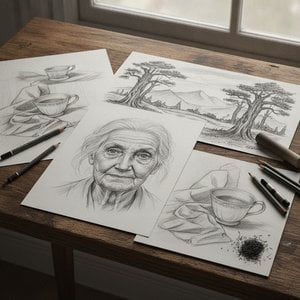
Explore the profound elegance of pencil and charcoal sketching. Discover how masters use line, shadow, and chiaroscuro to capture light and texture, bridging the gap between preparatory studies and timeless fine art masterpieces.

 Voorvertoning
 Verstuur
 Delen
Delen
 Details bekijken

 Download
 Vergelijkbare items
 Röntgenonderzoek
 Diavoorstelling


 Lees meer







 De optie voor glas is alleen beschikbaar bij een formaat kleiner dan 110 cm.


