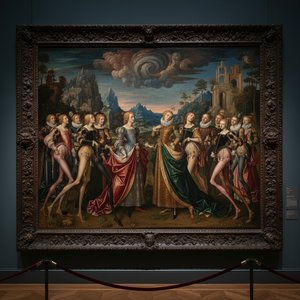
Bekijk op ware grootte Bekijk in AR Koop handgeschilderd kunstwerk Schakel over naar digitale afbeeldingen Verstuur
Details bekijken Gids voor studentenkunstwerken Toevoegen aan favorieten Download Vergelijkbare items Röntgenonderzoek Diavoorstelling Statistieken

Gerbil

Jacopo Ligozzi's 'Gerbil' captures a vibrant depiction of the animal, showcasing his meticulous detail and blending art with scientific observation – a unique Renaissance masterpiece.

Jacopo Ligozzi (1547-1627) was een Italiaanse schilder uit de late Renaissance en het Maniërisme, beroemd om botanische illustraties, fauna en ontwerpen voor het hof van de Medici. De 'Audubon van Florence', die kunst & wetenschap verbond.

Giclée / Kunstafdrukken

Giclée- of canvasafdruk van museumkwaliteit met een snelle productie en flexibele afwerkingsmogelijkheden. ( Koop handgeschilderd kunstwerk Schakel over naar digitale afbeeldingen)

Corner sample of the P118B picture frame: gegoten polystyreen, 5 cm wide and 3 cm thick
P118B €10
Corner sample of the P118H picture frame: gegoten polystyreen, 5 cm wide and 3 cm thick
P118H €10
Corner sample of the P118W picture frame: gegoten polystyreen, 5 cm wide and 3 cm thick
P118W €10
Corner sample of the P438Z picture frame: gegoten polystyreen, 5.5 cm wide and 3.5 cm thick
P438Z €10
Corner sample of the P508JH picture frame: gegoten polystyreen, 7 cm wide and 3.5 cm thick
P508JH €12
Corner sample of the P508YH picture frame: gegoten polystyreen, 7 cm wide and 3.5 cm thick
P508YH €12
Corner sample of the P805H picture frame: gegoten polystyreen, 5 cm wide and 3.5 cm thick
P805H €10
Corner sample of the P805Z picture frame: gegoten polystyreen, 5 cm wide and 3.5 cm thick
P805Z €10
Corner sample of the P919BZ picture frame: gegoten polystyreen, 7 cm wide and 3.5 cm thick
P919BZ €10
Corner sample of the P919G picture frame: gegoten polystyreen, 7 cm wide and 3.5 cm thick
P919G €10
Corner sample of the P919XJ picture frame: gegoten polystyreen, 7 cm wide and 3.5 cm thick
P919XJ €10
Corner sample of the P959ZH picture frame: gegoten polystyreen, 5 cm wide and 3 cm thick
P959ZH €10
Corner sample of the P968JZ picture frame: gegoten polystyreen, 6 cm wide and 4 cm thick
P968JZ €12
Corner sample of the W106C picture frame: massief hout, 5 cm wide and 3 cm thick
W106C €8
Corner sample of the W218G picture frame: massief hout, 5 cm wide and 3 cm thick
W218G €10
Corner sample of the W218JH picture frame: massief hout, 5 cm wide and 3 cm thick
W218JH €8
Corner sample of the W218Y picture frame: massief hout, 5 cm wide and 3 cm thick
W218Y €10
Corner sample of the W307PJ picture frame: massief hout, 6 cm wide and 3 cm thick
W307PJ €10
Corner sample of the W316G picture frame: massief hout, 6 cm wide and 3 cm thick
W316G €10
Corner sample of the W316PJ picture frame: massief hout, 6 cm wide and 3 cm thick
W316PJ €8
Corner sample of the W316Y picture frame: massief hout, 6 cm wide and 3 cm thick
W316Y €10
Corner sample of the W398PJ picture frame: massief hout, 5 cm wide and 3 cm thick
W398PJ €8
Corner sample of the W4111J picture frame: massief hout, 6.5 cm wide and 3.5 cm thick
W4111J €10
Corner sample of the W500HY picture frame: massief hout, 7 cm wide and 5 cm thick
W500HY €15
Corner sample of the W500JH picture frame: massief hout, 7 cm wide and 5 cm thick
W500JH €15
Corner sample of the W692G picture frame: massief hout, 8 cm wide and 4 cm thick
W692G €12
Corner sample of the W849H picture frame: massief hout, 5 cm wide and 3 cm thick
W849H €8
Corner sample of the W940BG picture frame: massief hout, 7.5 cm wide and 4.5 cm thick
W940BG €15
Corner sample of the W953PJ picture frame: massief hout, 6 cm wide and 3.5 cm thick
W953PJ €8

Standaardformaat
op maat gemaakt
CM
INCH

Kies uit onze vooraf ingestelde maten die overeenkomen met de originele verhoudingen van het kunstwerk.

breedte
hoogte

Voer de breedte en de hoogte in die u nodig heeft, passend bij uw lijst of uw muur. Een afdruk kan alleen worden ingekort, nooit groter worden gemaakt dan het origineel, waardoor een formaat met een andere verhouding een deel van de afbeelding verliest. Wij sturen u een digitaal mockup ter goedkeuring voordat we iets drukken. De afbeelding op deze pagina toont niet de werkelijke uitsnede — dit is alleen te zien op het mockup.

Wereldwijde levering () binnen 2 weken in plaats van de standaard 4/5 weken. (23 oktober)

Gratis wereldwijde expressverzending
Hoogwaardig linnen canvas
Volledige verzendverzekering
Garantie op terugbetaling van invoerrechten
Garantie op exacte kleurweergave
Retourbeleid van 100 dagen (alleen bij defecten)
100% Geld-terug-garantie
Korting bij meerdere afnames

Totaalprijs

€ 61

Gerbil

Giclée / Kunstafdrukken

Formaat reproductie

-

Totaalprijs

€ 61

Belangrijkste kenmerken

  • Notable elements or techniques: Depiction of movement
  • Title: Gerbil
  • Artistic style: Mannerism
  • Year: 1580

Kunstquiz

Er is slechts één goed antwoord op elke vraag.

Vraag 1:
Who is the artist credited with painting 'Gerbil'?
Vraag 2:
Approximately what year was the painting 'Gerbil' created?
Vraag 3:
What notable characteristic of Jacopo Ligozzi's work is mentioned in his biography?
Vraag 4:
In the artwork 'Gerbil', how is the animal depicted?
Vraag 5:
What style is Jacopo Ligozzi associated with during his time?

The Captivating Energy of Life in Miniature

To gaze upon Jacopo Ligozzi's depiction of the gerbil is to witness not merely a portrait of an animal, but a frozen moment of pure, unbridled vitality. This painting transcends simple naturalism; it captures the very essence of motion. The small creature is suspended in mid-air, its front legs splayed as if caught at the apex of a joyful leap or swift dash across an unseen plain. Ligozzi has imbued this humble subject with such palpable energy that one feels the slight puff of air accompanying its jump. The meticulous detail applied to the fur, the alertness in its large ears, and the graceful arc of its tail all conspire to create a scene brimming with life force against the stark simplicity of the white background.

A Masterpiece of Mannerist Observation

Dating from 1580, this work sits squarely within the rich currents of late Renaissance and early Mannerism. Ligozzi himself was a pivotal figure, one who masterfully bridged the gap between high art and keen scientific observation. While many contemporaries focused on grand mythological scenes or religious narratives, Ligozzi turned his sophisticated eye toward the natural world. This choice speaks volumes about the intellectual curiosity of the era; it suggests an age where the boundary between artistic representation and empirical study was delightfully porous. The technique employed is one of exquisite rendering—a hallmark of Florentine craftsmanship—where every whisker and muscle tension is rendered with academic precision, yet never sacrificing the painting's inherent charm.

Symbolism and the Allure of the Small

In art history, the depiction of small, energetic creatures often carries layers of meaning. The gerbil, in this context, becomes a potent symbol of resilience, agility, and the persistent spirit that thrives even in seemingly mundane settings. Against the void of the white wall, the animal’s existence is highlighted—a perfect meditation on life's inherent momentum. For the modern collector or designer, owning such a piece offers more than mere decoration; it introduces a focal point of dynamic contemplation into any space, suggesting that beauty and vigor can be found in the most unexpected subjects.

Bringing Renaissance Whimsy Home

Considering the scale—a substantial 260 x 341 cm reproduction—this artwork commands attention. It is designed not just to hang on a wall, but to anchor a room with its narrative energy. For those seeking an accent piece that speaks to both scholarly appreciation and whimsical delight, this Ligozzi original offers unparalleled depth. Reproducing such a work allows one to integrate the sophisticated artistry of 16th-century Italian masters into contemporary décor, inviting conversation and admiration for the artist's unique ability to find grandeur in the everyday flutter of life.

Vragen & Antwoorden

Zijn de kleuren van "Gerbil" krachtig of juist zacht?

"Gerbil" door Jacopo Ligozzi vertoont een Vivid kleurintensiteit.

Welke sfeer zou "Gerbil" aan een ruimte toevoegen?

"Gerbil" door Jacopo Ligozzi heeft een Calm atmosfeer en wordt aanbevolen voor een Living Room. De stemming is wat het werk toevoegt aan de omringende ruimte.

Heeft "Gerbil" een augmented reality-preview?

De AR-voorvertoning-pagina van "Gerbil" door Jacopo Ligozzi maakt gebruik van augmented reality om het kunstwerk op een compatibel apparaat in uw eigen ruimte te tonen.


Biografie van de kunstenaar

De Visionaire Synthese van Jacopo Ligozzi

In het levendige, transformerende tijdperk van het late Renaissance en het Maniërisme in Italië, belichaamden weinig figuren de kruising tussen esthetische gratie en empirische nieuwsgierigheid zo diepgaand als Jacopo Ligozzi. Geboren in Verona in 1547 als zoon van de gerespecteerde kunstenaar Giovanni Ermano Ligozzi, werd Jacopo vanaf zijn geboorte ondergedompeld in een wereld waarin vakmanschap en visuele verhalen vertellen van cruciaal belang waren. Zijn vroege leven werd gevormd door de strenge tradities van de ambachtsgilden, maar zijn geest bezat een onverzadigbare honger naar de wonderen van de natuurlijke wereld. Deze dubbele passie—de gedisciplineerde techniek van de schilder en het observerende oog van de naturalist—zou hem er uiteindelijk in laten slagen de kloof tussen kunst en wetenschap te overbruggen, wat hem een nalatenschap opleverde die verder gaat dan louter decoratie.

Ligozzi’s artistieke reis werd aanzienlijk bepaald door zijn tijd in Florence, waar hij studeerde onder de legendarische beeldhouwer Giovanni Battista Buonarroti. Deze periode van intensieve training binnen de Florentijnse maniëristische traditie bracht hem een meesterschap in vorm, licht en dramatische compositie bij. Ligozzi was echter nooit tevreden om enkel binnen de grenzen van stilistische imitatie te blijven. Zijn ambities leidden hem naar de opkomende wetenschappelijke onderzoeken van zijn tijd. Zijn uitnodiging aan het Habsburgse hof in Wenen vormde een cruciaal moment in zijn carrière; daar presenteerde hij voortreffelijke tekeningen van botanische en zoölogische exemplaren die de keizerlijke blik betoverden. Deze werken waren niet slechts prachtige illustraties, maar fungeerden als vroege voorlopers van de moderne wetenschappelijke documentatie, waarbij een precisie werd getoond die hem later door velen de "Audubon van Florence" zou doen worden genoemd.

Een Meester van het Medici-hof en Natuurlijke Wonderen

Na zijn vestiging in Florence steeg Ligozzi op naar de hoogste echelons van de artistieke gemeenschap. Na de dood van Giorgio Vasari in 1574 nam hij het leiderschap over van de Accademia e compagnia delle arti del disegno, een positie die hem immense invloed gaf op de richting van de Florentijnse kunst. Zijn carrière was onlosmakelijk verbonden met de machtige dynastie van de Medici, aangezien hij opeenvolgende grootvorsten diende, waaronder Francesco I, Ferdinando I en Cosimo II. Dit prestigieuze mecenaat stelde hem in staat om te experimenteren met diverse media, van grootschalige historische narratieven tot de delicate kunst van pietre dure-ontwerp.

Zijn oeuvre wordt gekenmerkt door een opmerkelijke veelzijdigheid die varieert van het diep spirituele tot het intens biologische:

  • Bijbelse Narratieven: In werken zoals zijn Sacrifice of Isaac uit 1596, maakte Ligozzi gebruik van de dramatische spanning van de barokstijl om diepgaande thema's van geloof en goddelijke interventie te verkennen, waarbij hij licht en schaduw inzette om de emotionele inzet van het bijbelse drama te verhogen.
  • Botanische Precisie: Zijn illustraties, zoals de minutieuze weergave van de Agave americana, tonen een wetenschappelijke strengheid die de complexe texturen en ingetogen tinten van de natuurlijke wereld vastlegt, wat diende als essentiële verslaglegging voor botanici uit zijn tijd.
  • Historisch en Maritiem Drama: In werken zoals de Return of the Cavalier of Santo Stefano from Lepanto, toonde hij het vermogen om grootschalige historische gebeurtenissen vast te leggen met een gevoel van beweging en culturele betekenis die resoneerde met het politieke klimaat van die tijd.

De Nalatenschap van de Florentijnse Naturalist

De historische betekenis van Jacopo Ligozzi ligt in zijn weigering om kunst en wetenschap als gescheiden disciplines te beschouwen. Terwijl veel van zijn tijdgenoten zich concentreerden op het geïdealiseerde menselijke lichaam of mythologische allegorieën, richtte Ligozzi zijn blik op de aarde, de flora en de fauna met een eerbied die nauwkeurigheid vereiste. Hij transformeerde het canvas tot een laboratorium van observatie, waar elk bloemblad en elke schub werd weergegeven met een bijna tastbare realiteit.

Door de nauwgezetheid van wetenschappelijke illustratie te integreren met de verfijnde taal van het maniërisme, hielp Ligozzi de weg vrij te maken voor de natuurhistorische bewegingen van de daaropvolgende eeuwen. Zijn leven blijft een getuigenis van de kracht van nieuwsgierigheid, waarmee hij bewees dat de penseel van de kunstenaar even krachtig een instrument voor ontdekking kan zijn als de lens van de wetenschapper. Vandaag de dag staan zijn werken als blijvende monumenten voor een periode waarin het streven naar schoonheid en het streven naar waarheid één en hetzelfde waren.

Jacopo Ligozzi

Jacopo Ligozzi

1547 - 1627 , Italië

Snelle feiten

  • Artistic Movement Or Style: Late Renaissance & Maniërisme
  • Artists Or Movements Influenced By This Artist: ['Giorgio Vasari']
  • Artists Who Influenced This Artist: ['Giovanni Ermano Ligozzi']
  • Date Of Birth: 1547 Verona Italië
  • Date Of Death: 1627
  • Full Name: Jacopo Ligozzi
  • Nationality: Italiaans
  • Notable Artworks:
    • Fresko's van St. Francis van Assisi
    • Doek van St. Raymond die een kind reanimeert
    • Agave americana
  • Place Of Birth: Verona Italië