The Architecture of Form: Exploring Crystallization, Dress
To stand before Crystallization, Dress is not merely to observe an article of clothing; it is to encounter wearable sculpture, a breathtaking dialogue between the organic and the engineered. Iris van Herpen and Neri Oxman have conjured forth a vision that seems plucked from a future where biology meets advanced computation. The piece commands attention through its sheer complexity, presenting a form that appears simultaneously delicate and impossibly rigid. It speaks to a moment in time—a confluence of couture's artistry with the rigorous logic of scientific modeling.
Technique and Material Alchemy
The mastery displayed here lies in the manipulation of material itself. The garment seems constructed from countless, meticulously layered planes, giving the illusion that the wearer is encased within a matrix of crystallized energy. While the description points to leather as a primary medium, the final effect transcends mere hide; it suggests something more ephemeral—perhaps hardened light or petrified growth. Notice how the vertical lines radiate outward from the bodice, creating an almost skeletal structure that mimics natural branching patterns found in coral or mineral deposits. This intricate detailing is not simply decorative; it is structural, demanding a profound understanding of both material science and textile engineering.
Symbolism: Nature's Blueprint Meets Human Artifice
Emotionally, the dress evokes a sense of futuristic elegance tinged with fragility. It embodies the tension between what is natural and what is constructed. The crystalline structure inherently suggests processes of slow, inevitable formation—the way minerals precipitate over eons, or how life itself builds complexity from simple components. Yet, by placing this process onto the human form, van Herpen forces us to consider our own bodies as sites of potential transformation. It asks: what if our very existence could be rendered in such breathtaking, mathematically perfect detail?
A Study in Light and Shadow
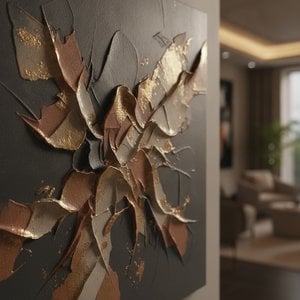
The way light interacts with Crystallization, Dress is crucial to its impact. The focused illumination catches the myriad facets, creating deep pools of shadow that give the piece an astonishing sense of depth despite its close-up presentation. These contrasts are what bring the work to life, making the viewer feel as if they could reach out and trace the cool, hard edges of its structure. For those considering a reproduction for interior design or display, understanding this interplay is key; the artwork thrives on dramatic lighting that will accentuate its three-dimensional narrative.



 Voorvertoning
 Bestel handgeschilderde reproductie
 Verstuur
 Delen
Delen
 Details bekijken

 Download
 Vergelijkbare items
 Röntgenonderzoek
 Diavoorstelling
 Stats
Stats


 Lees meer






































 De optie voor glas is alleen beschikbaar bij een formaat kleiner dan 110 cm.