
VoorvertoningVoorvertoning Bekijk in ARBekijk in AR Bestel print Bestel printBestel handgeschilderde reproductie Bestel handgeschilderde reproductie VerstuurVerstuur
Details bekijkenDetails bekijken Toevoegen aan favorieten Toevoegen aan favorieten DownloadDownload Vergelijkbare itemsVergelijkbare items RöntgenonderzoekRöntgenonderzoek DiavoorstellingDiavoorstelling

Ruins at Nimes

Hubert Robert's "Ruins at Nimes" captures a classical Roman temple in decay, showcasing his mastery of light, atmosphere & romantic ruins. Explore this iconic landscape painting.

Hubert Robert (1733-1808): Een Franse schilder van sfeervolle landschappen & 'capriccio' ruïnes, die geschiedenis, verval en fantasie combineren. Ontdek zijn kunst!

Koop een digitale afbeelding in hoge resolutie met verbeterde kwaliteit, die veel superieur is aan de online voorvertoning.

Elk bestand wordt met uiterste precisie voorbereid door onze interne specialisten, met behulp van geavanceerde tools en deskundige handmatige retouche. Wij garanderen dat elke afbeelding een uitzonderlijke helderheid, nauwkeurige kleurweergave en verfijnde details bezit.

Het uiteindelijke bestand wordt binnen 72 uur per e-mail geleverd, geoptimaliseerd voor direct gebruik in professionele, redactionele en printomgevingen. Dit is dezelfde kwaliteit waarop vooraanstaande designstudio's, uitgevers en galerieën vertrouwen.

Digitale afbeeldingen

Download een bestand met hoge resolutie voor persoonlijke weergave, afdrukken en creatieve projecten. (Bestel print Bestel printBestel handgeschilderde reproductie Bestel handgeschilderde reproductie)

Totaalprijs

$ 24,90

Inbegrepen bij elke bestelling van een digitale afbeelding

Professionele digitale levering, gegarandeerd

Wanneer u kiest voor WahooArt.com, ontvangt u niet alleen een afbeelding – u krijgt een professioneel verbeterd digitaal kunstwerk, met precisie vervaardigd en voorzien van een tevredenheidsgarantie. Dit is alles wat automatisch bij uw bestelling is inbegrepen:

shipping_icon
Snelle levering per e-mail

Uw hoogwaardige digitale afbeeldingsbestand wordt binnen 72 uur na bestelling naar u gemaild – klaar voor direct gebruik.

canvas_icon
AI-verbeterd digitaal bestand

Uw kunstwerk wordt professioneel geoptimaliseerd met behulp van geavanceerde AI-tools en handmatige bewerkingen, waardoor maximale details, helderheid en kleurnauwkeurigheid worden gegarandeerd.

insurance_icon
Gratis levenslange herlevering van digitale afbeeldingen

Je bestand per ongeluk verwijderd of kwijtgeraakt? Geen zorgen – we sturen het u op elk gewenst moment gratis opnieuw toe.

tax_icon
Geen invoerkosten – nooit

Geniet direct van uw kunstwerk zonder invoerrechten, belastingen of verzendkosten – digitale downloads zijn altijd belastingvrij.

color_icon
Garantie op kleurgetrouwheid

Met behulp van professionele hulpmiddelen en kleurbeheer zorgen wij ervoor dat uw digitale afbeelding de originele kleuren zo nauwkeurig mogelijk weergeeft.

return_icon
100 dagen tevredenheidsgarantie

Als u niet tevreden bent met uw digitale afbeelding, passen wij deze aan of storten wij 100% terug binnen 100 dagen – zonder vragen gesteld.

guarantee_icon
100% Geld-terug-garantie

Niet tevreden? Ontvang binnen 100 dagen na ontvangst van uw digitale bestand uw volledige aankoopbedrag terug – zonder vragen te stellen.

discount_icon
Korting bij grote bestellingen

Koop 3 afbeeldingen, bespaar 10% - Koop 5, bespaar 15% - Koop 10+, bespaar 20%. Ideaal voor creatieve projecten, galerieën en bureaus.

Snelle feiten

  • Movement: Romanticism
  • Artistic style: Capriccio
  • Location: Staatliche Museen, Berlin
  • Notable elements: Roman temple ruins
  • Influences:
    • Piranesi
    • Panini
  • Artist: Hubert Robert
  • Subject or theme: Ancient Roman architecture

Kunstquiz

Er is slechts één goed antwoord op elke vraag.

Vraag 1:
What is the primary subject depicted in Hubert Robert’s ‘Ruins at Nimes’?
Vraag 2:
In what century was ‘Ruins at Nimes’ painted?
Vraag 3:
According to the description, what is a notable feature of the architecture in ‘Ruins at Nimes’?
Vraag 4:
Hubert Robert was known for his paintings of which style?
Vraag 5:
The description mentions figures in the foreground of the painting. What do these figures suggest about the scene?

The Poetic Echoes of Antiquity: Ruins at Nimes

To gaze upon Hubert Robert's "Ruins at Nimes" is not merely to observe crumbling stone; it is to step across the threshold of time itself. This masterful depiction transports the viewer into a sun-drenched, yet melancholic, corner of history. The scene unfolds around magnificent remnants of Roman grandeur—a temple boasting colossal columns and a central pediment, all bearing the eloquent scars of centuries. Yet, despite the evident decay, there is an undeniable majesty to the architecture, suggesting a life once vibrant with civic ceremony or sacred devotion. The artist has captured that perfect tension between monumental permanence and inevitable dissolution.

A Study in Romantic Atmosphere and Light

Technically, the painting showcases Robert's unparalleled skill in rendering atmosphere. The interplay of light and shadow is nothing short of breathtaking; one can almost feel the warmth of the Mediterranean sun filtering through the hazy sky. Notice how the artist treats the textures—the rough grit of the aged stone contrasting with the lush, verdant life reclaiming the foreground. In the distance, a graceful bridge spans a tranquil river, drawing the eye deep into the composition and lending an exquisite sense of depth. This careful handling of light transforms mere ruins into a sublime, almost dreamlike vista.

Life Interwoven with History

What elevates this piece beyond a simple architectural study are the figures populating the scene. Dressed in attire evocative of the 18th century, these strolling visitors—some carrying umbrellas, others simply observing—provide an immediate sense of scale and narrative. They are not mere props; they are witnesses to history, lending a human touch to the monumental silence of the ruins. This juxtaposition—the fleeting presence of contemporary life against the backdrop of immutable antiquity—is central to the painting's emotional resonance.

Symbolism and Enduring Allure

For the connoisseur, "Ruins at Nimes" speaks volumes about the passage of time itself. The ruins symbolize the transience of human endeavor, a poignant reminder that even the greatest empires eventually yield to nature’s slow embrace. Yet, this melancholy is tempered by a profound sense of peace. It suggests that beauty persists, not just in flawless construction, but in the very act of endurance—the way nature softens the edges of man's ambition. Owning a reproduction allows one to curate this feeling: a sophisticated nod to classical learning mixed with the romantic yearning for what once was.

Bringing the Grandeur Home

Whether adorning an academic study, a grand drawing-room, or a space that calls for intellectual depth, this artwork offers unparalleled gravitas. Its rich detail and masterful composition make it a focal point that invites contemplation. To reproduce such a piece is to invite a conversation about history, beauty, and the enduring poetry found where civilization meets wilderness.

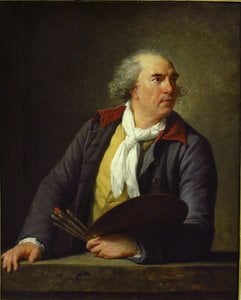
Kunstenaarsbiografie

Hubert Robert: A Painter of Ruins and Visions

Hubert Robert, a name inextricably linked to the evocative beauty of ruins and the romantic allure of bygone eras, stands as a singular figure in 18th-century French art. Born in Paris in 1733, his life unfolded against a backdrop of profound artistic transformation—a journey from the ornate elegance of the Rococo to the nascent spirit of Neoclassicism, all while navigating the tumultuous currents of the French Revolution. Robert’s genius wasn't merely in replicating decay; it resided in crafting meticulously detailed visions that resonated with both a poignant nostalgia for the past and an anticipation of the future—a delicate balance between observation and imaginative reconstruction. His formative years were spent within the structured environment of artistic training, initially under the tutelage of the sculptor Michel-Ange Slodtz, who recognized Robert’s innate talent but wisely steered him towards painting, sensing a deeper calling in capturing light, atmosphere, and the subtle poetry inherent in form.

Roman Reveries: Shaping an Artistic Identity

The defining moment in Robert's artistic development arrived with his extended sojourn to Rome between 1754 and 1765. Accompanying Étienne-François de Choiseul, he immersed himself completely within the ancient city’s captivating world—a realm steeped in history, architectural grandeur, and a palpable sense of timelessness. This wasn't simply a matter of documenting what he saw; it was an act of profound interpretation, reimagining Rome through his own artistic lens. He spent countless hours sketching the crumbling temples, majestic arches, and overgrown gardens of the Eternal City, absorbing its essence with an almost obsessive intensity. His work during this period is profoundly influenced by Giovanni Paolo Panini, whose meticulous depictions of Roman ruins served as a crucial foundation. However, Robert quickly transcended mere imitation, developing his own distinctive style characterized by an unparalleled level of detail, masterful atmospheric perspective, and a remarkable sensitivity to the interplay of light and shadow—qualities that elevated his *capriccio* compositions – fanciful views juxtaposing classical ruins with contemporary life – into something truly exceptional. His sketchbook pages from this period are invaluable windows into his creative process, revealing not just drawings but also a deep understanding of architectural nuance and landscape composition.

Parisian Acclaim and Royal Patronage

Robert’s return to Paris in 1765 marked a significant turning point in his career trajectory. He swiftly gained recognition within the established artistic circles, securing admission to the Académie Royale de Peinture et de Sculpture with “The Port of Rome, Ornamented with Different Monuments of Architecture, Ancient and Modern.” This painting, showcasing his newfound mastery of capturing atmosphere and detail, immediately captivated audiences. His subsequent exhibitions at the Salon – the official art exhibition of the French Academy – garnered widespread acclaim, drawing considerable attention to his evocative depictions of ruins and picturesque landscapes. The critic Denis Diderot, a leading figure of the Enlightenment, famously lauded Robert’s ability to transport viewers to another time and place, recognizing in his work a profound connection between history, memory, and artistic vision. This success swiftly led to royal patronage; he was commissioned to design decorative projects for various palaces and estates, and later appointed as “Designer of the King's Gardens” – a prestigious position reflecting his growing influence within the court. He became a highly sought-after artist, not only for his easel paintings but also for his innovative designs for gardens and palatial interiors—demonstrating a remarkable versatility and an understanding of how art could enhance and elevate the spaces around it.

Revolution, Resilience, and Lasting Legacy

The French Revolution presented Robert with unprecedented challenges. As the political landscape shifted dramatically, many artists struggled to navigate the turbulent times. However, Robert demonstrated remarkable resilience, continuing to paint prolifically despite the upheaval. He even experienced a harrowing period of imprisonment during the Reign of Terror, an ordeal that profoundly impacted his work and ultimately fueled a series of drawings documenting his confinement—testaments to both his artistic spirit and his enduring commitment to truth. Following the Revolution, Robert was appointed curator of the newly established Muséum Central des Arts – later known as the Louvre – a testament to his expertise and dedication to preserving France’s cultural heritage. He played a crucial role in organizing and cataloging the museum's vast collection, ensuring that its artistic treasures were safeguarded for future generations. Hubert Robert died in Paris in 1808, leaving behind an extraordinary body of work—a legacy that continues to captivate and inspire with its evocative beauty, technical mastery, and profound understanding of the relationship between art, history, and memory.
  • Key Influences: Giovanni Paolo Panini, Piranesi, the architectural landscape of Rome.
  • Major Themes: Ruins, landscapes, *capriccio* paintings, historical memory, the passage of time.
  • Artistic Style: Meticulous detail, atmospheric perspective, evocative lighting, blending observation with imagination.
Hubert Robert

Hubert Robert

1733 - 1808 , Frankrijk

Belangrijkste feiten

  • Artistic Movement Or Style: Romantiek, Neoklassiek
  • Artists Or Movements Influenced By This Artist: ['Romantiek']
  • Artists Who Influenced This Artist:
    • Giovanni Panini
    • Piranesi
  • Date Of Birth: 22 mei 1733
  • Date Of Death: 15 april 1808
  • Full Name: Hubert Robert
  • Nationality: Frans
  • Notable Artworks:
    • De Haven van Rome
    • Vlucht van Galatea
  • Place Of Birth: Parijs, Frankrijk