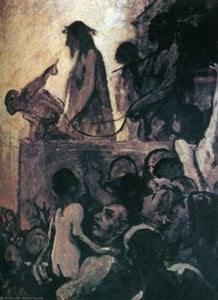
Honoré Daumier’s ‘The Third-Class Carriage’: A Chronicle of Urban Life
Honoré Daumier's 1865 painting, “The Third-Class Carriage,” is more than a simple depiction of a train journey; it’s a poignant snapshot of mid-19th century French society, rendered with the artist’s characteristic blend of realism and social commentary. Measuring 65 x 90 cm, this black and white composition immediately draws the viewer into the cramped confines of a third-class railway car, capturing a moment of everyday life that speaks volumes about class divisions and the burgeoning urbanization of France during the Second Empire.
- Subject Matter: The scene meticulously portrays passengers in a third-class train carriage. The focus is on the ordinary individuals – their postures, expressions, and belongings – revealing a slice of life rarely afforded attention in formal portraiture.
- Composition: Daumier’s masterful use of perspective creates a sense of claustrophobia, emphasizing the density of the space and the close proximity of the travelers. The arrangement of luggage—suitcases, handbags, and personal effects—adds to the feeling of lived-in authenticity.
Daumier's Artistic Style and Technique
Daumier’s style is immediately recognizable through his meticulous draftsmanship and a deliberate avoidance of idealized beauty. He was deeply influenced by artists like Rubens, particularly in his use of dramatic lighting (chiaroscuro) to sculpt forms and create mood. In “The Third-Class Carriage,” this influence is evident in the strong contrasts between light and shadow, which highlight the textures of the benches, luggage, and clothing. The artist’s technique relies on precise lines and detailed observation, reflecting his commitment to capturing reality with unflinching honesty. His work was often characterized by a rough, almost sketch-like quality, contributing to its raw emotional impact.
Historical Context: A Nation in Transition
Painted in 1865, “The Third-Class Carriage” reflects the significant social and political changes occurring in France during this period. The rapid growth of Paris and other industrial centers led to a massive influx of rural populations seeking work and opportunity – often finding themselves crammed into overcrowded, poorly maintained train cars like the one depicted here. Daumier’s work aligns with the broader trend of Realist art, which sought to depict everyday life without romanticizing or idealizing it. The painting subtly critiques the social inequalities inherent in this transition, offering a glimpse into the lives of those marginalized by industrialization and urbanization.
Symbolism and Emotional Impact
Beyond its documentary value, “The Third-Class Carriage” possesses a powerful symbolic resonance. The presence of a woman holding a baby amidst the bustling crowd evokes themes of family, vulnerability, and the challenges faced by working-class families. The scattered luggage represents not just possessions but also dreams, aspirations, and the burdens carried on journeys – both literal and metaphorical. The overall mood is one of quiet observation, inviting viewers to contemplate the lives of these anonymous individuals and consider their place within a rapidly changing society. This artwork’s enduring appeal lies in its ability to capture a fleeting moment of human experience with remarkable sensitivity and artistic skill.
Veelgestelde vragen
Onder welke andere namen is Honoré Daumier bekend?
Andere namen waaronder Honoré Daumier, maker van "The Third-class Carriage", bekend is, zijn onder andere Honore-Victorin Daumier.
Hoe harmonieren de kleuren van "The Third-class Carriage" met elkaar?
De kleuren van "The Third-class Carriage" door Honoré Daumier vertonen een Strong Color Unity harmonie. Harmonie beschrijft de onderlinge relatie tussen de kleuren.
Is er een gids beschikbaar voor "The Third-class Carriage" door Honoré Daumier?
Er is een Informatieblad pagina beschikbaar voor "The Third-class Carriage" door Honoré Daumier: een printbaar informatieblad over het kunstwerk, ontworpen voor studenten en gebruik in de klas.



 Voorvertoning
 Schakel over naar print
 Verstuur
 Delen
Delen
 Details bekijken
 Gids
Gids

 Download
 Vergelijkbare items
 Röntgenonderzoek
 Diavoorstelling
 Q&A
Q&A Statistieken


 Lees meer






































 De optie voor glas is alleen beschikbaar bij een formaat kleiner dan 110 cm.