Biografie van de kunstenaar
Een Leven Geëtst in Satire: De Wereld van Honoré Daumier
Honoré-Victorin Daumier, geboren in Marseille in 1808, leefde een leven dat diep verweven was met de turbulente stromingen van het 19e-eeuwse Frankrijk. Zijn vroege jaren, gekenmerkt door de poëtische aspiraties van zijn vader en de daaropvolgende verhuizing naar Parijs in 1814, brachten hem in een stad die bruiste van artistieke energie. Hoewel aanvankelijk bestemd voor een loopbaan als jurist, leunde Daumier’s hart onwrikbaar naar de kunst. Hij begon zijn carrière als leerling onder Alexandre Lenoir, waar hij klassieke invloeden opnam naast een waardering voor het dramatische clair-obscur van Rubens, en verdiepte zich verder in zijn vaardigheden aan de Academie Suisse. Deze fundamentele training zou cruciaal blijken bij het vormen van zijn kenmerkende stijl – een krachtige mix van realisme en expressieve tekeningstechniek. Maar het was niet alleen de artistieke techniek die Daumier definieerde; het was een diepe gevoeligheid voor de sociale onrechtvaardigheden en politieke absurditeiten om hem heen.
De Geslepen Pijl: Karikatuur en Sociale Bekritiek
Daumier’s carrière ontvouwde zich werkelijk in de nasleep van de Revolutie van 1830, een gebeurtenis die de loop van Franse geschiedenis onomkeerbaar veranderde en tegelijkertijd vruchtbare grond bood voor zijn opkomende satirische talent. Hij vestigde zich snel als een meester lithograaf, aanvankelijk door anoniem bij verschillende publicaties bij te dragen voordat hij bekendheid verwierf via zijn werk voor *Le Charivari*, een fel onafhankelijke stripblad dat was opgericht door Charles Philipon. Hier bloeide Daumier’s genie werkelijk uit. Zijn karikaturen waren niet simpelweg humoristische afbeeldingen; ze waren vernietigende aanklachten tegen de bourgeoisie, het juridische systeem en de politieke machthebbers. Hij sprak onverbloemelijk koning Louis-Philippe aan, waardoor hij zes maanden werd gearresteerd in 1832 voor een bijzonder scherp karikatuur. Deze ervaring, die zijn stem niet verstomde, maar juist versterkte, bevestigde zijn toewijding om hypocrisie te ontmaskeren en autoriteit uit te dagen door middel van kunst. Zijn lithografieën werden visuele manifesten, vastleggend de geest van verzet en een kritische commentaar op de maatschappelijke problemen van zijn tijd. De enorme hoeveelheid werk die hij tijdens deze periode produceerde is verbazingwekkend – duizenden lithografieën die zowel populair entertainment als krachtige politieke verklaringen vormden.
Buiten Karikatuur: Schilderkunst en Beeldhouwwerk
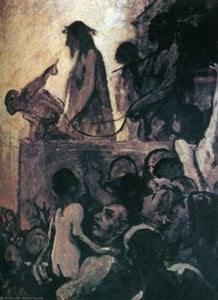
Hoewel Daumier vooral bekend staat om zijn lithografieën, zou het een onrechtvaardige beperking zijn hem uitsluitend tot deze discipline te reduceren. Hij was ook een toegewijde schilder en beeldhouwer, hoewel erkenning voor dit werk pas later in zijn leven kwam. Zijn schilderijen, vaak beelden van alledaagse Parijse levens – de derde klaswagen, de wasserettes, de advocaten – zijn doordrenkt van een diep gevoel van realisme en empathie. Ze waren geen geïdealiseerde portretten, maar eerder onverbogen weergaven van lijden en strijd. Hij beheerst losse penseelstreken en dramatische belichting om emotie en sfeer over te brengen, wat foreshadowing was voor de technieken die later door de Impressionisten werden omarmd. Zijn beeldhouwwerk, grotendeels gemaakt in klei (veel stukken onbebroekt tijdens zijn leven), toont een vergelijkbare toewijding aan het vastleggen van de menselijke vorm met eerlijkheid en emotionele diepte. Deze beelden, ontdekt na zijn dood, bewijzen een opmerkelijke talent voor modellering en een vermogen om psychologische complexiteit over te brengen door middel van fysieke gebaren.
Een Duurzaam Erfgoed: Invloed en Historische Betekenis
Honoré Daumier’s impact op de kunstgeschiedenis is onmiskenbaar. Hij verbond de romantiek met het realisme, waardoor toekomstige generaties kunstenaars een weg vrijmaakten om de wereld te portretteren zoals die werkelijk was – met al zijn imperfecties. Zijn onverbogen sociale commentaar beïnvloedde kunstenaars als Gustave Courbet en Édouard Manet, terwijl zijn innovatieve gebruik van lithografie het drukstechniek radicaal veranderde. Zijn werk resonneert nog steeds vandaag de dag, herinnert ons aan de kracht van kunst om autoriteit uit te dagen, onrechtvaardigheid bloot te leggen en getuige te zijn van de menselijke conditie. Het Musée d’Orsay in Parijs huisvest een aanzienlijke collectie van zijn schilderijen en beelden, waardoor bezoekers een blik krijgen op de wereld die hij zo levendig heeft weergegeven. Zijn lithografieën zijn wijdverspreid toegankelijk via collecties zoals die te vinden zijn op WahooArt, waardoor zijn satirische genialiteit voortdurend nadenken en inspireren. Daumier was niet alleen een kunstenaar; hij was een chroniqueur van zijn tijd – een vispoët die zijn talent gebruikte om de stemmen van de minderbedeelde te verheffen en macht verantwoordelijk te houden. Zijn nalatenschap duurt voort als een getuigenis van de blijvende relevantie van kunst als kracht voor sociale verandering.
Huidige Meta Beschrijving:
Discover Honoré Daumier (1808-1879), the French master of realism & satire. Explore his powerful lithographs, paintings & sculptures critiquing 19th-century society and influencing modern art.
Huidige Meta Trefwoorden:
Honoré Daumier, Honore Daumier, French Realism, 19th Century Art, Political Satire, Lithography, Caricature, Parisian Life, Daumier Prints



 Bekijk op ware grootte
 Schakel over naar print
 Verstuur
 Delen
Delen
 Details bekijken
 Gids
Gids

 Download
 Vergelijkbare items
 Röntgenonderzoek
 Diavoorstelling
 Statistieken


 Lees meer






































 De optie voor glas is alleen beschikbaar bij een formaat kleiner dan 110 cm.