vroege jaren en opleiding
Hermann Struck, een vooraanstaande Duits-Joodse kunstenaar, werd op 6 maart 1876 geboren in Berlijn, Duitsland. Hij perfectioneerde zijn vaardigheden in de schilderkunst en etskunst aan de
Berlijnse Academie voor Schone Kunsten, waar hij de fundamenten legde voor een leven gewijd aan de esthetiek.
artistieke carrière
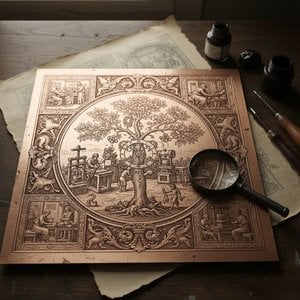
De artistieke loopbaan van Struck werd gekenmerende door zijn uitzonderlijke talent in lithografieën en etsen, werken die vaak Joodse onderwerpen en landschappen tot leven brachten met een ongekende fijngevoeligheid. Zijn werk kreeg wereldwijde erkenning, waardoor hij uitgroeide tot een gerespecteerd figuur binnen de kunstwereld. Een bijzonder mijlpaal in zijn carrière was de publicatie van "Die Kunst des Radierens" ("De kunst van het etsen") in 1908, een baanbrekend werk dat zowel theoretische diepgang als praktische instructies bood aan toekomstige generaties kunstenaars.
opmerkelijke werken en associaties
Onder de meest beeldbepalende werken van Struck behoren:
zionistisch activisme en militaire dienst
Struck was niet alleen een kunstenaar, maar ook een gepassioneerd zionist en Joods activist. In 1903 bezocht hij het land Israël en exposeerde daar zijn kunst tijdens het vijfde zionistische congres. Tijdens de Eerste Wereldoorlog vervulde hij een diverse rol als vertaler, liaisonofficier en militair kunstenaar, waarbij hij zijn artistieke oog combineerde met zijn plichtsbesef.
erfenis en latere leven
De nalatenschap van Struck leeft voort in zijn talrijke etsen en schilderijen, die te vinden zijn in diverse musea, waaronder het
Kaiser-Wilhelm-Museum (Krefeld, Duitsland). Hij kwam op 11 januari 1944 te overlijden in Haifa, Israël.
bekijk de kunst van Struck bij WahooArt
Ontdek het oeuvre van Hermann Struck op
WahooArt, met een bijzondere collectie van zijn etsen en schilderijen. Voor meer informatie over het leven en werk van Struck kunt u terecht op
Wikipedia.
ontdek de kunst van Hermann Struck:



 Bekijk op ware grootte
 Schakel over naar print
 Verstuur
 Delen
Delen
 Details bekijken
 Gids voor studentenkunstwerken

 Download
 Vergelijkbare items
 Röntgenonderzoek
 Diavoorstelling
 Statistieken


 Lees meer






































 De optie voor glas is alleen beschikbaar bij een formaat kleiner dan 110 cm.