


Giclée- of canvasafdruk van museumkwaliteit met een snelle productie en flexibele afwerkingsmogelijkheden. ( Bestel handgeschilderde reproductie Koop afbeelding)





























Kies uit onze vooraf ingestelde maten die overeenkomen met de originele verhoudingen van het kunstwerk.

U kunt uw eigen afmetingen opgeven om in een specifieke lijst of ruimte te passen. Als de door u gekozen maat niet overeenkomt met de proporties van het originele kunstwerk, zullen wij de afbeelding bijsnijden of uitbreiden met een gespiegelde of effen rand. Een digitaal mockup wordt ter goedkeuring naar u verzonden voordat de productie begint.
Houd er rekening mee dat de preview op het scherm de werkelijke bijsneding of uitbreiding niet weergeeft. Alleen de mockup toont de uiteindelijke compositie nauwkeurig.
Hoewel aangepaste maten beschikbaar zijn, raden wij aan een afmeting uit de vooraf bepaalde lijst te kiezen om de originele proporties te behouden.
Wereldwijde levering () binnen 2 weken in plaats van de standaard 4/5 weken. (7 september)


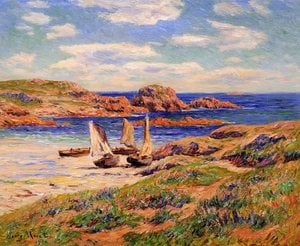
Evening at Doelan
Afmetingen reproductie

Born amidst the salt-sprayed air of Cherbourg in 1856, Henri Moret emerged as a vital voice within the vibrant tapestry of French Impressionism. His journey was one defined by an intimate dialogue with the natural world, a pursuit that led him far beyond the industrial edges of his birthplace and into the rugged, soul-stirting landscapes of Brittany. Moret did not merely observe nature; he sought to capture its very pulse, translating the shifting interplay of light and atmosphere onto canvas with a sensitivity that bordered on the poetic. His early years in Cherbourg provided the foundational palette of maritime textures and coastal moods that would forever haunt and inspire his brushwork.
As his artistic vision matured, Moret found himself drawn into the magnetic orbit of the Pont-Aven School, a movement that revolutionized the way light and form were perceived in late 19th-century France. Influenced by the profound Symbolist currents of his time, he moved away from the purely observational techniques of early Impressionism toward a more structured, emotive approach. This evolution saw him embracing bolder outlines and more deliberate color compositions, allowing the essence of the Breton landscape to resonate with a deeper, almost spiritual intensity. His work became a bridge between the fleeting impressions of light and the enduring, symbolic weight of the earth itself.
The true brilliance of Moret’s oeuvre lies in his ability to render the ephemeral qualities of the French coast. To study a Moret landscape is to experience the rhythmic ebb and flow of the Atlantic tides and the soft, creeping mists of the Breton moors. He possessed an uncanny knack for capturing the specific luminosity of different times of day—the pale, pearlescent glow of dawn, the harsh, brilliant clarity of midday sun, and the melancholic, violet shadows of twilight. His technique was characterized by a rich, textured application of paint that gave his landscapes a tactile, breathing quality.
His thematic focus remained steadfastly rooted in the organic beauty of the countryside, yet he approached these familiar subjects with a fresh, modern eye. Through his work, we see:
Throughout his career, Henri Moret remained a dedicated chronicler of the French landscape, leaving behind a legacy that celebrates the profound connection between humanity and the environment. While he may not have sought the global notoriety of some of his contemporaries, his contribution to the development of Post-Impressionism and Symbolism is undeniable. He helped refine a visual language that allowed artists to move beyond mere representation toward an expression of internal feeling through external scenery.
Today, Moret’s paintings serve as luminous windows into a bygone era of French art, reminding us of the enduring power of nature to inspire awe and introspection. His ability to synthesize the structural lessons of the Pont-Aven circle with the light-drenched freedom of Impressionism ensures his place in the pantheon of masters who taught us how to truly see the world around us. His work remains a testament to the enduring beauty of the Breton spirit, captured forever in strokes of brilliant, emotive color.
1856 - 1913 , France

Explore the ethereal beauty of Impressionist landscapes. Discover how masters like Monet captured fleeting light through color and texture, and learn to curate these timeless, luminous masterpieces for your home collection.

 Voorvertoning
 Verstuur
 Delen
Delen
 Details bekijken

 Download
 Vergelijkbare items
 Röntgenonderzoek
 Diavoorstelling

 Lees meer







 De optie voor glas is alleen beschikbaar bij een formaat kleiner dan 110 cm.


