VoorvertoningVoorvertoning Bekijk in ARBekijk in AR Bestel handgeschilderde reproductie Bestel handgeschilderde reproductieKoop afbeelding Koop afbeelding VerstuurVerstuur
Details bekijkenDetails bekijken Toevoegen aan favorieten Toevoegen aan favorieten DownloadDownload Vergelijkbare itemsVergelijkbare items RöntgenonderzoekRöntgenonderzoek DiavoorstellingDiavoorstelling

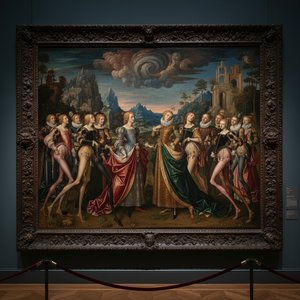
Standard-bearer

Experience Northern Mannerism's drama with Goltzius's masterful 1587 engraving of a standard-bearer; discover this intricate print today.

Hendrik Goltzius (1558-1617) was een meesterlijke Nederlandse graveur en schilder van de Noordelijke Manierismeperiode. Bekend om zijn dynamische composities, innovatieve technieken zoals de "swelling line" en invloedrijk in de kunstgeschiedenis.

Giclée / Kunstafdrukken

Giclée- of canvasafdruk van museumkwaliteit met een snelle productie en flexibele afwerkingsmogelijkheden. (Bestel handgeschilderde reproductie Bestel handgeschilderde reproductieKoop afbeelding Koop afbeelding)

P118B $10
P118H $10
P118W $10
P438Z $10
P508JH $12
P508YH $12
P805H $10
P805Z $10
P919BZ $10
P919G $10
P919XJ $10
P959ZH $10
P968JZ $12
W106C $8
W218G $10
W218JH $8
W218Y $10
W307PJ $10
W316G $10
W316PJ $8
W316Y $10
W398PJ $8
W4111J $10
W500HY $15
W500JH $15
W692G $12
W849H $8
W940BG $15
W953PJ $8

Standaardformaat
op maat gemaakt
CM
INCH

Kies uit onze vooraf ingestelde maten die overeenkomen met de originele verhoudingen van het kunstwerk.

breedte
hoogte

U kunt uw eigen afmetingen opgeven om in een specifieke lijst of ruimte te passen. Als de door u gekozen maat niet overeenkomt met de proporties van het originele kunstwerk, zullen wij de afbeelding bijsnijden of uitbreiden met een gespiegelde of effen rand. Een digitaal mockup wordt ter goedkeuring naar u verzonden voordat de productie begint.
Houd er rekening mee dat de preview op het scherm de werkelijke bijsneding of uitbreiding niet weergeeft. Alleen de mockup toont de uiteindelijke compositie nauwkeurig.
Hoewel aangepaste maten beschikbaar zijn, raden wij aan een afmeting uit de vooraf bepaalde lijst te kiezen om de originele proporties te behouden.

Wereldwijde levering () binnen 2 weken in plaats van de standaard 4/5 weken. (7 september)

why_choose_icon
Gratis wereldwijde expressverzending
why_choose_icon
Hoogwaardig linnen canvas
why_choose_icon
Volledige verzendverzekering
why_choose_icon
Garantie op terugbetaling van invoerrechten
why_choose_icon
Garantie op exacte kleurweergave
why_choose_icon
Retourbeleid van 100 dagen (alleen bij defecten)
why_choose_icon
100% Geld-terug-garantie
why_choose_icon
Korting bij meerdere afnames

Totaalprijs

$ 69

reproduction

Standard-bearer

Giclée / Kunstafdrukken

Afmetingen reproductie

-

Eindtotaal

$ 69

Snelle feiten

  • Influences: Albrecht Dürer
  • Medium: Engraving
  • Artist: Hendrik Goltzius
  • Artistic style: Renaissance
  • Year: 1587
  • Movement: Northern Mannerism
  • Dimensions: 286 x 199 cm

Hendrik Goltzius: A Master of Northern Mannerism

Hendrik Goltzius (1558–1617) stands as one of the most influential figures in Dutch art history, a titan whose legacy continues to resonate through centuries. Born in Bracht or Millebrecht near Duisburg, his early life was marked by tragedy – a devastating fire claimed his infant brother’s life and left him with a debilitating deformity in his right hand. Ironically, this physical limitation proved instrumental in shaping his artistic genius; the forceful movements required to manipulate the burin honed a technique that would become synonymous with Goltzius's distinctive style: the “swelling line.” This revolutionary approach, championed by luminaries like Albrecht Dürer, involved subtly thickening and thinning lines to achieve tonal shading from afar—a feat unheard of at the time and one that cemented Goltzius’s reputation as a visionary innovator.
  • Early Training & Influence: Goltzius's formative years were spent under the tutelage of Dirck Volckertszoon Coornhert, a renowned humanist scholar and printmaker who instilled in him a profound appreciation for classical ideals and artistic rigor. This influence would permeate his entire oeuvre, shaping his compositions and informing his meticulous attention to detail.
  • The Haarlem Workshop: Moving to Haarlem in 1577 alongside Coornhert marked the beginning of Goltzius’s prolific artistic career. He established a thriving workshop where he mentored younger artists and collaborated on ambitious projects, notably the engraving set depicting the history of Lucretia commissioned by Philip Galle—a testament to his ability to synthesize humanist scholarship with artistic virtuosity.

The Great Standard Bearer: Symbolism and Technique

“The Great Standard Bearer,” created in 1587, exemplifies Goltzius’s mastery of engraving and embodies the spirit of Northern Mannerism—a stylistic movement characterized by dramatic contrasts of light and dark, stylized figures, and an obsession with anatomical precision. The artwork depicts a military officer holding aloft a flag emblazoned with a lion emblem, symbolizing strength and royalty – potent symbols reflecting the anxieties surrounding Spain’s dominance in Europe during this turbulent period. Goltzius's technique is breathtakingly complex; he employed burins and other engraving tools to create an astonishing level of detail, utilizing hatching and cross-hatching extensively to render the armor, flag, and landscape with unparalleled realism. The swelling line technique—a hallmark of his style—transforms the image into a dynamic interplay of tonal variations, capturing not only the visual appearance but also conveying a palpable sense of movement and urgency.
  • Composition & Perspective: The central figure dominates the foreground, positioned dynamically against a mountainous landscape receding into the distance – a deliberate compositional choice that reinforces the impression of grandeur and conveys a profound respect for classical perspective.
  • Material & Process: The engraving was produced on copper plate using meticulous burin techniques, resulting in an exceptionally durable print with remarkable tonal range and textural richness.

Legacy and Emotional Impact

Goltzius’s influence extended far beyond his own lifetime, shaping the artistic sensibilities of subsequent generations and establishing him as a cornerstone of Dutch Baroque art. His unwavering dedication to anatomical accuracy—evident in portraits like “Self-Portrait”—demonstrates an intellectual curiosity that transcended mere technical skill. More importantly, Goltzius's work speaks to fundamental human concerns: courage, loyalty, and the pursuit of excellence. "The Great Standard Bearer" remains a powerful reminder of the transformative potential of art—its ability to capture not only visual beauty but also the deepest emotions and aspirations of its time. It is a testament to Goltzius’s genius that his engravings continue to inspire awe and admiration centuries after their creation, securing his place as one of the greatest printmakers in European history.

Biografie van de kunstenaar

Early Life and Artistic Foundations

Hendrik Goltzius, a name synonymous with the vibrant dynamism of Northern Mannerism in Dutch art, was born in Mullbracht – now part of Brüggen – in the Lower Rhine region of Germany around 1558. His early life, marked by a childhood tragedy, profoundly shaped his artistic trajectory. A fire when he was just three years old left him with a permanently deformed right hand, an imperfection that surprisingly became a source of strength and distinctive style. His family’s relocation to Duisburg provided him with his initial artistic training under his father, Jan Goltz II, a skilled glass painter. This early exposure instilled in him a deep appreciation for meticulous detail and the transformative power of color – skills he would later adapt to the stark lines of engraving. However, it was Dirck Volckertszoon Coornhert, a renowned polymath and engraver, who truly molded Goltzius into the master printmaker he became. Coornhert’s influence extended beyond mere technical instruction; he introduced Goltzius to the burgeoning world of humanist thought and artistic experimentation prevalent in Haarlem during that era. This period laid the groundwork for Goltzius's later embrace of Mannerist aesthetics, a style characterized by its elegance, stylized figures, and dramatic compositions.

The Rise of a Master Engraver

Around 1577, Goltzius embarked on a pivotal chapter in his career, relocating to Haarlem – the heart of the Dutch Republic’s artistic scene – alongside Coornhert. This move marked a significant shift from his father's craft and propelled him into the vibrant world of printmaking. Initially, he found employment with Philip Galle, a prominent Antwerp-based publisher, where he honed his skills by reproducing works by renowned artists like Dürer and Van Leyden. Crucially, this early experience exposed him to diverse artistic styles and techniques, allowing him to develop his own unique approach. However, Goltzius’s ambition extended beyond mere replication; he quickly began designing and engraving original compositions, establishing himself as a distinct voice within the Dutch art world. His marriage in 1579 to Margaretha Jansdr., a widow with considerable wealth, provided him with the financial stability necessary to establish his own printing workshop – a bold move that signaled his determination to control every aspect of his artistic output. This independence allowed him to cultivate a distinctive style and attract a loyal clientele throughout Europe.

The Influence of Spranger and Italian Renaissance

A defining moment in Goltzius’s career arrived with the arrival of Karel van Mander in Haarlem in 1583, bringing with him the influence of Bartholomeus Spranger, a leading figure in the Mannerist style. Spranger's opulent, theatrical compositions – characterized by elongated figures, dramatic poses, and intricate details – captivated Goltzius, profoundly shaping his artistic vision. Goltzius’s engravings during this period are deeply indebted to Spranger, mirroring his use of exaggerated forms, dynamic diagonals, and a sense of heightened emotion. He produced masterful reproductions of Spranger's celebrated works, such as *The Wedding of Cupid and Psyche*, demonstrating an unparalleled level of technical skill and artistic understanding. Furthermore, Goltzius’s journey to Italy in 1590 proved transformative. His time spent studying the classical sculptures and paintings of Rome fueled a renewed interest in antiquity and informed his later works with a sense of balance and harmony. He meticulously documented these encounters through engravings, capturing the essence of Renaissance art for a European audience.

Technique and Legacy

Hendrik Goltzius’s mastery of engraving was legendary. His command of the burin – the primary tool used in printmaking – was unparalleled, allowing him to create lines of astonishing delicacy and power. He pioneered the “swelling line” technique, manipulating the pressure applied to the burin to produce varying thicknesses of line, effectively mimicking tonal shading and adding depth to his prints. He also developed the "dot and lozenge" technique, a sophisticated method of creating subtle gradations through strategically placed dots within lozenge-shaped spaces – a testament to his innovative approach. His engravings are characterized by their meticulous detail, dramatic compositions, and a remarkable sense of movement. Goltzius’s influence extended far beyond his own lifetime; he mentored numerous engravers who went on to become prominent artists in their own right. His work is celebrated in major print rooms across the globe – including the Rijksmuseum in Amsterdam, the British Museum in London, and the Metropolitan Museum of Art in New York – solidifying his place as one of the most important figures in the history of Dutch art. His legacy continues to inspire artists and scholars alike, a testament to his enduring genius and innovative spirit.
Hendrik Goltzius

Hendrik Goltzius

1558 - 1617 , Duitsland

Belangrijkste feiten

  • Artistic Movement Or Style: Noordelijke Manierisme
  • Artists Or Movements Influenced By This Artist: ['Bartholomeus Spranger']
  • Artists Who Influenced This Artist: ['Dirck Coornhert']
  • Date Of Birth: Jan/Feb 1558
  • Date Of Death: 1617
  • Full Name: Hendrik Goltzius
  • Nationality: Nederlands
  • Notable Artworks:
    • De Aanbidding der Herders
    • Arcadië Landschap
  • Place Of Birth: Braunschweig, Duitsland
Ontdek kunstwerken georganiseerd op thema, stijl en kenmerk.