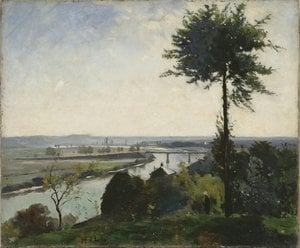
Hans Leganger Reusch: A Vision of the Norwegian Landscape
Born in Norway during a period of significant artistic and national awakening, Hans Leganger Reusch (1800-1854) stands as a pivotal figure in 19th-century landscape painting. His work transcends mere depiction; it’s imbued with a profound sense of place, capturing the rugged beauty and ethereal light of his homeland with an almost melancholic intensity. While often categorized within the broader tradition of Flemish Primitive art – a label reflecting his early training and stylistic affinities – Reusch developed a uniquely Norwegian voice, deeply rooted in the Romantic sensibility that dominated European art at the time.
Reusch’s artistic journey began in Bergen, Norway, where he received his initial training under Johan Christian Claussen Dahl, a leading figure of the Norwegian Romantic movement. Dahl's influence is undeniably present in Reusch’s early works, particularly their shared emphasis on dramatic mountainscapes and the evocative use of light and shadow. However, unlike Dahl’s often overtly heroic or sublime portrayals, Reusch’s landscapes possess a quieter, more introspective quality. He wasn’t interested in grand pronouncements about nature's power; instead, he sought to capture its subtle moods and the quiet dignity of the natural world.
His artistic development can be traced through a series of captivating paintings that showcase his evolving style. Early works like “Norwegian Landscape” (a digital reproduction available on various art databases) demonstrate a clear debt to Dahl, with their dramatic fjord vistas and imposing mountain ranges. Yet, as Reusch matured, he began to refine his technique, employing looser brushstrokes and a more muted palette. This shift reflects a growing interest in capturing the fleeting effects of light and atmosphere – a hallmark of the Romantic tradition. His later works, such as “Baldersteinen på Leikanger i Sogn,” a meticulously rendered depiction of a local landmark, reveal a mastery of color and texture, creating an almost palpable sense of depth and space.
The Influence of Flemish Tradition
Reusch’s early training in Bruges, Belgium, profoundly shaped his artistic approach. He studied under the guidance of masters associated with the Flemish Primitive tradition – artists known for their directness, emotional intensity, and rejection of academic conventions. This exposure to the works of Jan van Eyck, Rogier van der Weyden, and other Flemish masters instilled in him a meticulous attention to detail and a preference for oil paint’s rich textures and luminous qualities. The influence is particularly evident in his portraits, which are characterized by their psychological depth and subtle nuances of expression – a departure from the more formal and idealized representations prevalent at the time.
However, Reusch never simply replicated the stylistic conventions of his Flemish mentors. He adapted these techniques to suit his own artistic vision, infusing them with a distinctly Norwegian sensibility. His portraits, for example, retain a certain solemnity and introspection, reflecting the cultural values of his homeland. The use of muted colors and dramatic lighting – reminiscent of Rembrandt – creates an atmosphere of quiet contemplation, inviting viewers to engage in a dialogue with the subject’s inner world.
Key Themes and Symbolism
Reusch's paintings are not merely scenic representations; they are imbued with symbolic meaning. The Norwegian landscape itself becomes a metaphor for the nation’s identity – its rugged beauty, its enduring spirit, and its connection to ancient traditions. Mountains, fjords, and rivers frequently appear as central motifs, representing both physical challenges and spiritual aspirations. The use of light and shadow is particularly significant, evoking feelings of hope, melancholy, and transcendence.
Recurring elements in his work include the solitary figure – often a shepherd or peasant – who embodies the resilience and humility of the Norwegian people. These figures are not presented as heroes or champions; rather, they are depicted as ordinary individuals grappling with the demands of their environment. Their presence serves to remind viewers of the interconnectedness between humanity and nature.
Legacy and Historical Significance
Despite his relatively short career, Hans Leganger Reusch left a lasting impact on Norwegian art. His paintings helped to establish landscape painting as a legitimate genre within the national artistic discourse, paving the way for future generations of artists. His work is now celebrated in the Memling Museum in Bruges, where it stands as a testament to his artistic skill and his profound connection to the Norwegian landscape.
Reusch’s legacy extends beyond his individual achievements. He embodies the spirit of the Romantic movement – its emphasis on emotion, imagination, and the sublime beauty of nature. His paintings continue to resonate with viewers today, offering a glimpse into the soul of Norway and reminding us of the enduring power of art to capture the essence of place and time.



 Voorvertoning
 Bestel print
 Verstuur
 Delen
Delen
 Details bekijken

 Download
 Vergelijkbare items
 Röntgenonderzoek
 Diavoorstelling

 Lees meer






































 De optie voor glas is alleen beschikbaar bij een formaat kleiner dan 110 cm.