VoorvertoningVoorvertoning Bekijk in ARBekijk in AR Bestel print Bestel printKoop afbeelding Koop afbeelding VerstuurVerstuur
Details bekijkenDetails bekijken Toevoegen aan favorieten Toevoegen aan favorieten DownloadDownload Vergelijkbare itemsVergelijkbare items RöntgenonderzoekRöntgenonderzoek DiavoorstellingDiavoorstelling

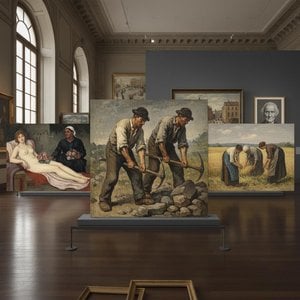
la mere gregoire

Explore Gustave Courbet’s ‘La Mere Gregoire,’ a realistic portrait of an elderly woman. Discover its muted palette, impasto texture & academic style – a timeless work.

Gustave Courbet (1819-1877): Een baanbrekende kunstenaar die Realisme nastreefde en een kritische blik op de samenleving bood, zoals zichtbaar in 'Een Begrafenis te Ornans'. Ontdek zijn invloedrijke stijl!

Handgemaakte olieverfreproductie

Met de hand geschilderd in olieverf op canvas in uw gewenste maat en lijst, op bestelling gemaakt door onze kunstenaars. (Bestel print Bestel printKoop afbeelding Koop afbeelding)

P118B $10
P118H $10
P118W $10
P438Z $10
P508JH $12
P508YH $12
P805H $10
P805Z $10
P919BZ $10
P919G $10
P919XJ $10
P959ZH $10
P968JZ $12
W106C $8
W218G $10
W218JH $8
W218Y $10
W307PJ $10
W316G $10
W316PJ $8
W316Y $10
W398PJ $8
W4111J $10
W500HY $15
W500JH $15
W692G $12
W849H $8
W940BG $15
W953PJ $8

Standaardformaat
op maat gemaakt
CM
INCH

Kies uit onze vooraf ingestelde maten die overeenkomen met de originele verhoudingen van het kunstwerk.

breedte
hoogte

U kunt uw eigen afmetingen invoeren om in een specifieke lijst of ruimte te passen. Als de door u gekozen maat niet overeenkomt met de verhoudingen van het originele beeld, zullen we het kunstwerk bijsnijden of het schilderij uitbreiden met extra handgeschilderde elementen. Een digitale mockup wordt ter goedkeuring naar u verzonden voordat de productie begint.
Houd er rekening mee dat de preview op het scherm niet de werkelijke uitsnede of uitbreiding weergeeft. Alleen de mockup toont de uiteindelijke compositie nauwkeurig.
Hoewel aangepaste afmetingen mogelijk zijn, raden we aan een maat uit de vooraf gedefinieerde lijst te selecteren om de originele verhoudingen te behouden.

Voorbeelden van aanpassingen: Vervang het gezicht met een eigen foto; Voeg een huisdier toe (bijv. vervang de kat door een hond); Verwerk een verborgen boodschap in de achtergrond; Wijzig het landschap of andere elementen in de achtergrond.
Na de bestelling zal het team van WahooArt.com per e-mail contact opnemen met de klant voor instructies en een mockup-voorbeeld sturen.

Wereldwijde levering () binnen 3 tot 4 weken in plaats van de standaard 5 weken. (7 september). Zonder concessies aan de kwaliteit.

why_choose_icon
Gratis wereldwijde expressverzending
why_choose_icon
Hoogwaardig linnen canvas
why_choose_icon
Volledige verzendverzekering
why_choose_icon
Garantie op terugbetaling van invoerrechten
why_choose_icon
Garantie op exacte kleurweergave
why_choose_icon
Retourbeleid van 100 dagen (alleen bij defecten)
why_choose_icon
100% Geld-terug-garantie
why_choose_icon
Korting bij meerdere afnames

Totaalprijs

$ 272

reproduction

la mere gregoire

Druktechniek

Afmetingen reproductie

-

Eindtotaal

$ 272

Snelle feiten

  • style: academic realism
  • movement: realism
  • subject: portraiture
  • artist: gustave courbet
  • title: la mere gregoire
  • medium: oil on canvas

Kunstquiz

Er is slechts één goed antwoord op elke vraag.

Vraag 1:
To which art movement is Gustave Courbet most closely associated?
Vraag 2:
What is the primary subject matter of 'La Mère Grégoire'?
Vraag 3:
Based on the description, what can be said about Courbet’s painting technique in this work?
Vraag 4:
The description notes the color palette is predominantly what?

A Portrait of Quiet Dignity: Exploring Gustave Courbet’s *La Mère Grégoire*

Gustave Courbet's *La Mère Grégoire*, painted in 1859, is a deeply affecting portrait that exemplifies the artist’s commitment to Realism and his revolutionary approach to depicting everyday life. This isn’t a glamorous depiction of aristocracy; instead, Courbet presents us with an honest and dignified portrayal of an elderly woman, radiating a quiet strength born from years lived.

Subject & Composition: A Moment Frozen in Time

The painting centers on *La Mère Grégoire* herself – a woman seated at a simple wooden table. Her hands are gently open in her lap, suggesting both vulnerability and acceptance. The composition is deliberately straightforward; she dominates the frame, drawing our immediate attention to her face and expression. A still life arrangement—a vase of flowers and a small book—sits beside her, hinting at domesticity and perhaps intellectual pursuits. This isn’t merely a likeness; it's an intimate glimpse into a private moment.

Style & Technique: The Brushstrokes of Realism

Courbet masterfully employs the techniques of academic realism but infuses them with his own distinctive style. Visible brushstrokes create texture and depth, while a muted color palette—predominantly browns, greys, reds, and whites—contributes to the painting’s somber yet warm atmosphere. The application of paint is rich and layered, particularly noticeable in the drapery and skin tones, suggesting an *impasto* technique that gives the surface a tactile quality. He eschews idealization, presenting his subject with all her wrinkles and imperfections – a radical departure from the polished portraits favored by earlier generations.

Historical Context: A Challenge to Artistic Conventions

Painted during a period of significant social and artistic change, *La Mère Grégoire* represents Courbet’s deliberate rejection of academic conventions. In an era that prized mythological or historical subjects, he chose to elevate the ordinary individual—a working-class woman—to the status traditionally reserved for nobility or religious figures. This was a bold statement, aligning him with the burgeoning Realist movement and paving the way for future artistic revolutions. Courbet’s philosophy – “to record the customs, the ideas, the appearance of my time” – is powerfully embodied in this work.

Symbolism & Emotional Impact: Wisdom and Resilience

While seemingly straightforward, *La Mère Grégoire* carries subtle symbolic weight. The book suggests a life enriched by learning, while the flowers may represent beauty and fragility. More profoundly, the painting evokes themes of age, wisdom, resilience, and the dignity of labor. The woman’s gaze is direct and unwavering, conveying a sense of inner strength and quiet contemplation. It's a portrait that invites empathy and reflection, prompting viewers to consider the lives and stories behind ordinary faces. The overall emotional impact is one of profound respect and tenderness.

For Collectors & Designers

  • A Statement Piece: *La Mère Grégoire* offers a timeless elegance that complements both traditional and contemporary interiors.
  • Color Palette Versatility: The muted tones blend seamlessly with various color schemes, providing a grounding element in any space.
  • Historical Significance: Owning a reproduction of this work is not just acquiring art; it’s embracing a pivotal moment in art history and supporting the legacy of a groundbreaking artist.
  • Consider pairing with antique furniture or neutral-toned textiles to enhance its classic appeal.
This painting isn't simply an image; it is a testament to Courbet’s artistic vision and a poignant celebration of the human spirit.

Biografie van de kunstenaar

A Rebel’s Brush: The Life and Legacy of Gustave Courbet

Jean Désiré Gustave Courbet, born in Ornans, France, on June 10, 1819, stands as a monumental figure in the history of art – a defiant iconoclast who irrevocably altered the trajectory of painting during the mid-nineteenth century. More than simply capturing visual impressions; his artistic journey embodies a profound rejection of convention and an unwavering dedication to portraying reality with uncompromising honesty. His upbringing within a moderately prosperous bourgeois family fostered an early appreciation for artistic pursuits, nurtured by his mother’s encouragement – a formative influence that propelled him toward a revolutionary vision of artistic expression. Formal training commenced at the École des Beaux-Arts in Paris in 1839, yet Courbet swiftly recognized the stifling limitations imposed by academic dogma and Romantic idealism. While acknowledging debts to artists like Eugène Delacroix and Théodore Géricault – figures who championed dramatic emotion and historical narrative – Courbet resolutely forged his own path, prioritizing observation over imagination and truth above all else. This deliberate divergence from established artistic norms would define his entire career and establish him as the undisputed leader of Realism.

The Birth of Realism: Challenging Artistic Conventions

Courbet’s artistic development was characterized by a conscious repudiation of prevailing aesthetic standards. He eschewed mythological tales and heroic allegories, instead focusing intently on the everyday lives of ordinary individuals – particularly laborers and rural inhabitants. This commitment to depicting the world without embellishment—a stance that would soon become synonymous with Realism—encountered vehement opposition from critics accustomed to idealized representations steeped in romantic sentimentality. Early canvases explored landscapes and portraits; however, he swiftly transitioned toward scenes of working-class existence, rendered on monumental scales traditionally reserved for grand historical or religious paintings. This deliberate choice wasn’t merely stylistic; it was a declaration about the inherent dignity and significance of subjects often marginalized by artistic discourse. The Stone Breakers (1849), tragically destroyed during World War II, exemplifies this approach—a stark portrayal of two laborers toiling under oppressive conditions, their faces obscured by exhaustion and despair. Critics deemed such depictions vulgar and unworthy of serious consideration, highlighting the profound challenge Courbet posed to the prevailing artistic sensibilities of his time.

Major Works and Artistic Philosophy

Courbet’s artistic philosophy extended beyond subject matter to encompass technique. He championed a direct, impasto style—applying paint thickly onto the canvas—that prioritized the materiality of the medium itself. This method deliberately rejected the smooth surfaces favored by academic painters, emphasizing texture and physicality as crucial elements of visual expression. His most celebrated paintings include A Burial at Ornans (1850-51), a monumental canvas depicting a provincial funeral that provoked considerable controversy upon its exhibition. Unlike Romantic artists who sought to elevate emotion and inspire awe, Courbet presented the mourners with unflinching realism—faces etched with sorrow, boredom, and resignation—challenging viewers to confront uncomfortable truths about human experience. Similarly, Château du Chillon (1874), a breathtaking depiction of the medieval castle overlooking Lake Geneva, showcases Courbet’s meticulous attention to detail and his masterful command of light and color. He sought to capture not merely what he saw but also how it felt—a profound ambition that resonated deeply with fellow artists grappling for new modes of artistic representation.

Legacy and Historical Significance

Gustave Courbet's influence on subsequent art movements is undeniable. While acknowledging debts to earlier masters like Caravaggio for their dramatic realism and use of chiaroscuro, his impact transcended mere imitation. He fundamentally reshaped the landscape of painting by liberating artists from the constraints of tradition—encouraging them to explore uncharted territories of visual perception. His unwavering advocacy for artistic freedom cemented his position as a champion of intellectual dissent and fueled the burgeoning movement toward socially engaged art. Courbet’s participation in the Salon des Refusés (1863)—an audacious defiance of official censure—solidified his reputation as an iconoclastic rebel who refused to compromise on his convictions. He died peacefully in Paris on April 29, 1877, leaving behind a legacy that continues to inspire artists and scholars alike – a testament to the transformative power of art to confront societal norms and illuminate the complexities of human existence.
Gustave Courbet

Gustave Courbet

1819 - 1877 , Frankrijk

Belangrijkste feiten

  • Artistic Movement Or Style: Realisme
  • Artists Or Movements Influenced By This Artist:
    • Impressionisme
    • Post-impressionisme
  • Artists Who Influenced This Artist:
    • Eugène Delacroix
    • Théodore Géricault
    • Caravaggio
  • Date Of Birth: 10 juni 1819
  • Date Of Death: 31 december 1877
  • Full Name: Gustave Courbet
  • Nationality: Frans
  • Notable Artworks:
    • De Steenbakers
    • Een begrafenis te Ornans
    • De Schilderstudio
  • Place Of Birth: Orléans, Frankrijk
Ontdek kunstwerken georganiseerd op thema, stijl en kenmerk.