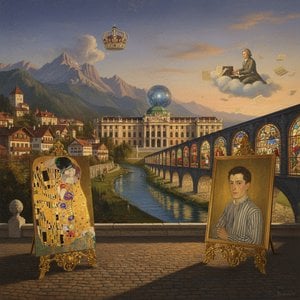
Een Leven in Gouden Schittering: Gustav Klimt en de Weense Secession
Gustav Klimt, geboren op 14 juli 1862 in Baumgarten nabij Wenen, was een kind van zijn tijd – een tijd van weelderige pracht, maar ook diepe sociale spanningen. Zijn vader, Ernst Klimt, was een goudgraveur, en het is niet ondenkbaar dat de jonge Gustav al vroeg gefascineerd raakte door de glans en precisie van dit ambacht. Deze vroege blootstelling aan gouden blad en gedetailleerde ornamentiek zou later doorslaggevend worden voor zijn unieke stijl. De familie Klimt kende een onzekere financiële situatie, wat resulteerde in frequente verhuizingen binnen Wenen. Dit nomadische bestaan kan bijgedragen hebben aan Gustavs scherpe observatievermogen en gevoeligheid voor de menselijke conditie. Al vroeg toonde hij uitzonderlijk teken talent, aangemoedigd door zijn vader en een aangeboren begaafdheid die snel duidelijk werd. In 1876 trad hij toe tot de Kunstgewerbeschule in Wenen, waar hij zich formeel begon te bekwalificeren als architectuur schilder onder Ferdinand Laufberger. Deze opleiding legde een solide technische basis, maar exposeerde hem ook aan de heersende academische stijlen – stijlen die Klimt later zou uitdagen en overstijgen. Hier ontmoette hij zijn broer Ernst en Franz von Matsch, met wie hij een vruchtbare samenwerking begon, wat leidde tot vroege opdrachten voor decoratieve muurschilderingen en plafonds, de eerste stappen naar zijn toekomstige succes.
De Opkomst van de Wiener Secession
In de jaren 1890 groeide Klimt steeds ontevredener over het conservatisme van de gevestigde kunstwereld in Wenen. Hij verlangde naar meer artistieke vrijheid, een ruimte waar innovatie kon bloeien zonder de beperkingen van traditionele normen. Deze wens culmineerde in 1897 in de oprichting van de Wiener Secession, een cruciaal moment in de Oostenrijkse kunstgeschiedenis. Klimt werd gekozen tot eerste voorzitter en werd het boegbeeld van een beweging die streefde naar een breuk met de rigide academische regels en omarming van nieuwe artistieke stromingen uit heel Europa – Art Nouveau, Symbolisme en Japonisme. Het Secessiongebouw, ontworpen door Joseph Maria Olbrich, werd een symbool van deze rebellie, een tempel gewijd aan moderne kunst. Klimts werk stond centraal in de ethos van de Secession, belichaamde haar afwijzing van conventionele esthetiek en haar omarming van decoratieve elementen, gedurfde kleuren en symbolische beelden. Zijn schilderijen begonnen thema’s als liefde, dood en seksualiteit te verkennen met een ongekende openheid, wat zowel bewondering als verontwaardiging opwekte.
De Gouden Periode en Artistieke Volwassenheid
Rond 1900 betrad Klimt zijn zogenoemde “Gouden Periode”, gekenmerkt door het weelderige gebruik van bladgoud, geïnspireerd door Byzantijnse mozaïeken en middeleeuwse verluchte manuscripten. Deze techniek transformeerde zijn schilderijen in glinsterende, bovenaardse visioenen, doordrenkt met een gevoel van spirituele diepte en zintuiglijke aantrekkingskracht.
De Kus (1907-1908), misschien wel zijn meest iconische werk, is een perfect voorbeeld van deze stijl – een koppel innig verstrengeld in een omhelzing, gehuld in een gouden aura, hun lichamen versierd met ingewikkelde patronen. In dezelfde periode creëerde Klimt een reeks adembenemende portretten, waaronder *Portret van Adele Bloch-Bauer I* (1907), dat zijn vermogen toonde om niet alleen fysieke gelijkenis vast te leggen, maar ook de psychologische complexiteit van zijn modellen. Hij vervaagde steeds meer de grenzen tussen schilderkunst en ornamentiek, integreerde decoratieve elementen in zijn composities om een harmonieuze fusie van vorm en inhoud te creëren. De invloed van Japanse kunst – Japonisme – was bijzonder zichtbaar in zijn afgeplatte perspectief, nadruk op lijnvoering en het gebruik van decoratieve patronen.
Controverses, Invloeden en Blijvende Erfenis
Klimts carrière kende ook controverse. In 1900 ontving hij een prestigieuze opdracht voor plafondschilderingen in de Grote Zaal van de Universiteit van Wenen, met als thema Filosofie, Jurisprudence en Theologie. Deze werken – vooral *Filosofie* – werden echter door conservatieve critici als provocatief en zelfs pornografisch beschouwd, wat leidde tot publieke verontwaardiging en uiteindelijk ertoe aanzette dat Klimt verdere openbare opdrachten weigerde. Dit incident markeerde een keerpunt in zijn carrière, waardoor hij zich meer richtte op privéopdrachten en hem grotere artistieke vrijheid gaf. Gedurende zijn leven werd Klimt beïnvloed door een diverse reeks kunstenaars en stijlen – van Hans Makarts historische schilderijen tot de decoratieve kunst van Byzantium en Japan. Hij liet zich ook inspireren door de Symbolistische beweging, waarbij hij thema’s als mythologie, allegorie en het onderbewustzijn verkende. Gustav Klimt bleef productief schilderen tot zijn dood op 6 februari 1918 aan een beroerte tijdens de Spaanse Griep pandemie. Zijn latere werken toonden meer abstracte vormen en landschappen, wat zijn voortdurende artistieke evolutie aantoont. Hij wordt nu erkend als een van de belangrijkste figuren in de Oostenrijkse kunstgeschiedenis, een vooraanstaande exponent van de Wiener Secession, en een blijvend symbool van Art Nouveau elegantie.
Zijn schilderijen bereiken hoge prijzen op veilingen, en zijn invloed blijft resoneren in hedendaagse kunst en design.
Kernkenmerken & Artistieke Stijl
- Symbolisme: Klimts werk is diep symbolisch, vaak verkennend thema’s als liefde, dood, seksualiteit en de menselijke conditie.
- Art Nouveau: Hij was een leidende figuur in de Art Nouveau beweging, gekenmerkt door zijn organische lijnen, decoratieve patronen en nadruk op schoonheid.
- Gouden Periode: Zijn gebruik van bladgoud creëerde glinsterende, weelderige oppervlakken die zijn kenmerkende stijl werden.
- Decoratieve Elementen: Klimt integreerde decoratieve elementen in zijn composities, waardoor de grenzen tussen schilderkunst en ornamentiek vervaagden.
- Vrouwelijke Vorm: De vrouwelijke vorm was een centraal onderwerp in zijn werk, vaak afgebeeld met sensualiteit en psychologische diepte.



 Voorvertoning
 Bestel handgeschilderde reproductie
 Verstuur
 Delen
Delen
 Details bekijken

 Download
 Vergelijkbare items
 Röntgenonderzoek
 Diavoorstelling
 Statistieken

 Lees meer






































 De optie voor glas is alleen beschikbaar bij een formaat kleiner dan 110 cm.