Ontvang een bestand dat klaar is voor drukwerk en de kwaliteit van het online voorbeeld ver overstijgt. Elke digitale afbeelding die wij verkopen, is afkomstig van een high-resolution master uit onze database — meestal tussen de 5.000 en 15.000 pixels breed — zodat u met vertrouwen groot kunt afdrukken, nauwkeurig kunt bijsnijden of fijne details kunt reproduceren.
Geen enkel bestand verlaat ons atelier onbewerkt. Een digitaal expert controleert de kleuren aan de hand van het originele schilderij en corrigeert deze indien nodig, om vervolgens de helderheid en details te verbeteren met professionele retoucheertechnieken — waarbij de penseelstreek en stijl van de kunstenaar altijd strikt worden gerespecteerd. Het resultaat is een afbeelding die oogt als het schilderij zelf, en niet als een gescande foto met een filter.
U keurt de afbeelding goed voordat de bestelling wordt afgerond: onze expert stuurt u binnen 72 uur een e-mail ter beoordeling. Niet tevreden? Vraag om aanpassingen of correcties, of vraag een terugbetaling aan als de kwaliteit niet aan de verwachtingen voldoet.
Dit is de kwaliteit waarop uitgevers, designstudio's, galeries en drukkerijen vertrouwen.
Download een bestand met hoge resolutie voor persoonlijke weergave, afdrukken en creatieve projecten. ( Schakel over naar print Bestel handgeschilderde reproductie)
Wanneer u kiest voor WahooArt.com, ontvangt u niet alleen een afbeelding – u krijgt een professioneel verbeterd digitaal kunstwerk, met precisie vervaardigd en voorzien van een tevredenheidsgarantie. Dit is alles wat automatisch bij uw bestelling is inbegrepen:
Uw hoogwaardige digitale afbeeldingsbestand wordt binnen 72 uur na bestelling naar u gemaild – klaar voor direct gebruik.
Uw kunstwerk wordt professioneel geoptimaliseerd met behulp van geavanceerde AI-tools en handmatige bewerkingen, waardoor maximale details, helderheid en kleurnauwkeurigheid worden gegarandeerd.
Je bestand per ongeluk verwijderd of kwijtgeraakt? Geen zorgen – we sturen het u op elk gewenst moment gratis opnieuw toe.
Geniet direct van uw kunstwerk zonder invoerrechten, belastingen of verzendkosten – digitale downloads zijn altijd belastingvrij.
Met behulp van professionele hulpmiddelen en kleurbeheer zorgen wij ervoor dat uw digitale afbeelding de originele kleuren zo nauwkeurig mogelijk weergeeft.
Mocht u niet tevreden zijn met uw digitale afbeelding, dan passen wij deze aan of storten wij 100% terug binnen 100 dagen – zonder vragen te stellen.
Niet tevreden? Ontvang een volledige terugbetaling binnen 100 dagen na ontvangst van uw digitale bestand – zonder vragen te stellen.
Koop 3 afbeeldingen, bespaar 10% - Koop 5, bespaar 15% - Koop 10+, bespaar 20%. Ideaal voor creatieve projecten, galerieën en bureaus.
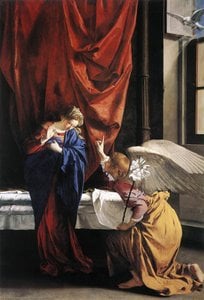
In the masterpiece The Annunciation, created in 1620, Giulio Cesare Procaccini captures the profound moment when the angel Gabriel announces to the Virgin Mary that she will bear a son, Jesus. The composition is defined by a sense of movement and energy, with the figures of Gabriel and Mary arranged along a diagonal line. Through the masterful use of chiaroscuro, the artist employs strong contrasts between light and dark to instill the scene with drama and tension, adding significant depth and volume to the figures.
The painting is rich with symbolic elements that deepen its narrative impact. A lily is featured as a symbol of purity and innocence, while a book represents knowledge and wisdom. The vibrant colors and intricate details highlight Procaccini's technical skill, particularly in how light and shadow interact within the frame.
The foreground of this oil on canvas features two central figures: a woman dressed in blue robes and a man wearing red garments. The woman is depicted kneeling before the man, who holds a book or manuscript, suggesting an interaction of revelation. Above these figures, three cherubs are seen playing with a butterfly, adding an element of joy and innocence to the scene.
The background presents a dark landscape situated under a cloudy sky, providing a sharp contrast to the brightly lit figures in the foreground. The use of vibrant blues and reds draws the viewer's attention to the importance of the central characters within the composition.
De dominante kleur van "The Annunciation" door Giulio Cesare Procaccini is Espresso (#462727).
Voor een Living Room wordt voor "The Annunciation" een afdruk van Large aanbevolen.
Op de Voorvertoning-pagina van "The Annunciation" kunt u het kunstwerk bekijken voordat u bestelt.

Giulio Cesare Procaccini stands as a pivotal figure in the burgeoning artistic landscape of early Baroque Milan, marking a decisive transition from Mannerist formalism to the expressive dynamism that would define an era. Born in Bologna in 1574, he descended from a lineage steeped in profound artistic tradition; his father, Ercole Procaccini the Elder, was himself a notable Mannerist painter. This heritage profoundly shaped his formative years, instilling within him an appreciation for nuanced stylistic complexities and a technical rigor that would later allow him to masterfully blend grace with grandeur. Around 1585, spurred by the influential patronage of Pierro Visconti, the family relocated to Milan, establishing a crucial connection with one of Italy’s wealthiest art collectors and fostering an environment ripe for the artistic experimentation that would become Procaccini's hallmark.
The artist's creative journey began not with the brush, but with the chisel. His early training was rooted in sculptural endeavors, primarily focused on the sacred spaces of the Milanese Duomo and Santa Maria presso San Celso. This tactile foundation in sculpture left an indelible mark on his later paintings, manifesting in a unique sense of volume, weight, and anatomical presence. However, he eventually transitioned to painting, recognizing its unparalleled capacity for conveying intense emotion and celestial light. During this period of development, Procaccini moved within the highest intellectual circles of Milan, associating with luminaries such as Giovanni Battista Crespi, known as Il Cerano, and Pier Francesco Mazzucchelli, or Il Morazzone. Under the spiritual and material guidance of Cardinal Federico Borromeo, Procaccini's creative output was propelled toward greatness, allowing him to capture the very spirit of the Counter-Reformation.
Procaccini’s mature style is a breathtaking synthesis of various European influences, most notably the vibrant colorism of the Venetian school and the sweeping, energetic compositions of Peter Paul Rubens. His works are characterized by a dramatic use of chiaroscuro, where deep shadows dance against luminous highlights to create a sense of theatrical movement. In masterpieces such as The Annunciation, one can witness this Baroque drama firsthand, as vibrant colors and swirling drapery evoke a profound sense of divine intervention. His ability to manipulate light allowed him to breathe life into religious narratives, transforming static icons into living, breathing moments of spiritual ecstasy.
His technical prowess is perhaps most evident in his large-scale religious commissions, which served both as artistic triumphs and instruments of faith. Notable examples include:
The historical significance of Giulio Cesare Procaccini lies in his role as a bridge between two worlds. He took the sophisticated, often artificial elegance of the Mannerist period and infused it with a new, visceral humanity that resonated with the religious fervor of 17th-century Italy. His work does not merely depict a scene; it invites the viewer into a sensory experience of the divine. Through his mastery of color, light, and movement, he helped establish Milan as a major center of Baroque excellence, leaving behind a legacy of altarpieces and frescoes that continue to captivate the modern imagination with their profound emotional depth and technical brilliance.

1574 - 1625 , Italy
 Voorvertoning
 Verstuur
 Delen
Delen
 Details bekijken
 Gids
Gids

 Download
 Vergelijkbare items
 Röntgenonderzoek
 Diavoorstelling
 Vraag & antwoord
 Statistieken


 Lees meer