Giovanni da Milano: Een Brug Tussen Gotiek en Renaissance
Giovanni da Milano, een naam die zacht resoneert in de annalen van de Proto-Renaissance kunst, belichaamt een cruciaal moment in de Italiaanse schilderkunst – een schakel tussen de gracieuze lyriek van de gotische periode en het ontluikend naturalisme dat de Renaissance zou definiëren. Geboren als Giovanni di Jacopo di Guido da Caversaccio in Lombardije rond 1346, ontvouwde zijn artistieke reis voornamelijk binnen het bruisende culturele landschap van Florence tijdens een tijd van immense verandering en innovatie. Hoewel zijn leven tragisch werd afgebroken in 1369, waardoor een relatief klein maar diepgaand invloedrijk oeuvre achterbleef, is Giovanni’s bijdrage aan de evolutie van de Italiaanse schilderkunst onmiskenbaar. De vroegste gedocumenteerde spoor van zijn aanwezigheid verschijnt in Florentijnse archieven van 17 oktober 1346, waar hij vermeld staat als Johannes Jacobi de Commo onder buitenlandse schilders die in Toscane werkten – een getuigenis van de aantrekkingskracht die Florence uitoefende op kunstenaars die nieuwe mogelijkheden en een bloeiend artistiek klimaat zochten. Deze verhuizing suggereert een bewuste zoektocht naar vooruitgang, waarbij hij zijn Lombardische oorsprong achterliet om zich te onderdompelen in het epicentrum van artistieke innovatie.
De Schaduw van Giotto: Stijl en Invloeden
Giovanni da Milano’s stijl is onlosmakelijk verbonden met die van Giotto di Bondone, de revolutionaire kunstenaar die al decennia eerder de conventies van middeleeuwse schilderkunst had beginnen te ontmantelen. Hij was echter geen louter kopieerder; hij absorbeerde Giotto’s innovaties – de nadruk op naturalistisch realisme, emotionele expressiviteit en ruimtelijke diepte – en filterde deze door zijn eigen artistieke gevoeligheid. Zijn schilderijen tonen een duidelijke poging om verder te gaan dan de gestileerde figuren en afgeplatte perspectieven van de gotische kunst, in plaats daarvan strevend naar een grotere mate van realisme bij het afbeelden van menselijke vormen en oprechte emoties over te brengen door middel van gezichtsuitdrukkingen en gebaren. Deze zoektocht is zichtbaar in de zorgvuldige modellering van draperieën, de subtiele nuances van licht en schaduw, en het algehele gevoel van gewicht en volume dat zijn figuren kenmerkt. Hij werkte niet geïsoleerd; Giovanni werkte samen met andere prominente kunstenaars van die tijd, waaronder Giottino – Giotto’s eigen zoon – en de zonen van Taddeo Gaddi, waardoor hij werd blootgesteld aan baanbrekende artistieke benaderingen en bijdroeg aan zijn stilistische ontwikkeling. Deze samenwerkingen bevorderden een dynamische uitwisseling van ideeën die zijn unieke visie vormde. Hoewel hij diep verschuldigd is aan Giotto, vertonen Giovanni’s werken ook hints van Sienese invloed, met name in zijn delicate gebruik van kleur en verfijnde details, wat wijst op een bredere betrokkenheid bij de diverse artistieke stromingen die door heel Italië circuleerden.
Meesterwerken en Artistiek Erfgoed
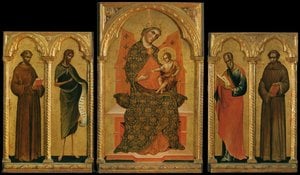
Ondanks zijn korte carrière heeft Giovanni da Milano verschillende belangrijke werken achtergelaten die zijn evoluerende stijl en technische vaardigheid demonstreren. Het
Ognissanti Polyptych, met name de zijpanelen, bewaard in de Galleria degli Uffizi te Florence, staat als een toonbeeld van zijn volwassen werk. De minutieuze aandacht voor detail binnen deze religieuze context is opvallend en toont zijn vermogen om heilige onderwerpen te doordrenken met een gevoel van menselijke waardigheid en emotionele resonantie. Andere belangrijke werken zijn het
Madonna and Child with Donors, een verbluffend vroege Renaissance meesterwerk dat naturalisme en devotionele schoonheid belichaamt in de Lombardische kunst, en de aangrijpende
St Francis of Assisi, gekenmerkt door zijn serene compositie, aardse tinten en symbolische diepte. Het
Coronation of the Virgin, een olieschildering met ingewikkelde details en symbolische schoonheid, bevestigt verder zijn plaats in het artistieke landschap van de periode. Zijn fresco’s in de Rinuccini Kapel van Santa Croce, Florence – met name die welke scènes uit het leven van de Maagd Maria en Maria Magdalena afbeelden – onthullen een meesterlijke beheersing van narratieve compositie en expressieve figuurweergave.
Een Overgangsfiguur
Giovanni da Milano’s historische betekenis ligt in zijn rol als een cruciale overgangsfiguur binnen de Proto-Renaissance. Hij was geen revolutionair zoals Giotto, maar hij synthetiseerde beproefde artistieke tradities op meesterlijke wijze en duwde subtiel grenzen op naar groter naturalisme en emotionele diepte. Hij hielp de weg vrijmaken voor latere Renaissance kunstenaars door te demonstreren hoe krachtig observatie is, hoe belangrijk menselijke emotie is en welk potentieel schilderkunst heeft om complexe verhalen over te brengen. Zijn werk belichaamt het evoluerende artistieke landschap van 14e-eeuws Italië – een periode die werd gekenmerkt door een groeiende interesse in de klassieke oudheid, een hernieuwd nadruk op humanisme en een geleidelijke verschuiving weg van de rigide conventies van middeleeuwse kunst. Hoewel zijn leven tragisch kort was, duurt Giovanni da Milano’s nalatenschap voort als een getuigenis van de kracht van artistieke innovatie en de blijvende aantrekkingskracht van schoonheid, geloof en menselijke expressie. Zijn schilderijen blijven kijkers betoveren met hun delicate gratie, emotionele intensiteit en diepe spirituele resonantie, waardoor een glimp wordt geboden in een cruciaal moment in de geschiedenis van de westerse kunst.
Verdere Verkenning
- Museum San Giovanni in Siena: Beschikt over een indrukwekkende collectie waaronder werken van Giovanni da Milano naast kunstenaars zoals Lorenzo Ghiberti en Domenico di Pace Beccafumi.
- The Metropolitan Museum of Art: Toont het “Madonna and Child with Donors”, dat inzicht biedt in zijn stijl en techniek.
- Web Gallery of Art (WGA): Biedt een uitgebreide biografie en toegang tot gedigitaliseerde afbeeldingen van zijn kunstwerken.



 Bekijk op ware grootte
 Schakel over naar print
 Verstuur
 Delen
Delen
 Details bekijken
 Gids
Gids

 Download
 Vergelijkbare items
 Röntgenonderzoek
 Diavoorstelling
 Statistieken


 Lees meer






































 De optie voor glas is alleen beschikbaar bij een formaat kleiner dan 110 cm.