Bekijk op ware grootte Bekijk in AR Schakel over naar print Schakel over naar digitale afbeeldingen Verstuur
Details bekijken Gids Toevoegen aan favorieten Download Vergelijkbare items Röntgenonderzoek Diavoorstelling Statistieken

Perseus and Andromeda

Discover Giorgio Vasari’s ‘Perseus & Andromeda,’ a dramatic Baroque masterpiece! Explore this 1570 oil painting's classical myth, rich detail, and dynamic composition. A stunning Renaissance artwork.

"meta_description": "Giorgio Vasari (1511-1574): Italiaanse Renaissance kunstenaar, architect & kunsthistoricus. Bekend om 'Levens van Kunstenaars', een hoeksteen van kunstgeschiedenis en ontwerper van de Uffizi Galery."

Handgemaakte olieverfreproductie

Met de hand geschilderd in olieverf op canvas in uw gewenste maat en lijst, op bestelling gemaakt door onze kunstenaars. ( Schakel over naar print Schakel over naar digitale afbeeldingen)

P118B $10
P118H $10
P118W $10
P438Z $10
P508JH $12
P508YH $12
P805H $10
P805Z $10
P919BZ $10
P919G $10
P919XJ $10
P959ZH $10
P968JZ $12
W106C $8
W218G $10
W218JH $8
W218Y $10
W307PJ $10
W316G $10
W316PJ $8
W316Y $10
W398PJ $8
W4111J $10
W500HY $15
W500JH $15
W692G $12
W849H $8
W940BG $15
W953PJ $8

Standaardformaat
op maat gemaakt
CM
INCH

Kies uit onze vooraf ingestelde maten die overeenkomen met de originele verhoudingen van het kunstwerk.

breedte
hoogte

U kunt uw eigen afmetingen invoeren om in een specifieke lijst of ruimte te passen. Als de door u gekozen maat niet overeenkomt met de verhoudingen van het originele beeld, zullen we het kunstwerk bijsnijden of het schilderij uitbreiden met extra handgeschilderde elementen. Een digitale mockup wordt ter goedkeuring naar u verzonden voordat de productie begint.
Houd er rekening mee dat de preview op het scherm niet de werkelijke uitsnede of uitbreiding weergeeft. Alleen de mockup toont de uiteindelijke compositie nauwkeurig.
Hoewel aangepaste afmetingen mogelijk zijn, raden we aan een maat uit de vooraf gedefinieerde lijst te selecteren om de originele verhoudingen te behouden.

Voorbeelden van wat aangepast kan worden: Vervang het gezicht met een eigen foto; Voeg een huisdier toe (bijv. vervang de kat door een hond); Verwerk een verborgen boodschap in de achtergrond; Wijzig het landschap of andere elementen in de achtergrond.
Na de bestelling zal het team van WahooArt.com per e-mail contact opnemen met de klant voor instructies en een mockup-voorbeeld sturen.

Wereldwijde levering () binnen 3 tot 4 weken in plaats van de standaard 5 weken. (24 september). Zonder concessies aan de kwaliteit.

why_choose_icon
Gratis wereldwijde expressverzending
why_choose_icon
Hoogwaardig linnen canvas
why_choose_icon
Volledige verzendverzekering
why_choose_icon
Garantie op terugbetaling van invoerrechten
why_choose_icon
Garantie op exacte kleurweergave
why_choose_icon
Retourbeleid van 100 dagen (alleen bij defecten)
why_choose_icon
100% Geld-terug-garantie
why_choose_icon
Korting bij meerdere afnames

Totaalprijs

$ 322

reproduction

Perseus and Andromeda

Reproductiemethode

Formaat reproductie

-

Totaalprijs

$ 322

Belangrijkste kenmerken

  • Notable elements or techniques: Dramatic lighting; Layered brushstrokes
  • Artistic style: Classical Mythology
  • Dimensions: 117 x 100 cm
  • Influences: Renaissance
  • Movement: Baroque
  • Year: 1570
  • Medium: Oil on canvas

Kunstquiz

Er is slechts één goed antwoord op elke vraag.

Vraag 1:
What is the primary subject matter of Perseus and Andromeda?
Vraag 2:
Which artistic style is most characteristic of Giorgio Vasari's Perseus and Andromeda?
Vraag 3:
What prominent artist influenced Vasari’s artistic vision?
Vraag 4:
The painting utilizes a technique known for layering colors and creating depth. What is this technique called?
Vraag 5:
Where was Perseus and Andromeda originally displayed?

A Dramatic Rescue: Giorgio Vasari's "Perseus and Andromeda"

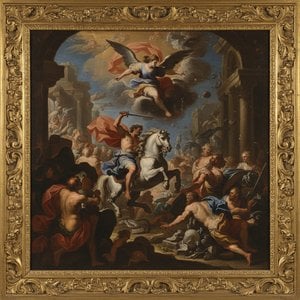
Giorgio Vasari’s “Perseus and Andromeda,” completed in 1570, is more than just a depiction of a classical myth; it’s a visceral embodiment of the Baroque spirit – a tempestuous drama rendered with meticulous detail and imbued with potent symbolism. Measuring 117 x 100 cm, this oil-on-canvas masterpiece transports the viewer directly into the heart of a heroic rescue, a narrative steeped in themes of divine intervention, courage, and ultimately, redemption. The scene unfolds within a dramatically lit coastal setting, dominated by a colossal rock formation that serves as both a stage for the unfolding action and a powerful visual anchor.

  • The Myth Unveiled: The painting portrays the legendary tale of Andromeda, chained to a rock as a sacrifice to appease a monstrous sea creature. Perseus, guided by the gods, arrives to rescue her, battling the beast with heroic strength and ultimately severing its head.
  • Baroque Flourishes: Vasari’s style is firmly rooted in the Baroque movement, characterized by dynamic composition, theatrical lighting, and an emphasis on emotional intensity. The swirling waves, the muscular forms of Perseus and Andromeda, and the imposing presence of Poseidon all contribute to a sense of dramatic movement and heightened realism.

Technique and Materials: A Master’s Hand

Vasari's mastery is immediately apparent in his skillful application of oil paint on canvas. The technique showcases a layered approach, utilizing visible brushstrokes to build up texture and create a palpable sense of depth. The smooth blending of colors – primarily earthy tones of browns, ochres, and greens punctuated by vibrant blues and reds – contributes to the illusion of three-dimensionality. The artist’s meticulous attention to detail is evident in the rendering of the rocky landscape, the flowing drapery, and the expressive faces of the figures. The use of atmospheric perspective subtly recedes into the distance, further enhancing the painting's spatial depth.

  • Oil on Canvas: The medium itself – oil paint applied to canvas – allowed for the rich colors and luminous effects characteristic of Baroque art.
  • Layered Brushwork: Vasari’s technique involved building up color and form through multiple layers of thin glazes, creating a sense of depth and realism.

Symbolism and Emotional Impact

Beyond the immediate narrative, “Perseus and Andromeda” is rich in symbolic meaning. The sea monster represents chaos and destruction, while Andromeda’s vulnerability underscores the need for divine protection. Poseidon's intervention symbolizes power and salvation, highlighting the role of the gods in human affairs. Vasari expertly captures the emotional intensity of the scene – the desperation of Andromeda, the heroic determination of Perseus, and the raw power of Poseidon – creating a profoundly moving experience for the viewer. The dramatic lighting further amplifies this effect, casting strong contrasts between light and shadow to emphasize key figures and heighten the sense of drama.

Historical Context and Artistic Significance

Completed in 1570, “Perseus and Andromeda” reflects the artistic currents of its time – a period marked by a renewed interest in classical antiquity and a burgeoning Baroque style. Giorgio Vasari’s work stands as a testament to his versatility and his commitment to celebrating the achievements of past masters. This painting exemplifies the Renaissance fascination with mythology and heroism, while simultaneously pushing the boundaries of artistic expression through its dynamic composition and dramatic use of light and color. Its enduring appeal lies in its ability to evoke powerful emotions and transport viewers to another time and place.


Biografie van de kunstenaar

A Life Woven into the Renaissance Fabric

Giorgio Vasari, born in Arezzo, Tuscany, on July 30, 1511, was more than simply a painter; he was a quintessential embodiment of the Italian Renaissance spirit. His life unfolded as a vibrant tapestry woven with threads of artistic creation, architectural innovation, insightful historical writing, and an unwavering dedication to celebrating the masters who came before him. From his earliest training under Guglielmo da Marsiglia, a skilled artisan in stained glass, young Giorgio’s path was steered towards visual artistry. However, it was his move to Florence at sixteen that truly ignited his potential. Immersing himself within the dynamic circle of Andrea del Sarto and absorbing the influences of Rosso Fiorentino and Jacopo Pontormo, Vasari began a journey that would see him become one of the most influential figures of his era. His formative years were also deeply marked by the patronage and friendship of the powerful Medici family, a relationship that would shape both his career and his perspective on art’s role in society.

The Artist's Hand and Eye

Vasari’s artistic style is often categorized as Mannerist, reflecting the prevailing aesthetic trends of the mid-16th century. His paintings are characterized by elongated figures, dynamic compositions, and a sophisticated use of color—qualities highly admired during his lifetime. While perhaps not achieving the same level of enduring fame as some of the artists he chronicled, Vasari’s skill was undeniable. Notable works such as *The Studio of the Painter*, a fresco housed in Casa Vasari in Arezzo, offer a fascinating glimpse into the artistic practices of the time. The sheer scale and ambition of his frescoes for the Palazzo Vecchio in Florence, undertaken between 1555 and 1572, demonstrate his mastery of large-scale decorative schemes. His final monumental undertaking, *The Last Judgement*, adorning the cupola of Florence Cathedral—completed after his death by Federico Zuccari—stands as a testament to his unwavering commitment to grand artistic visions. Beyond painting, Vasari’s architectural contributions were equally significant. He designed the elegant loggia of the Palazzo degli Uffizi, transforming it into a public piazza and creating a vital link within Florence's urban landscape. Perhaps most famously, he conceived and oversaw the construction of the Vasari Corridor, a secret passageway connecting the Uffizi Gallery with the Palazzo Pitti—a feat of engineering and architectural ingenuity that continues to captivate visitors today.

A Historian Forging a Legacy

However, it is arguably as an art historian that Giorgio Vasari secured his most lasting legacy. His monumental work, *Lives of the Most Excellent Painters, Sculptors, and Architects*, published in 1550 (with a revised edition in 1568), revolutionized the way art was understood and appreciated. This groundbreaking text wasn’t merely a collection of biographies; it established a narrative framework for the development of Italian Renaissance art, tracing its evolution from the early masters like Cimabue and Giotto to his contemporaries Michelangelo and Raphael. Vasari's work introduced the very concept of the “Renaissance” – a rebirth of classical ideals—and laid the foundation for modern art history as a discipline. While acknowledging that Vasari’s accounts are not without their biases and inaccuracies, particularly concerning artists predating his own time, the impact of *Lives* remains profound. It provided a crucial historical context for artistic creation, elevating the status of artists from skilled craftsmen to intellectual figures worthy of scholarly attention.

Influences and Enduring Significance

Vasari’s artistic development was profoundly shaped by his exposure to the works of Renaissance masters. His visit to Rome in 1529, where he studied the art of Raphael and other High Renaissance artists, proved pivotal. He absorbed their principles of composition, anatomical accuracy, and idealized beauty, incorporating them into his own style. Michelangelo, whom Vasari greatly admired, exerted a particularly strong influence on both his painting and architecture. The grandeur and dynamism characteristic of Michelangelo’s work are evident in many of Vasari’s projects. Beyond specific artists, the broader intellectual currents of the Renaissance—humanism, classical learning, and a renewed interest in empirical observation—also informed Vasari's approach to art and history. Giorgio Vasari died on June 27, 1574, in Florence, leaving behind a multifaceted legacy that continues to resonate today. He was not only a talented artist and architect but also a pioneering historian whose writings shaped our understanding of one of the most transformative periods in Western art history. His work remains essential for anyone seeking to explore the rich cultural heritage of the Italian Renaissance.

Key Achievements

  • The Lives of the Artists: Vasari’s magnum opus, a foundational text in art history that established a biographical approach to studying artists and their works.
  • Frescoes for the Palazzo Vecchio: His monumental frescoes decorating the Salone dei Cinquecento and the Studiolo showcased his mastery of large-scale decorative schemes and narrative painting.
  • Design of the Vasari Corridor: A remarkable feat of engineering and architectural design, connecting the Uffizi Gallery with the Palazzo Pitti – a secret passage that remains a symbol of Florentine history.
  • Architectural Design for the Uffizi Gallery Loggia: Transforming the Piazza della Signoria into a vibrant public space through his innovative design.

Further Exploration

Recommended Resources:
  • Vasari, Giorgio. *The Lives of the Most Excellent Painters, Sculptors, and Architects*. Translated by Allan Michell. Penguin Classics, 2003.
  • https://www.theartstory.org/artist/vasari-giorgio/

Giorgio Vasari

Giorgio Vasari

1511 - 1574 , Italië

Snelle feiten

  • Artistic Movement Or Style: Manierisme
  • Artists Or Movements Influenced By This Artist: ['Renaissance kunstgeschiedenis']
  • Artists Who Influenced This Artist:
    • Michelangelo
    • Guglielmo da Marsiglia
  • Date Of Birth: 30 juli 1511
  • Date Of Death: 27 juni 1574
  • Full Name: Giorgio Vasari
  • Nationality: Italiaans
  • Notable Artworks:
    • Studio Schilders
    • laatste oordeel
  • Place Of Birth: Arezzo, Italië
Ontdek kunstwerken georganiseerd op thema, stijl en kenmerk.