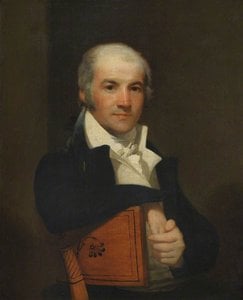
A Window into the Soul: Gilbert Stuart's 1786 Self-Portrait
Gilbert Stuart’s “Self Portrait,” completed in 1786, stands as a cornerstone of American Romantic portraiture—a masterful distillation of artistic innovation and psychological depth. Executed in oil paint with characteristic impasto technique, this artwork transcends mere likeness; it offers a profound glimpse into the artist's inner world and embodies the stylistic sensibilities of its era.
Neoclassical Roots, Romantic Expression
Stuart’s formative years were steeped in Neoclassicism, influenced by artists like Benjamin West and Jacques-Louis David. However, his artistic journey swiftly embraced the burgeoning Romantic movement, evidenced by the dramatic lighting—originating from above and slightly to the side—that sculpts the figure's face and casts evocative shadows. This deliberate manipulation of light isn’t merely decorative; it serves to heighten emotional intensity and underscores the solemn mood pervading the composition.
Technique and Texture: The Language of Impasto
The artist skillfully employs impasto—thickly applied paint—to imbue the canvas with palpable texture. Particularly prominent in the hair and clothing, these textured surfaces convey a sense of physicality and immediacy, mirroring the Romantic preoccupation with capturing raw emotion. Stuart’s meticulous brushstrokes are visible throughout the painting, demonstrating a commitment to traditional oil painting methods that prioritize expressive mark-making alongside realistic representation.
Composition and Symbolism: Focused Intensity
The portrait's tightly cropped composition draws attention exclusively to Stuart’s face and upper torso—a deliberate choice designed to foster intimacy and introspection. Lines are used expressively to delineate facial features, emphasizing the eyes and mouth, capturing a contemplative gaze that speaks volumes about the artist’s inner state. Subtle symbolic elements contribute to the artwork's emotional resonance; the somber color palette – predominantly browns and blacks – reflects melancholy and suggests a preoccupation with themes of solitude and self-awareness.
Historical Context: Reflecting Enlightenment Ideals
Created during Stuart’s time in London, “Self Portrait” aligns seamlessly with the broader artistic landscape of the period. It represents a pivotal moment in American art history, marking a departure from rigid academic conventions toward a more emotionally resonant and psychologically nuanced style. The Rhode Island State House proudly displays this masterpiece alongside other treasures of Rhode Island's heritage—a testament to Stuart’s enduring legacy as one of America’s most celebrated portraitists.
Resources for Further Exploration
Veelgestelde vragen
Waar wordt het Staand formaat-formaat van "Portret van zichzelf" aanbevolen te tonen?
Met zijn Staand formaat-formaat is een reproductie van "Portret van zichzelf" een prachtige aanvulling op een Woonkamer.
Zijn de kleuren van "Portret van zichzelf" krachtig of juist zacht?
"Portret van zichzelf" door Gilbert Stuart heeft een Monochroom kleurintensiteit.
Welke emotie straalt "Portret van zichzelf" door Gilbert Stuart uit?
"Portret van zichzelf" roept een Melancholisch gevoel op. De emotionele toon beschrijft de indruk die het werk achterlaat.



 Voorvertoning
 Bestel handgeschilderde reproductie
 Verstuur
 Delen
Delen
 Details bekijken
 Gids
Gids

 Download
 Vergelijkbare items
 Röntgenonderzoek
 Diavoorstelling
 Statistieken


 Lees meer






































 De optie voor glas is alleen beschikbaar bij een formaat kleiner dan 110 cm.