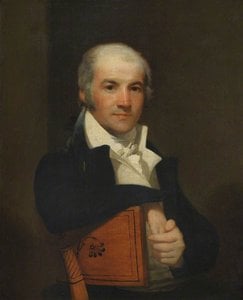
A Portrait of Authority: Gilbert Stuart’s Unfinished George Washington
Gilbert Stuart's "George Washington," painted in 1796, isn’t merely a likeness; it’s an embodiment of nascent American leadership and the very spirit of a nation forging its identity. This monumental portrait, now housed within the National Portrait Gallery in Washington D.C., offers a captivating glimpse into a pivotal moment in early American history – a time when George Washington was transitioning from military hero to the first president, and Stuart was establishing himself as the foremost portraitist of his era.
The painting immediately draws the eye with its dramatic lighting, a directional illumination that sculpts Washington’s face and shoulders. The artist masterfully employs chiaroscuro – the interplay of light and shadow – to create a sense of depth and volume, lending the figure an almost tangible presence. Notice how the light catches the planes of his cheekbones and forehead, while the shadows subtly define the lines of his mouth and eyes, conveying both dignity and a hint of thoughtful contemplation. The dark background serves not as a distraction but rather as a powerful stage for Washington’s commanding form, emphasizing his importance within the narrative.
Neoclassical Precision Meets Expressive Brushwork
Stuart's style firmly resides within the Neoclassicism movement, a trend that sought to revive the ideals and forms of ancient Greece and Rome. This is evident in Washington’s formal attire – the meticulously rendered coat, waistcoat, and cravat—a deliberate reference to classical portraiture. However, Stuart doesn’t simply replicate antiquity; he infuses it with his own distinctive approach. His brushwork is remarkably expressive, a far cry from the smooth, polished surfaces favored by some of his contemporaries. Thick, visible strokes create texture and dynamism, particularly in the fabric of the coat and the details of Washington's face. The unfinished quality—the large areas of white paint revealing the canvas beneath—is not a flaw but rather a deliberate choice, suggesting an ongoing process of refinement and reflecting the immediacy of the artistic endeavor.
The painting is executed in oil on canvas, utilizing pigments primarily consisting of white, black, and various shades of grey. The layering of these colors creates a rich tapestry of tones, contributing to the overall sense of depth and realism. The artist’s skillful manipulation of color allows him to capture not only Washington's physical appearance but also his character – a blend of strength, wisdom, and quiet resolve.
Symbolism and the Weight of Leadership
Beyond its technical brilliance, “George Washington” is laden with symbolic meaning. The subject’s posture—his head slightly turned towards the viewer—conveys an air of authority and confidence. His gaze, direct and unwavering, suggests a man accustomed to command and responsible for the future of his nation. The formal attire itself symbolizes leadership and civic virtue, aligning Washington with the ideals of republicanism that were just beginning to take root in America.
Interestingly, the unfinished state of the portrait adds another layer of interpretation. It speaks to the precariousness of the early republic, a nation still grappling with its identity and direction. The artist’s decision to leave portions of the canvas unpainted suggests that Washington's legacy was still being written, and that his image would continue to evolve as America itself did.
A Timeless Masterpiece – Perfect for Reproduction
Gilbert Stuart’s “George Washington” remains a profoundly resonant work of art. Its combination of technical skill, symbolic weight, and emotional impact ensures its enduring appeal. Reproductions offer an accessible way to experience this masterpiece firsthand, bringing the gravitas and authority of George Washington into any space. Whether adorning a grand salon or a more intimate setting, this portrait serves as a powerful reminder of America’s founding principles and the legacy of one of its most revered figures.
Vragen & Antwoorden
Welk palet en welk gevoel combineert "George Washington"?
Het Neutrals kleurenpalet van "George Washington" door Gilbert Stuart gaat samen met de Nostalgic emotionele toon. Kleur is een van de manieren waarop een werk gevoel overbrengt.
Welke kleur domineert de compositie van "George Washington" door Gilbert Stuart?
De dominante kleur van "George Washington" door Gilbert Stuart is Sap Green (#675b40).
Welke sfeer straalt "George Washington" uit?
De algehele stemming van "George Washington" door Gilbert Stuart is Classic. De stemming beschrijft de algemene atmosfeer van het werk.



 Bekijk op ware grootte
 Schakel over naar print
 Verstuur
 Delen
Delen
 Details bekijken
 Gids voor studentenkunstwerken

 Download
 Vergelijkbare items
 Röntgenonderzoek
 Diavoorstelling
 Statistieken


 Lees meer






































 De optie voor glas is alleen beschikbaar bij een formaat kleiner dan 110 cm.