GRATIS KUNSTADVIES

x
Bestel schilderij Bestel schilderijKoop afbeelding in hoge resolutie Koop afbeelding in hoge resolutie VerstuurVerstuur
DetailsDetails Toevoegen aan favorieten Toevoegen aan favorieten DownloadDownload Vergelijkbare werkenVergelijkbare werken RöntgenfotoRöntgenfoto DiavoorstellingDiavoorstelling

Untitled

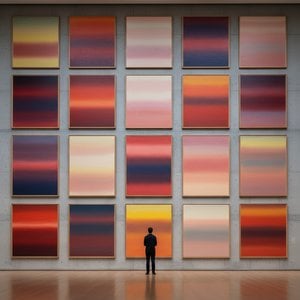
Experience the vibrant energy of Gerhard Richter's 'Untitled' (1987). This abstract expressionist piece bursts with color and texture, showcasing the master's unique blurred motion technique. A captivating addition to any art collection.

Gerhard Richter (1932): Bekend om abstracte & fotorealistische schilderijen, 'Capitalist Realism' en kleurkaarten. Een invloedrijke Duitse kunstenaar die de hedendaagse kunst definieert.

Giclée / Kunstafdruk

Giclée- of canvasafdruk van museumkwaliteit met snelle productie en flexibele afwerkingsopties.

P118B $10
P118H $10
P118W $10
P438Z $10
P508JH $12
P508YH $12
P805H $10
P805Z $10
P919BZ $10
P919G $10
P919XJ $10
P959ZH $10
P968JZ $12
W106C $8
W218G $10
W218JH $8
W218Y $10
W307PJ $10
W316G $10
W316PJ $8
W316Y $10
W398PJ $8
W4111J $10
W500HY $15
W500JH $15
W692G $12
W849H $8
W940BG $15
W953PJ $8

Standard
custom
CM
INCH

Kies uit onze vooraf ingestelde maten die overeenkomen met de originele verhoudingen van het kunstwerk.

breedte
hoogte

U kunt uw eigen afmetingen opgeven om in een specifieke lijst of ruimte te passen. Als de door u gekozen maat niet overeenkomt met de proporties van het originele kunstwerk, zullen wij de afbeelding bijsnijden of uitbreiden met een gespiegelde of effen rand. Een digitaal mockup wordt ter goedkeuring naar u verzonden voordat de productie begint.
Houd er rekening mee dat de preview op het scherm de werkelijke bijsneding of uitbreiding niet weergeeft. Alleen de mockup toont de uiteindelijke compositie nauwkeurig.
Hoewel aangepaste maten beschikbaar zijn, raden wij aan een afmeting uit de vooraf bepaalde lijst te kiezen om de originele proporties te behouden.

Wereldwijde levering () binnen 2 weken in plaats van de standaard 4/5 weken. (4 juli)

why_choose_icon
Gratis wereldwijde expressverzending
why_choose_icon
Hoogwaardig linnen canvas
why_choose_icon
Volledige verzendverzekering
why_choose_icon
Garantie op terugbetaling van invoerrechten
why_choose_icon
Garantie op exacte kleurweergave
why_choose_icon
60 dagen retourbeleid (alleen bij defecten)
why_choose_icon
100% Geld-terug-garantie
why_choose_icon
Korting bij meerdere afnames

Totaalprijs

-

reproduction

Untitled

Giclée / Kunstafdruk

Afmetingen reproductie

-

Eindtotaal

-

Snelle feiten

  • Movement: Abstract Expressionism
  • Artist: Gerhard Richter
  • Artistic style: Abstract
  • Title: Untitled
  • Notable elements or techniques: Vibrant colors, scraped paint

Kunstquiz

Er is slechts één correct antwoord op elke vraag.

Vraag 1:
In what year was this untitled painting by Gerhard Richter created?
Vraag 2:
Based on the image description, what are the dominant colors in Richter's 'Untitled'?
Vraag 3:
Gerhard Richter is known for a diverse range of styles. What artistic movement is this painting most closely associated with?
Vraag 4:
According to the provided information, what is a notable characteristic of Richter's early life?
Vraag 5:
What is mentioned about this specific 'Untitled' painting on the SFMOMA custom prints website?

Beschrijving verzamelobject

A Symphony of Color and Emotion: Exploring Gerhard Richter’s Untitled (1987)

Gerhard Richter's *Untitled* from 1987 is not merely a painting; it’s an encounter with pure sensation, a visual articulation of the complex emotional landscape that defines much of his oeuvre. Executed in oil on canvas, this abstract work explodes with a vibrant energy born from the collision of reds, yellows, and blues. The composition isn't one of deliberate form or recognizable imagery, but rather a dynamic interplay of color fields, scraped surfaces, and layered textures. It’s a testament to Richter’s mastery of manipulating paint – not as a means to represent reality, but as a material with its own inherent expressive power. The painting invites the viewer into an intimate space where color becomes the primary language, bypassing narrative in favor of direct emotional resonance. The dominance of red, punctuated by bursts of yellow and cool accents of blue, creates a sense of both urgency and depth, hinting at underlying tensions and unresolved energies.

The Abstract Expressionist Dialogue

Richter’s *Untitled* emerges from a rich historical context deeply rooted in the traditions of abstract expressionism, yet simultaneously transcends easy categorization. While echoes of artists like Jackson Pollock and Mark Rothko can be discerned – particularly in the gestural application of paint and the emphasis on large-scale color fields – Richter imbues his work with a distinctly contemporary sensibility. He doesn’t seek to replicate the heroic gestures or spiritual aspirations often associated with Abstract Expressionism; instead, he interrogates its very foundations. The scraping and layering techniques, almost violent in their execution, suggest a deliberate dismantling of traditional painterly conventions. This approach reflects Richter's broader artistic project: a constant questioning of representation, perception, and the nature of truth itself. The year 1987 was a pivotal moment for Richter, as he continued to explore abstract forms while simultaneously engaging with photographic realism, demonstrating his remarkable versatility and intellectual rigor.

Technique as Revelation

What truly sets Richter’s work apart is his innovative technique. He doesn't simply apply paint to the canvas; he *works* the surface, using squeegees, knives, and other tools to drag, scrape, and blend colors together. This process isn’t about achieving a polished or refined finish; it’s about revealing the inherent qualities of the material itself. The resulting textures are rich and complex, creating a sense of depth and movement that draws the viewer in. The layers of paint build up over time, obscuring and revealing underlying colors, suggesting a history embedded within the surface of the canvas. This technique also introduces an element of chance and unpredictability into the process, allowing the painting to evolve organically. It’s a method that emphasizes the physicality of painting – the act of applying pigment to a surface – while simultaneously challenging traditional notions of authorship and control.

Emotional Resonance and Interior Spaces

The emotional impact of *Untitled* is profound. The vibrant colors evoke feelings of energy, passion, and even turmoil, while the abstract forms allow for multiple interpretations. It’s a painting that doesn't dictate meaning but rather invites viewers to project their own emotions and experiences onto its surface. For interior designers, this work presents an exciting opportunity to create focal points within a space. The bold colors and dynamic composition can energize a room, adding depth and visual interest. Its abstract nature allows it to complement a wide range of styles, from minimalist modern interiors to more eclectic and bohemian spaces. A high-quality reproduction of *Untitled* would serve not just as an aesthetic addition but as a conversation starter—a powerful statement piece that reflects a sophisticated appreciation for art history and contemporary expression.

Vergelijkbare kunstwerken


Biografie van de kunstenaar

A Life Shaped by Division: The Early Years and Artistic Formation of Gerhard Richter

Gerhard Richter’s story is inextricably linked to the fractured history of 20th-century Germany. Born in Dresden in 1932, his childhood unfolded under the shadow of a rising National Socialist regime. This formative period, marked by displacement – his family moved several times during the war years – instilled within him a profound sense of uncertainty and a questioning spirit that would permeate his artistic practice for decades to come. The idyllic landscapes of his early upbringing in Reichenau and Waltersdorf were soon disrupted by conflict, leaving an indelible mark on his psyche. His father, though not a fervent supporter of the Nazi party, navigated the complexities of life under authoritarian rule as a schoolteacher, while his mother fostered a love for literature and music within the family. This duality – a pragmatic acceptance of circumstance alongside a yearning for cultural expression – became a defining characteristic of Richter’s own artistic approach. He began formal training at the Dresden Academy of Fine Arts in 1951, initially immersed in the tradition of socialist realism demanded by the East German state. However, even within this constrained environment, a desire for artistic freedom simmered beneath the surface, fueled by a growing dissatisfaction with ideological constraints and a longing to explore more expansive creative possibilities.

Escaping Constraints: Düsseldorf and the Exploration of Style

The year 1961 proved pivotal. Richter, along with his wife Marianne Eufinger, made the daring decision to flee East Germany, seeking refuge in the burgeoning art scene of Düsseldorf. This move marked a radical shift in his artistic trajectory. The West German landscape offered a liberating environment where experimentation and innovation were not only permitted but actively encouraged. In Düsseldorf, he encountered a vibrant community of artists grappling with questions of identity, representation, and the legacy of history. He quickly began to dismantle the rigid stylistic conventions of socialist realism, embarking on a period of intense exploration that would define his early mature work. This era saw him oscillate between seemingly disparate approaches – from photorealism, meticulously recreating photographic images with astonishing precision, to abstract compositions characterized by bold colors and dynamic brushstrokes. His collaboration with Sigmar Polke led to the coining of the term ‘Capitalist Realism,’ a deliberately ambiguous label that reflected their shared skepticism towards established artistic norms and their appropriation of imagery from advertising and mass media. This period wasn’t about finding *a* style, but rather questioning the very notion of stylistic coherence, embracing contradiction as a fundamental principle.

Blurring Boundaries: Photorealism, Abstraction, and the Power of Chance

Richter's artistic vocabulary expanded throughout the 1960s and beyond, encompassing a remarkable range of techniques and themes. His photorealistic paintings, often based on family photographs or newspaper images, are not merely copies of reality but rather investigations into the nature of perception and representation. By meticulously rendering these images with an almost clinical detachment, he forces viewers to confront the inherent ambiguity of photographic truth. Simultaneously, Richter delved deeper into abstraction, creating canvases layered with vibrant colors and gestural marks. These abstract works are often created using a unique technique involving squeegees – tools typically used for cleaning windows – which he drags across the surface of the canvas, manipulating the paint in unpredictable ways. This embrace of chance and spontaneity is central to his artistic philosophy, allowing him to relinquish control and invite unexpected outcomes. His ‘Color Charts,’ systematic arrangements of colored squares, further challenge traditional notions of artistic expression, questioning the very definition of painting itself. These works are not about individual aesthetic preferences but rather about exploring the inherent properties of color and its organizational possibilities.

The Weight of History: From Dresden to Recognition

Richter’s early years in Dresden were profoundly shaped by the devastation of World War II and the subsequent division of Germany. The city, heavily bombed during the war, was a landscape of rubble and reconstruction – a constant reminder of loss and trauma. This experience deeply influenced his artistic sensibility, fostering a sense of fragility and impermanence that would permeate much of his work. His early training at the Dresden Academy of Fine Arts provided him with a solid foundation in traditional techniques, but it also exposed him to the constraints of socialist realism – an ideology he increasingly resisted. The decision to leave East Germany in 1961 was not simply a matter of artistic freedom; it was a desperate attempt to escape the stifling atmosphere of political control and ideological conformity. Düsseldorf offered him a new beginning, a space where he could experiment without fear of censorship or reprisal. Despite initial struggles, Richter gradually gained recognition for his innovative approach, establishing himself as one of the leading figures in contemporary German art.

A Legacy of Ambiguity: Gerhard Richter Today

Gerhard Richter’s work continues to be exhibited and studied worldwide, cementing his place as one of the most important artists of our time. His paintings are characterized by their technical mastery, their emotional depth, and their profound engagement with complex social and historical themes. He has consistently resisted easy categorization, refusing to be defined by any single style or movement. This deliberate ambiguity is a key element of his artistic practice, inviting viewers to engage in critical dialogue and to interpret his work on their own terms. Richter’s influence can be seen in the work of countless artists who have followed in his footsteps, drawn to his innovative techniques and his unwavering commitment to artistic exploration. He remains a vital force in contemporary art, continuing to challenge conventions and to provoke audiences with his thought-provoking and deeply resonant work. His paintings are not simply beautiful objects; they are windows into the complexities of human experience – reflections on memory, identity, and the search for meaning in a world marked by uncertainty and change.
Gerhard Richter

Gerhard Richter

1932 - , Duitsland

Belangrijkste feiten

  • Artistic Movement Or Style:
    • Fotorealism
    • Abstractie
    • Kapitalistisch Realisme
  • Artists Or Movements Influenced By This Artist: ['Hedendaagse schilders']
  • Artists Who Influenced This Artist:
    • Pablo Picasso
    • Jean Arp
  • Date Of Birth: 9 februari 1932
  • Full Name: Gerhard Richter
  • Nationality: Duits
  • Notable Artworks:
    • Abstract Painting 610-1
    • Gilbert
    • S. with Child
    • Oktober 18, 1977
  • Place Of Birth: Dresden, Duitsland
Ontdek kunstwerken georganiseerd op thema's, stijlen en kenmerken.