A City Seen Through a Shimmer: Exploring Gerhard Richter’s Firenze
Gerhard Richter's *Firenze*, created in 2000, is more than just a cityscape; it’s an evocative meditation on perception, memory, and the very nature of representation. As one of the most significant artists of our time, Richter masterfully blends photorealism with abstract expressionism, creating works that are both visually arresting and intellectually stimulating. *Firenze* exemplifies this signature style, offering a fragmented yet compelling vision of urban life.
Deconstructing the Urban Landscape
The painting presents a blurred panorama of Florence, Italy – though the city’s iconic landmarks aren't rendered with precise detail. Instead, buildings and water surfaces dissolve into washes of color, suggesting a fleeting glimpse or a memory struggling to surface. The composition isn’t about topographical accuracy; it’s about capturing the *feeling* of being in a bustling urban environment. Hints of architectural forms are visible, alongside suggestions of movement – perhaps cars or pedestrians – but these elements remain indistinct, contributing to the painting's dreamlike quality.
Technique and Artistic Process
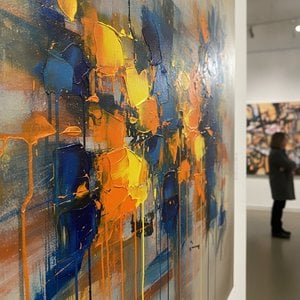
Richter’s technique is central to understanding *Firenze*. He often begins with a photographic source image, which he then manipulates through various methods, including blurring, scraping, and layering paint. In this work, the application of oil paint appears thick and gestural, creating a textured surface that adds depth and dynamism. The intense reds and browns dominate the palette, punctuated by flashes of blue and pink, generating a sense of energy and even turbulence. This deliberate ambiguity challenges traditional notions of artistic skill, prioritizing emotional impact over precise representation.
Historical Context & Richter’s Oeuvre
Born in Dresden, Germany, in 1932, Gerhard Richter experienced firsthand the trauma of World War II and the subsequent division of his country. This historical context profoundly influenced his artistic practice. His early work grappled with themes of memory, loss, and the challenges of representing reality after periods of ideological control. *Firenze* reflects a later stage in his career, where he increasingly explored abstraction while still referencing the visible world. It’s part of a series of cityscapes that demonstrate Richter's ongoing fascination with urban environments as sites of both beauty and alienation.
Symbolism & Emotional Resonance
While not explicitly symbolic, *Firenze* evokes powerful emotions. The blurred imagery suggests the impermanence of experience and the subjective nature of perception. The fragmented composition can be interpreted as a metaphor for the complexities of modern life – its constant flux, its overwhelming stimuli, and its inherent uncertainties. The painting doesn’t offer easy answers; instead, it invites viewers to engage with their own memories and associations, creating a deeply personal connection to the artwork.
Firenze in Your Collection
- For Art Lovers: *Firenze* is a compelling example of contemporary art that challenges conventional boundaries.
- For Collectors: Richter’s work consistently commands high prices at auction, making his paintings valuable and sought-after investments.
- For Interior Designers: The painting's rich color palette and dynamic composition make it a striking focal point for any modern or contemporary space. Its abstract nature allows it to complement a wide range of interior styles.
Gerhard Richter’s “Firenze” is not merely a depiction of a city; it’s an exploration of how we see, remember, and experience the world around us – a testament to his enduring legacy as one of the most important artists of our time.
Vragen & Antwoorden
Waar bevindt "Florence" door Gerhard Richter zich binnen de kunstgeschiedenis?
"Florence" door Gerhard Richter behoort tot de Contemporary Realism-stroming, binnen de Hedendaags-periode. Samen geven zij het werk zijn plaats in de kunstgeschiedenis.
Is "Florence" door Gerhard Richter een licht of een donker kunstwerk?
Wat betreft de waargenomen helderheid is "Florence" door Gerhard Richter schaduw.
Is er een gids voor "Florence" door Gerhard Richter?
Er is een Gids pagina beschikbaar voor "Florence" door Gerhard Richter: een printbaar informatieblad over het kunstwerk, ontworpen voor studenten en gebruik in de klas.



 Bekijk op ware grootte
 Koop handgeschilderd kunstwerk
 Verstuur
 Delen
Delen
 Details bekijken
 Gids voor studentenkunstwerken

 Download
 Vergelijkbare items
 Röntgenonderzoek
 Diavoorstelling
 Statistieken

 Lees meer






































 De optie voor glas is alleen beschikbaar bij een formaat kleiner dan 110 cm.