

De kunstwerken die op deze pagina worden weergegeven, zijn beschermd door de auteursrechtwetgeving, wat betekent dat het ons wettelijk niet is toegestaan om identieke reproducties te maken of te verkopen. Deze bescherming wordt gehandhaafd onder internationale overeenkomsten zoals de Conventie van Bern en door nationale wetgeving, waaronder de bepalingen van de Amerikaanse auteurswet - Titel 17. Alle rechten voorbehouden. Reproduceren of distribueren van afbeeldingen is niet toegestaan zonder uitdrukkelijke schriftelijke toestemming van WahooArt.com en de rechthebbenden.
Deze methode voldoet volledig aan de auteursrechtwetgeving, omdat het niet gaat om het kopiëren of dupliceren van het beschermde kunstwerk. In plaats daarvan is er sprake van een creatieve herinterpretatie — een nieuw schilderij dat door het origineel wordt geïnspireerd, maar er niet identiek aan is.
Giclée- of canvasafdruk van museumkwaliteit met een snelle productie en flexibele afwerkingsmogelijkheden. ( Bestel handgeschilderde reproductie Schakel over naar digitale afbeeldingen)
Kies uit onze vooraf ingestelde maten die overeenkomen met de originele verhoudingen van het kunstwerk.

Voer de gewenste breedte en hoogte in, passend bij uw lijst of muur. Een afdruk kan alleen worden ingekort en nooit groter worden gemaakt dan het origineel; een formaat met andere verhoudingen zal daarom een deel van de afbeelding verliezen. Wij sturen u een digitaal mockup ter goedkeuring voordat we tot drukwerk overgaan. De afbeelding op deze pagina toont niet de werkelijke uitsnede — dit is alleen te zien op het mockup.
Wereldwijde levering () binnen 2 weken in plaats van de standaard 4/5 weken. (19 november)
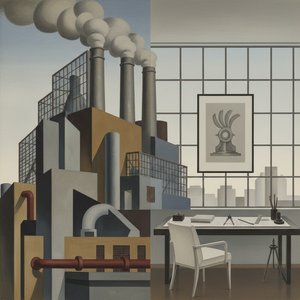
Elevators
Afmetingen reproductie
De kleur van "Elevators" heeft een verzadiging van Muted en een intensiteit van Monochromatic.
"Elevators" neigt naar een Amber to Saffron tint.
Op de Vergelijkbare werken-pagina van dit kunstwerk vindt u vergelijkbare werken als "Elevators" door Gerd Utescher.

Born in Schwerin, Germany, in 1912, Gerd Utescher’s life was a testament to resilience and artistic evolution shaped by the tumultuous backdrop of the early 20th century. His childhood in Berlin during the Weimar Republic instilled within him a deep appreciation for both the dynamism and the anxieties of a nation grappling with profound social and political change. Initially drawn to law, Utescher’s path shifted dramatically when he discovered his true calling: the visual arts. He enrolled at the prestigious Berlin Academy of Fine Arts, where he honed his skills in drawing, graphics, and sculpture – disciplines that would ultimately define his unique artistic voice.
Utescher's early work was characterized by a fascination with the human figure, particularly its capacity for both strength and vulnerability. He quickly established himself as a sculptor of striking originality, moving beyond traditional representations to explore abstract forms imbued with emotional resonance. His figures weren’t merely static depictions; they were dynamic expressions of inner turmoil, reflecting the psychological landscape of his era. This exploration of the human condition became a central theme throughout his career.
The artistic climate of the Weimar Republic profoundly influenced Utescher's development. The period’s experimental spirit, its embrace of abstraction, and its critical engagement with societal norms provided fertile ground for his creative explorations. He absorbed the ideas of Expressionism and early Abstraction, but ultimately forged a distinct style that combined powerful sculptural forms with evocative figuration. His work during this time often carried a sense of unease and introspection, mirroring the social unrest and uncertainty prevalent in Germany at the time.
Following World War II, Utescher’s career took an international turn. He married Ellen Rhret, whom he had met in Paris before the war, and in 1959, he settled permanently in Philadelphia, Pennsylvania. This move marked a significant shift, not only geographically but also stylistically. While retaining his core themes of human emotion and psychological depth, Utescher’s work began to incorporate elements of American Modernism, reflecting the influences of the vibrant art scene in Philadelphia.
Utescher's sculptural practice was distinguished by a masterful command of materials – primarily bronze. He possessed an exceptional ability to capture movement and emotion within his static forms, utilizing subtle shifts in texture and surface detail to create a sense of dynamism. His figures often appear caught in moments of intense feeling, conveying a powerful narrative without resorting to overt symbolism.
Throughout his career, Utescher received numerous public commissions, demonstrating the recognition of his work’s enduring quality and its ability to resonate with audiences. Perhaps his most notable achievement was the creation of the Freedom Fountain near City Hall in Philadelphia – a monumental sculpture that stands as a testament to his skill and artistic vision. Other significant works include various memorials and public art installations across Pennsylvania, solidifying his place as a prominent figure in American sculpture.
Gerd Utescher’s career spanned seven decades, during which he consistently pushed the boundaries of sculptural expression. His work is characterized by its raw emotional intensity, its exploration of the human psyche, and its masterful technical execution. While rooted in the artistic traditions of his homeland, Utescher ultimately developed a uniquely personal style that continues to captivate viewers today.
His untimely death in 1983, during an accident at a tile factory in Italy while overseeing the casting of a bronze sculpture, marked the loss of a significant voice in contemporary art. However, his legacy endures through his powerful and enduring sculptures, which offer profound insights into the complexities of human experience.
For more information about Gerd Utescher’s life and work, please consult these resources:

1912 - 1983 , Germany

Transform hotel transit spaces into immersive brand journeys. Discover how bold, high-impact art and neuroaesthetics redefine luxury corridors and elevators to drive guest loyalty and unforgettable hospitality experiences.
Explore the groundbreaking work of Charles Sheeler Jr., a pivotal figure in American Precisionism. Discover his iconic industrial landscapes, photographic studies & lasting influence on modernist art. Expert insights for collectors.
 Voorvertoning
 Verstuur
 Delen
Delen
 Details bekijken
 Gids
Gids

 Download
 Vergelijkbare items
 Röntgenonderzoek
 Diavoorstelling
 Vraag & antwoord
 Statistieken
 Lees meer






































 De optie voor glas is alleen beschikbaar bij een formaat kleiner dan 110 cm.


![Quatre Femmes Sur Socle [four Women On A Base] — Alberto Giacometti, Modern Sculpture](/media/artworks/images-thumb/1c/72/1c722d6543f367f3d3096fdffeadda54.jpg)


