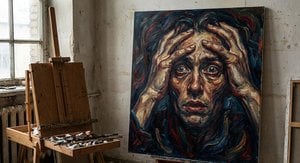
Georges Rouault’s “Spring”: A Chronicle of Human Empathy
Georges Rouault's "Spring," painted in 1911, is far more than a simple depiction of a forest scene; it’s a profound meditation on humanity – its joys, sorrows, and the quiet dignity found within everyday life. Executed with Rouault’s signature style, immediately recognizable for its stark contrasts and emotionally charged palette, this work offers a window into the artist's deeply felt empathy for the marginalized and suffering, a core tenet of his artistic vision. The painting captures a fleeting moment of rural tranquility, yet it resonates with an underlying sense of melancholy and contemplation – qualities that would become hallmarks of Rouault’s oeuvre.
The composition itself is deliberately un-idealized. There are no heroic figures or grand vistas; instead, we encounter three individuals engaged in seemingly simple activities: one seated, another standing attentively, and a third observing from a distance. A dog lies nearby, adding to the sense of domesticity and companionship. Rouault’s masterful use of dark contours – a technique inherited directly from his apprenticeship with stained glass artisans – frames luminous color fields, creating an almost theatrical effect. This layering of light and shadow isn't merely aesthetic; it serves to heighten the emotional impact of each figure, drawing our attention to their individual expressions and postures.
The Roots of Rouault’s Vision: Glass and Spiritual Seeking
Understanding Georges Rouault requires acknowledging his unique artistic journey. Born in the immediate aftermath of the Paris Commune, a period of immense upheaval and violence, Rouault's early life was shaped by hardship and a profound sense of loss. This experience profoundly influenced his worldview, fostering a deep compassion for those less fortunate. His apprenticeship as a glass painter from the age of fourteen proved formative, instilling in him an appreciation for vibrant color and precise execution – skills he would later translate to canvas with remarkable power.
Rouault’s fascination with stained glass extended beyond mere technical skill; it was deeply intertwined with his spiritual seeking. The luminous quality of the glass, its ability to transform light into something ethereal, mirrored his own desire for transcendence. This influence is readily apparent in “Spring,” where the use of dark outlines and intense color fields evokes a sense of sacredness, reminiscent of medieval religious art. His mother’s devout Catholic upbringing further solidified this spiritual connection, shaping his artistic themes and fueling his commitment to portraying the dignity of ordinary people.
Symbolism and Emotional Resonance
While seemingly straightforward, “Spring” is rich in symbolic potential. The figures themselves – a seated individual, perhaps representing contemplation or rest; two standing ones, possibly engaged in conversation or observation – invite interpretation. The dog, a traditional symbol of loyalty and companionship, adds to the painting’s sense of warmth and connection. Rouault wasn't interested in simply recording a scene; he was striving to capture an *emotion*, a feeling of quiet beauty amidst the complexities of human existence.
The muted color palette – dominated by browns, greens, and ochres – contributes significantly to the painting’s melancholic mood. However, strategically placed bursts of brighter hues – particularly in the figures' clothing – draw our eye and emphasize their presence. This careful manipulation of color creates a dynamic tension between darkness and light, reflecting the inherent duality of human experience. “Spring” is not a celebration of springtime itself; it’s an exploration of the human condition—a poignant reminder of life’s fleeting beauty and enduring sorrows.
Vragen & Antwoorden
Wie heeft "Spring" gemaakt?
"Spring" is gemaakt door Georges Rouault. De informatie op deze pagina beschrijft het originele werk van Georges Rouault.
Hoe oud was Georges Rouault toen "Spring" werd gemaakt?
Georges Rouault was 40 jaar oud bij het creëren van "Spring" in 1911. De leeftijd is berekend op basis van het geboortejaar van de kunstenaar, 1871.
Waar staat "Spring" binnen de terugkerende thema's van Georges Rouault?
"Spring" verbeeldt forest scene, figures outdoors, dog companion, rouault style, human interaction, 1911 painting, religious themes, terwijl de bekende thema's van Georges Rouault stained glass influence, catholic faith, marginalized figures, social critique, fauvist color, emotional intensity, spiritual seeking, existential themes zijn. Een vergelijking tussen beide laat zien hoe het werk zich verhoudt tot de gebruikelijke onderwerpen van de kunstenaar.
Hoe past "Spring" binnen de thema's en stijl van Georges Rouault?
Binnen het oeuvre van Georges Rouault past "Spring" binnen de Fauvism-stijl, samen met de thema's van stained glass influence, catholic faith, marginalized figures, social critique, fauvist color, emotional intensity, spiritual seeking, existential themes.
Welke emotie straalt het Fauvism-werk "Spring" uit?
De Nostalgic emotie van "Spring" gaat samen met de Fauvism stijl.
Is "Spring" door Georges Rouault een licht of een donker kunstwerk?
Wat betreft de waargenomen helderheid is "Spring" door Georges Rouault balanced.
Wat is de creatiedatum van "Spring" door Georges Rouault?
"Spring" dateert uit 1911. Deze datum plaatst het werk binnen de carrière van Georges Rouault en de betreffende tijdperk.



 Bekijk op ware grootte
 Koop handgeschilderd kunstwerk
 Verstuur
 Delen
Delen
 Details bekijken
 Gids voor studentenkunstwerken

 Download
 Vergelijkbare items
 Röntgenonderzoek
 Diavoorstelling
 Statistieken

 Lees meer






































 De optie voor glas is alleen beschikbaar bij een formaat kleiner dan 110 cm.