Bekijk op ware grootte Bekijk in AR Schakel over naar print Schakel over naar digitale afbeeldingen Verstuur
Details bekijken Gids voor studentenkunstwerken Toevoegen aan favorieten Download Vergelijkbare items Röntgenonderzoek Diavoorstelling Statistieken

Pedestal Table

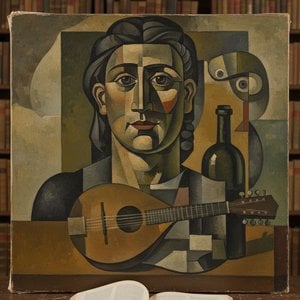
Experience Georges Braque’s ‘Pedestal Table,’ a pivotal 1911 Cubist masterpiece. This hand-painted reproduction captures the artist's innovative use of form and space, showcasing a unique art decoration.

Georges Braque (1882-1963): Pionier van het kubisme & fauvisme. Ontdek zijn baanbrekende kunst, van 'Houses at L'Estaque' tot indrukwekkende collages. Een meester van de moderne kunst!

De kunstwerken die op deze pagina worden weergegeven, zijn beschermd door de auteursrechtwetgeving, wat betekent dat het ons wettelijk niet is toegestaan om identieke reproducties te maken of te verkopen. Deze bescherming wordt gehandhaafd onder internationale overeenkomsten zoals de Conventie van Bern en door nationale wetgeving, waaronder de bepalingen van de Amerikaanse auteurswet - Titel 17. Alle rechten voorbehouden. Reproduceren of distribueren van afbeeldingen is niet toegestaan zonder uitdrukkelijke schriftelijke toestemming van WahooArt.com en de rechthebbenden.

Als een respectvol en legaal alternatief bieden wij op maat gemaakte, handgeschilderde kunstwerken aan die geïnspireerd zijn op het origineel. Onze bekwame en professionele kunstenaars bestuderen zorgvuldig de stijl, sfeer en artistieke essentie van het origineel om een nieuw, uniek werk te creëren dat dezelfde emotie oproept – terwijl het een op zichzelf staande, originele creatie blijft.

Deze methode voldoet volledig aan de auteursrechtwetgeving, omdat het niet gaat om het kopiëren of dupliceren van het beschermde kunstwerk. In plaats daarvan is er sprake van een creatieve herinterpretatie — een nieuw schilderij dat door het origineel wordt geïnspireerd, maar er niet identiek aan is.

Handgemaakte olieverfreproductie

Met de hand geschilderd in olieverf op canvas in uw gewenste maat en lijst, op bestelling gemaakt door onze kunstenaars. ( Schakel over naar print Schakel over naar digitale afbeeldingen)

Corner sample of the P118B picture frame: gegoten polystyreen, 5 cm wide and 3 cm thick
P118B €10
Corner sample of the P118H picture frame: gegoten polystyreen, 5 cm wide and 3 cm thick
P118H €10
Corner sample of the P118W picture frame: gegoten polystyreen, 5 cm wide and 3 cm thick
P118W €10
Corner sample of the P438Z picture frame: gegoten polystyreen, 5.5 cm wide and 3.5 cm thick
P438Z €10
Corner sample of the P508JH picture frame: gegoten polystyreen, 7 cm wide and 3.5 cm thick
P508JH €12
Corner sample of the P508YH picture frame: gegoten polystyreen, 7 cm wide and 3.5 cm thick
P508YH €12
Corner sample of the P805H picture frame: gegoten polystyreen, 5 cm wide and 3.5 cm thick
P805H €10
Corner sample of the P805Z picture frame: gegoten polystyreen, 5 cm wide and 3.5 cm thick
P805Z €10
Corner sample of the P919BZ picture frame: gegoten polystyreen, 7 cm wide and 3.5 cm thick
P919BZ €10
Corner sample of the P919G picture frame: gegoten polystyreen, 7 cm wide and 3.5 cm thick
P919G €10
Corner sample of the P919XJ picture frame: gegoten polystyreen, 7 cm wide and 3.5 cm thick
P919XJ €10
Corner sample of the P959ZH picture frame: gegoten polystyreen, 5 cm wide and 3 cm thick
P959ZH €10
Corner sample of the P968JZ picture frame: gegoten polystyreen, 6 cm wide and 4 cm thick
P968JZ €12
Corner sample of the W106C picture frame: massief hout, 5 cm wide and 3 cm thick
W106C €8
Corner sample of the W218G picture frame: massief hout, 5 cm wide and 3 cm thick
W218G €10
Corner sample of the W218JH picture frame: massief hout, 5 cm wide and 3 cm thick
W218JH €8
Corner sample of the W218Y picture frame: massief hout, 5 cm wide and 3 cm thick
W218Y €10
Corner sample of the W307PJ picture frame: massief hout, 6 cm wide and 3 cm thick
W307PJ €10
Corner sample of the W316G picture frame: massief hout, 6 cm wide and 3 cm thick
W316G €10
Corner sample of the W316PJ picture frame: massief hout, 6 cm wide and 3 cm thick
W316PJ €8
Corner sample of the W316Y picture frame: massief hout, 6 cm wide and 3 cm thick
W316Y €10
Corner sample of the W398PJ picture frame: massief hout, 5 cm wide and 3 cm thick
W398PJ €8
Corner sample of the W4111J picture frame: massief hout, 6.5 cm wide and 3.5 cm thick
W4111J €10
Corner sample of the W500HY picture frame: massief hout, 7 cm wide and 5 cm thick
W500HY €15
Corner sample of the W500JH picture frame: massief hout, 7 cm wide and 5 cm thick
W500JH €15
Corner sample of the W692G picture frame: massief hout, 8 cm wide and 4 cm thick
W692G €12
Corner sample of the W849H picture frame: massief hout, 5 cm wide and 3 cm thick
W849H €8
Corner sample of the W940BG picture frame: massief hout, 7.5 cm wide and 4.5 cm thick
W940BG €15
Corner sample of the W953PJ picture frame: massief hout, 6 cm wide and 3.5 cm thick
W953PJ €8

Standaardformaat
op maat gemaakt
CM
INCH

Kies uit onze vooraf ingestelde maten die overeenkomen met de originele verhoudingen van het kunstwerk.

breedte
hoogte

Voer de breedte en de hoogte in die u nodig heeft, passend bij uw lijst of uw muur. Dit is handgeschilderd, dus bij een afmeting met een andere vormverhouding kan de kunstenaar iets meer rondom het schilderij schilderen of juist iets meer weglaten — u kiest zelf. Wij sturen u een digitaal mockup ter goedkeuring voordat het schilderwerk begint. De afbeelding die op deze pagina wordt getoond, is niet het uiteindelijke resultaat — alleen de mockup geeft dit weer.

Voorbeelden van wat aangepast kan worden: Vervang het gezicht met een eigen foto; Voeg een huisdier toe (bijv. vervang de kat door een hond); Verwerk een verborgen boodschap in de achtergrond; Wijzig het landschap of andere elementen in de achtergrond.
Na de bestelling zal het team van WahooArt.com per e-mail contact opnemen met de klant voor instructies en een mockup-voorbeeld sturen.

Wereldwijde levering () binnen 3 tot 4 weken in plaats van de standaard 5 weken. (23 oktober). Zonder concessies aan de kwaliteit.

Gratis wereldwijde expressverzending
Hoogwaardig linnen canvas
Volledige verzendverzekering
Garantie op terugbetaling van invoerrechten
Garantie op exacte kleurweergave
Retourbeleid van 100 dagen (alleen bij defecten)
100% Geld-terug-garantie
Korting bij meerdere afnames

Totaalprijs

€ 239

Pedestal Table

Reproductiemethode

Formaat reproductie

-

Totaalprijs

€ 239

Belangrijkste kenmerken

  • Artist: Georges Braque
  • Year: 1911
  • Subject or theme: Still life, interior
  • Medium: Painting
  • Dimensions: 116 x 81 cm
  • Notable elements: Horse statue, guitar

Kunstquiz

Er is slechts één goed antwoord op elke vraag.

Vraag 1:
What artistic movement is most closely associated with Georges Braque’s ‘Pedestal Table’?
Vraag 2:
The image depicts a scene featuring a man and a horse statue. What is the primary significance of the pedestal in this composition?
Vraag 3:
Based on the description, what style of art is evident in ‘Pedestal Table’?
Vraag 4:
In the context of Braque's career, what was his early training primarily focused on?

Georges Braque’s ‘Pedestal Table’: A Fragmented World of Form and Perception

Georges Braque's “Pedestal Table,” painted in 1911, is not merely a depiction of an object; it’s a carefully constructed puzzle for the viewer, a window into the nascent world of Analytical Cubism. This work, housed within the Kunstmuseum Basel, immediately captivates with its fragmented forms and deliberate ambiguity, inviting us to actively participate in reconstructing the scene before us. The painting presents a man seated at a table, a horse statue looming in the background, and a sense of contained chaos—a visual embodiment of the era’s shifting perceptions of reality.

Braque's choice of subject matter – a simple pedestal table – is itself significant. Pedestals, as our research reveals (linked here: Wikipedia Search), traditionally elevate and support objects, providing stability and grounding. However, in Braque’s painting, the pedestal becomes a fractured element, dissected and reassembled into geometric planes. This disruption of traditional spatial relationships is a hallmark of Cubism, reflecting a desire to move beyond single viewpoints and represent an object from multiple perspectives simultaneously. The table itself isn't rendered as a solid, unified form; instead, it’s broken down into interlocking facets, suggesting its inherent instability and the subjective nature of observation.

Analytical Cubism: Deconstructing Reality

Painted during the period of Analytical Cubism – roughly 1908-1912 – “Pedestal Table” exemplifies the movement's core principles. This phase, developed in close collaboration with Pablo Picasso, focused on reducing objects to their fundamental geometric components. Braque’s palette is deliberately muted, dominated by browns, ochres, and grays, creating a sense of somberness and introspection. The artist employs a meticulous technique, applying paint in thin, overlapping layers – a characteristic of Analytical Cubism – to build up the complex network of planes and angles that define each element. The use of monochromatic tones further emphasizes the deconstruction of form, stripping away any illusion of depth or three-dimensionality.

Further insight into Braque’s approach can be found in articles like Georges Braque: Pioneering Cubism & the Evolution of Modern Form, which details his experimentation with color and form during this pivotal period. The artist’s meticulous attention to detail, combined with a radical departure from traditional representation, established Analytical Cubism as a groundbreaking movement that profoundly influenced the course of 20th-century art.

Symbolic Layers and Emotional Resonance

Beyond its formal innovations, “Pedestal Table” invites speculation about its symbolic meaning. The presence of the horse statue, a recurring motif in Braque’s work (linked here: Wikipedia Search), could represent power, strength, or even vulnerability – themes often explored within the context of the era's social and political landscape. The guitar held by the seated figure might symbolize creativity, contemplation, or perhaps a moment of quiet reflection amidst the intellectual ferment of Parisian artistic circles. The inclusion of books and letters suggests an engagement with knowledge, ideas, and communication—elements central to the burgeoning modern world.

Despite its fragmented composition, “Pedestal Table” evokes a sense of contained energy and subtle drama. The interplay of light and shadow, combined with the carefully arranged planes, creates a visual rhythm that draws the eye across the canvas. It’s a painting that rewards careful observation, inviting us to decipher its complex layers of meaning and appreciate Braque's masterful manipulation of form and space. Reproductions of this work, like our high-quality hand-painted versions (viewable here: Pedestal Table, Kunstmuseum Basel and Pedestal Table 1), offer a unique opportunity to experience the power and beauty of this seminal Cubist masterpiece in your own home.

A Collector’s Perspective: Braque's Legacy

Georges Braque (1882-1963) remains one of the most influential figures in modern art. His contributions to Cubism, alongside Picasso, fundamentally altered our understanding of representation and paved the way for subsequent artistic movements. Exploring his oeuvre – from iconic works like “Houses at L’Estaque” (Georges Braque) – reveals a sustained commitment to experimentation, innovation, and a profound engagement with the complexities of the modern world. Investing in a reproduction of "Pedestal Table" is not simply acquiring an image; it’s connecting with a pivotal moment in art history and celebrating the genius of a true visionary.

Vragen & Antwoorden

Hoe verbindt "Pedestal Table" door Georges Braque Analytical Cubism met het geboorteland van de kunstenaar?

"Pedestal Table" werd gecreëerd door Georges Braque, geboren in Frankrijk, binnen de Analytical Cubism-stroming. De herkomst van de kunstenaar verbindt het werk met Analytical Cubism, zoals beoefend door kunstenaars uit Frankrijk.

Wat is de luminantie van "Pedestal Table" door Georges Braque?

"Pedestal Table" door Georges Braque heeft een luminantie van Gentle Luminance. Luminantie beschrijft hoeveel licht de kleuren lijken te reflecteren.

Is "Pedestal Table" door Georges Braque een schilderij, een tekening of een prent?

In de catalogus is "Pedestal Table" door Georges Braque geclassificeerd als WallArt. De categorie helpt bij het vinden van vergelijkbare werken.


Biografie van de kunstenaar

Early Life and Artistic Foundations

Georges Braque, geboren in Argenteuil, Frankrijk, in 1882, begon een pad die diep verweven was met het evoluerende landschap van moderne kunst. Zijn opvoeding binnen een familie van huismeubelmakkers en -afwerkingen stelde hem niet alleen in staat tot technische meesterschap van materialen, maar ook tot een vroeg begrip voor vorm en structuur. Hoewel hij aanvankelijk volgde in zijn vader’s voetsporen, leidde Braque's inherente artistieke neigingen al snel tot formele opleiding aan de École des Beaux-Arts in Le Havre, waarmee hij begon aan zijn reis om een van de meest invloedrijke schilders van de 20e eeuw te worden. Deze basis—een combinatie van praktisch vakmanschap en academische studie—zou cruciaal blijken te zijn wanneer hij later traditionele artistieke conventies ontbond en herinterpreteerde.

Verhuisd naar Parijs in 1902, bleef Braque zijn studies voortzetten aan de Académie Humbert, waarbij hij zich onderdompelde in het levendige kunstenaarsmilieu van de stad. Daar ontmoette hij kunstenaars zoals Marie Laurencin en Francis Picabia, waardoor hij connecties vormde die zijn vroege ontwikkeling zouden beïnvloeden. Zijn eerste werken weerspiegelden de invloed van Impressionisme en Post-Impressionisme, maar een cruciale ontmoeting met de felle kleuren en expressieve vrijheid van Fauvisme in 1905 ontketende een nieuwe richting in zijn artistieke exploratie.

De Omarming van Fauvisme en het Ontstaan van Cubisme

Braque's adoptie van Fauvist principes— gekenmerkt door intense, niet-realistische kleuren en emotionele expressie—wordt levendig verbeeld in schilderijen zoals The Patience. Deze periode zag hem werken met kunstenaars als Henri Matisse en André Derain, waarbij ze experimenteerden met levendige paletten en gestroomlijnde vormen. Echter, Braque's betrokkenheid bij Fauvisme was niet alleen imitatie; hij infuseerde het met een unieke gevoeligheid, temperde de beweging’s ongebreidelde uitbarsting met een meer ingetogen en analytische benadering.

Een keerpunt kwam in 1907, toen hij werd blootgesteld aan de retrospectieve expositie van het werk van Paul Cézanne. Cézanne's nadruk op geometrische vormen en meerdere perspectieven had een diepe impact op Braque, waardoor de weg vrijkwam voor zijn baanbrekende samenwerking met Pablo Picasso. Vanaf 1908 begonnen deze twee artistieke titanen een periode van intens intellectueel uitwisselen die de geboorte gaf aan Cubisme—een revolutionaire beweging die traditionele concepties van representatie verstoorde.

Samen ontwikkelden Braque en Picasso Analytisch Cubisme, waarbij objecten werden ontbonden in fragmentarische geometrische vormen en vanuit meerdere perspectieven tegelijkertijd werden gepresenteerd. Schilderijen zoals Houses at L'Estaque tonen deze vroege fase, die een radicale afwijking van conventioneel perspectief en een focus op de onderliggende structuur van vormen laat zien.

Innovatie door Fragmentatie en Collage

De partnerschap tussen Braque en Picasso ging echter door met het uitbreiden van de grenzen van artistieke expressie, wat leidde tot de ontwikkeling van Synthetisch Cubisme rond 1912. Deze fase zag de introductie van collage—het integreren van real-world materialen zoals krantenknipsels, wallpaper en stof in schilderijen. Deze innovatie daagde de traditionele hiërarchie tussen schilderkunst en beeldhouwkunst uit, waardoor de lijnen tussen kunst en leven vervaagd werden.

Braque's pioniersgebruik van *papier collé* (geplakt papier) markeerde een significante verschuiving in zijn artistieke evolutie. Door fragmenten van alledaagse objecten in zijn composities te integreren, verstoorde hij de illusievolle ruimte van traditionele schilderkunst en introduceerde hij een nieuw niveau van materialiteit en textuur. Deze techniek breidde niet alleen de formele mogelijkheden van kunst uit, maar weerspiegelde ook een groeiend belang voor de relatie tussen representatie en realiteit.

Later Jaren en Erfgoed

Na de oorlog evolueerde Braque's stijl verder dan de strikte grenzen van Cubisme, waarbij elementen van klassieke compositie werden opgenomen en een hernieuwde interesse werd gewekt voor stillevens. Hoewel hij de geometrische invloeden behield die zijn vroege werk hadden gedefinieerd, ontwikkelde hij een meer genuanceerde en contemplatieve benadering van schilderen. Zijn latere landschappen en interieurs worden gekenmerkt door hun serene sfeer en subtiele harmonieën van kleur.

Door zijn hele carrière bleef Braque toegewijd aan het verkennen van de fundamentele principes van vorm, ruimte en representatie. Hij experimenteerde voortdurend met verschillende materialen en technieken, waardoor de grenzen van artistieke expressie werden verlegd tot zijn dood in 1963. Zijn invloed op latere generaties kunstenaars is onbetaalbaar, waardoor de loop van moderne kunst werd gevormd en talloze schilders, beeldhouwers en collagisten inspireerde.

Braque's nalatenschap strekt zich verder uit dan zijn individuele werken; hij veranderde fundamenteel ons begrip van hoe we de wereld om ons heen waarnemen en representeren. Zijn partnerschap met Picasso, gecombineerd met zijn eigen unieke artistieke visie, zette hem op een vaste plaats in de kunstgeschiedenis—een meester die durfde conventies uit te dagen en de mogelijkheden van schilderkunst opnieuw te definiëren.

Invloeden en Bekende Werken

  • Invloedrijke personen: Henri Matisse, André Derain, Paul Cézanne
  • Belangrijk werk: Houses at L'Estaque, The Patience, Violin and Palette, Mandola
  • Impact op de kunstgeschiedenis: Revolutioneerde de 20e-eeuwse kunst door Cubisme; daagde traditionele concepties van perspectief en representatie uit.
Georges Braque

Georges Braque

1882 - 1963 , Frankrijk

Snelle feiten

  • Artistic Movement Or Style: Cubisme, Fauvisme
  • Artists Or Movements Influenced By This Artist:
    • Picasso
    • Modern Kunst
  • Artists Who Influenced This Artist:
    • Matisse
    • Derain
    • Cézanne
  • Date Of Birth: 13 mei 1882
  • Date Of Death: 31 augustus 1963
  • Full Name: Georges Braque
  • Nationality: Frans
  • Notable Artworks:
    • Houses L'Estaque
    • Patience
    • Violin Palette
  • Place Of Birth: Argenteuil, Frankrijk
Ontdek kunstwerken georganiseerd op thema, stijl en kenmerk.