Ontvang een bestand dat klaar is voor drukwerk en de kwaliteit van het online voorbeeld ver overstijgt. Elke digitale afbeelding die wij verkopen, is afkomstig van een high-resolution master uit onze database — meestal tussen de 5.000 en 15.000 pixels breed — zodat u met vertrouwen groot kunt afdrukken, nauwkeurig kunt bijsnijden of fijne details kunt reproduceren.
Geen enkel bestand verlaat ons atelier onbewerkt. Een digitaal expert controleert de kleuren aan de hand van het originele schilderij en corrigeert deze indien nodig, om vervolgens de helderheid en details te verbeteren met professionele retoucheertechnieken — waarbij de penseelstreek en stijl van de kunstenaar altijd strikt worden gerespecteerd. Het resultaat is een afbeelding die oogt als het schilderij zelf, en niet als een gescande foto met een filter.
U keurt goed voordat het proces wordt afgerond: onze expert stuurt de afbeelding binnen 72 uur per e-mail naar u toe ter beoordeling. Niet tevreden? Vraag om verbeteringen of correcties, of vraag een terugbetaling aan als de kwaliteit niet voldoet.
Dit is de kwaliteit waarop uitgevers, designstudio's, galeries en drukkerijen vertrouwen.

Download een bestand met hoge resolutie voor persoonlijke weergave, afdrukken en creatieve projecten. ( Schakel over naar print
Bestel handgeschilderde reproductie)
Wanneer u kiest voor WahooArt.com, ontvangt u niet alleen een afbeelding – u krijgt een professioneel verbeterd digitaal kunstwerk, met precisie vervaardigd en voorzien van een tevredenheidsgarantie. Dit is alles wat automatisch bij uw bestelling is inbegrepen:
Uw hoogwaardige digitale afbeeldingsbestand wordt binnen 72 uur na bestelling naar u gemaild – klaar voor direct gebruik.
Uw kunstwerk wordt professioneel geoptimaliseerd met behulp van geavanceerde AI-tools en handmatige bewerkingen, waardoor maximale details, helderheid en kleurnauwkeurigheid worden gegarandeerd.
Je bestand per ongeluk verwijderd of kwijtgeraakt? Geen zorgen – we sturen het u op elk gewenst moment gratis opnieuw toe.
Geniet direct van uw kunstwerk zonder invoerrechten, belastingen of verzendkosten – digitale downloads zijn altijd belastingvrij.
Met behulp van professionele hulpmiddelen en kleurbeheer zorgen wij ervoor dat uw digitale afbeelding de originele kleuren zo nauwkeurig mogelijk weergeeft.
Mocht u niet tevreden zijn met uw digitale afbeelding, dan passen wij deze aan of storten wij 100% terug binnen 100 dagen – zonder vragen te stellen.
Niet tevreden? Ontvang een volledige terugbetaling binnen 100 dagen na ontvangst van uw digitale bestand – zonder vragen te stellen.
Koop 3 afbeeldingen, bespaar 10% - Koop 5, bespaar 15% - Koop 10+, bespaar 20%. Ideaal voor creatieve projecten, galerieën en bureaus.
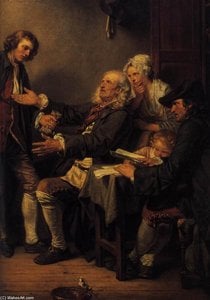
To stand before La Rixe is to be immediately drawn into the vibrant heart of human interaction—a moment suspended between jest and genuine discord. The title itself, translating simply as 'The Quarrel,' suggests a volatile energy barely contained within the canvas. Yet, what captivates the modern viewer is not merely the conflict, but the exquisite refinement with which it is rendered. This scene pulses with the characteristic spirit of the Rococo period; an era that celebrated life’s pleasures and social intricacies, even when those interactions devolved into spirited debate or outright dispute. The composition masterfully clusters three central figures in a dynamic tableau, their proximity suggesting both intimacy and palpable tension.
Technically, the painting is a rich testament to oil on canvas mastery. One observes the signature softness of the Rococo style—the flowing lines defining the voluminous drapery and the delicate gestures of the figures’ hands. The artist has employed a palette dominated by warm, earthy tones—deep reds, sunlit yellows, and rich browns—which imbue the scene with an almost feverish vibrancy. These warmth are beautifully counterpointed by cooler accents of blue and grey in the garments, providing necessary visual rest points for the eye. The light itself is diffused, bathing the group in a soft glow that sculpts the faces and highlights the luxurious textures of their elaborate attire, allowing the viewer to appreciate every fold of silk and every subtle expression.
The hand that painted this work belongs to Gaspare Traversi, an artist whose career blossomed in Naples during a period of profound artistic transition. While the Rococo aesthetic speaks of aristocratic leisure, Traversi’s training under masters influenced by Caravaggism lends an unexpected dramatic weight to the scene. This fusion is key: the lightness and grace expected of Rococo portraiture are grounded by a sense of narrative immediacy, a touch of Baroque drama that prevents the quarrel from feeling merely frivolous. It speaks to a society both deeply concerned with outward appearance—the finery of their clothes—and intensely invested in the power dynamics played out among its members.
For those who collect art not just for beauty, but for narrative depth, La Rixe offers a compelling meditation on social status and conflict. The elaborate clothing is more than mere decoration; it functions as a visual marker of rank within an imagined aristocratic sphere. The overlapping figures and the use of linear perspective draw the viewer into the very vortex of their disagreement, making one feel like an unseen observer privy to a private moment of high drama. Reproducing this piece allows one to bring not just a painting, but a carefully curated atmosphere—an echo of sophisticated, passionate human exchange—into a modern interior space.
Formaat (Landscape) en aanbevolen ruimte (Lounge) zijn de twee plaatsingskenmerken vastgelegd voor "LA RIXE" door Gaspare Traversi.
"LA RIXE" deelt met andere werken van Gaspare Traversi de Rococo-stijl en de terugkerende thema's: caravaggist realism & drama, social satire & critique, religious fervor & allegory, genre art, venetian tradition, artist's signature style.
De röntgenweergave van "LA RIXE" door Gaspare Traversi is te vinden op de Röntgenanalyse-pagina van het kunstwerk: een interactieve verkenning van het beeld door middel van elf optische lagen.
1722 - 1770 , Italië