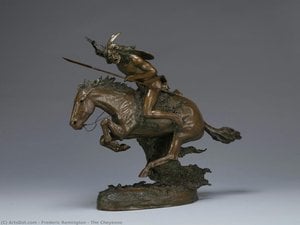
A Chronicler of the Vanishing West: The Life and Art of Frederic Remington
Frederic Sackrider Remington, geboren in Canton, New York, op 4 oktober 1861, was geen product van de Wilde Westen die hij zo levendig weergaf; eerder was hij een Easterner die zijn artistieke identiteit vormde door fascinatie en toewijding aan studie. Zijn afkomst wees op een leven ver verwijderd van stoffige paden en cavalerie-aanvallen – Franse Baskische afstamming vermengd met staunch Republikeinse New England wortels, een vader die een oorlogskolonel en krantenuitgever was, en connecties tot de beroemde Remington Arms dynastie via verre verwanten. Toch was het een vroege blootstelling aan militaire thema’s, gekoppeld aan een levendige geest en een scherp oog voor storytelling, dat hem op weg stelde naar het worden van misschien wel de meest herkenbare kunstenaar van het Amerikaanse Westen. Zijn jeugd verplaatste zich naar Bloomington, Illinois, vervolgens terug naar Canton en uiteindelijk Ogdensburg, New York, maar zijn verbeelding bleef gefascineerd door verhalen over het leven aan de grens. Hoewel hij aanvankelijk werd geleid naar een militaire opleiding op Vermont Episcopal Institute, was Remington’s ware roeping niet in bevelen te volgen, maar in het observeren en interpreteren van de wereld om hem heen door kunst. Een kort verblijf aan Yale Universiteit bevestigde dit; voetbal en schetsen hadden veel meer aantrekkingskracht dan formele academische bezigheden.
Van Illustrator naar Schilder: Het Vormgeven van een Artistieke Visie
Remingtons artistieke reis begon niet met grote doeken, maar met inkt en papier. Zijn eerste gepubliceerde werk, een cartoon voor de *Yale Courant*, signaleerde een vroege aanleg voor het vastleggen van actie en narratief. Een cruciale reis naar Montana in 1881 ontketende zijn levenslange obsessie met het Westen. Dit was niet zomaar een toeristenblik; Remington zocht immers om zich te verdiepen in de cultuur, door cowboys, Native Americans en het landschap zelf te observeren. In eerste instantie probeerde hij ranching en mijnbouw ondernemingen, maar deze bleken onsuccesvol, waardoor hij zich volledig kon wijden aan kunst. Terugkeer naar het Oosten vestigde hij zich snel als een getalenteerd illustrator voor tijdschriften zoals *Harper’s Weekly* en *Collier’s*, zijn dynamische beelden van Westerse scènes troffen een nationaal publiek die hunkerde naar verhalen over de grens. Deze illustraties waren niet simpelweg rapportage; ze waren doordrenkt van drama, energie en een romantisch beeld van het Westen dat diep resoneren met de collectieve verbeelding. Door dit werk perfectioneerde hij zijn vaardigheden in compositie, het vastleggen van beweging en het overbrengen van emotie – kwaliteiten die later zijn schilderijen zouden definiëren. Hij ontving weinig formele training buiten enkele tekenlessen aan Yale en een korte periode aan de Art Students League, ontwikkelde daarentegen een kenmerkende stijl gekenmerkt door energiek penseelwerk, felle kleuren en een focus op realisme vermengd met dramatische flair.
Het Vangen van een Verdwijnend Wereld: Thema’s en Stijl
Remingtons kunst is onlosmakelijk verbonden aan een specifiek moment in de Amerikaanse geschiedenis – het verval van het Wilde Westen. Zijn doeken zijn bevolkt door iconische figuren: ruige cowboys die vee drijven, stoïcijnse Native Americans die worden verplaatst en Amerikaanse cavalerie soldaten die betrokken zijn bij zowel heroïsche veldslagen als tragische conflicten. Hij schuwde het niet om de harde realiteit van het leven aan de grens te portretteren, maar zijn werk neigt vaak naar een romantisch beeld, waarbij moed, avontuur en de botsing van culturen worden benadrukt.
Zijn schilderijen zijn niet simpelweg historische documenten; ze zijn evocatieve verhalen die verkennen thema’s als heldendom, verlies en de onvermijdelijke vooruitgang. Remington’s stijl evolueerde in de loop der jaren, van strakkere, meer academische weergaven naar losser, expressiever penseelwerk. Hij was een meester in het vastleggen van beweging – paarden die over de vlaktes galopperen, cowboys die koeien worstelen en soldaten die in aanval gaan.
Hij maakte vaak gebruik van snelle schetsen en foto’s als referentiemateriaal, maar zijn kunst ging verder dan simpelweg imitatie, doordrenkt met zijn eigen unieke visie en emotionele intensiteit. Bekende werken zoals *My Ranch*, *Waiting in the Moonlight*, *Ridden Down* (1905) en *The Long-Horn Cattle Sign* (1908) illustreren zijn vermogen om zowel de grandeur als de kwetsbaarheid van het Amerikaanse Westen vast te leggen.
Een Erfgoed en Een Duurzaam Beïnvloeden
Frederic Remington overleed onverwacht in 1909 op 48 jarige leeftijd, waardoor een uitgebreide oeuvre achterblijft dat vandaag de dag nog steeds publiek aantrekt. Zijn impact op de Westerse kunst is onmiskenbaar; hij heeft niet alleen het Westen weergegeven, maar ook *gedefinieerd* voor generaties Amerikanen. Hij vestigde een visuele taal voor de grens – een iconografie van cowboys, Indianen en cavalerie-mannen die diep geworteld raakten in het populaire bewustzijn.
- Zijn werk inspireerde talloze andere kunstenaars, waaronder N.C. Wyeth en Zane Grey.
- Het Frederic Remington Art Museum in Ogdensburg, New York, staat als een getuigenis van zijn blijvende nalatenschap, waarbij een uitgebrewe collectie van zijn schilderijen, sculpturen en archiefmateriaal wordt bewaard.
- Zijn kunst wordt voortdurend tentoongesteld in belangrijke musea in het land, waaronder het Metropolitan Museum of Art en het Amon Carter Museum of American Art.
Remington’s weergaven, hoewel soms bekritiseerd voor hun romantische portrettering van het Westen, bieden een waardevolle blik op een cruciaal moment in de Amerikaanse geschiedenis. Hij heeft niet alleen wat *was*, maar ook wat mensen *geloofden* over het Westen – zijn mythen, zijn legendes en zijn blijvende aantrekkingskracht. Hij blijft een krachtig symbool van de Amerikaanse geest—een chroniqueur van een verdwijnend wereld die het tot een blijvend artistiek erfgoed heeft verheven.



 Bestel handgeschilderde reproductie
 Verstuur
 Delen
Delen
 Details bekijken
 Gids
Gids

 Download
 Vergelijkbare items
 Diavoorstelling
 Q&A
Q&A Statistieken


 Lees meer






































 De optie voor glas is alleen beschikbaar bij een formaat kleiner dan 110 cm.