Bekijk op ware grootte Bekijk in AR Koop handgeschilderd kunstwerk Schakel over naar digitale afbeeldingen Verstuur
Details bekijken Gids voor studentenkunstwerken Toevoegen aan favorieten Download Vergelijkbare items Röntgenonderzoek Diavoorstelling Statistieken

Tiger

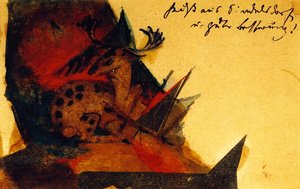
Experience the raw emotion of Franz Marc's 'Tiger,' a powerful woodcut capturing the spirit of nature through bold lines and monochromatic hues. A masterpiece of Expressionism, reflecting harmony & introspection.

Franz Marc (1880-1916): Een Duitse expressionist die met kleur en spiritualiteit de essentie van het dierenrijk vastlegde. Ontdek zijn iconische werken & de 'Blue Rider' beweging!

Giclée / Kunstafdrukken

Giclée- of canvasafdruk van museumkwaliteit met een snelle productie en flexibele afwerkingsmogelijkheden. ( Koop handgeschilderd kunstwerk Schakel over naar digitale afbeeldingen)

Corner sample of the P118B picture frame: moulded polystyrene, 5 cm wide and 3 cm thick
P118B €10
Corner sample of the P118H picture frame: moulded polystyrene, 5 cm wide and 3 cm thick
P118H €10
Corner sample of the P118W picture frame: moulded polystyrene, 5 cm wide and 3 cm thick
P118W €10
Corner sample of the P438Z picture frame: moulded polystyrene, 5.5 cm wide and 3.5 cm thick
P438Z €10
Corner sample of the P508JH picture frame: moulded polystyrene, 7 cm wide and 3.5 cm thick
P508JH €12
Corner sample of the P508YH picture frame: moulded polystyrene, 7 cm wide and 3.5 cm thick
P508YH €12
Corner sample of the P805H picture frame: moulded polystyrene, 5 cm wide and 3.5 cm thick
P805H €10
Corner sample of the P805Z picture frame: moulded polystyrene, 5 cm wide and 3.5 cm thick
P805Z €10
Corner sample of the P919BZ picture frame: moulded polystyrene, 7 cm wide and 3.5 cm thick
P919BZ €10
Corner sample of the P919G picture frame: moulded polystyrene, 7 cm wide and 3.5 cm thick
P919G €10
Corner sample of the P919XJ picture frame: moulded polystyrene, 7 cm wide and 3.5 cm thick
P919XJ €10
Corner sample of the P959ZH picture frame: moulded polystyrene, 5 cm wide and 3 cm thick
P959ZH €10
Corner sample of the P968JZ picture frame: moulded polystyrene, 6 cm wide and 4 cm thick
P968JZ €12
Corner sample of the W106C picture frame: solid wood, 5 cm wide and 3 cm thick
W106C €8
Corner sample of the W218G picture frame: solid wood, 5 cm wide and 3 cm thick
W218G €10
Corner sample of the W218JH picture frame: solid wood, 5 cm wide and 3 cm thick
W218JH €8
Corner sample of the W218Y picture frame: solid wood, 5 cm wide and 3 cm thick
W218Y €10
Corner sample of the W307PJ picture frame: solid wood, 6 cm wide and 3 cm thick
W307PJ €10
Corner sample of the W316G picture frame: solid wood, 6 cm wide and 3 cm thick
W316G €10
Corner sample of the W316PJ picture frame: solid wood, 6 cm wide and 3 cm thick
W316PJ €8
Corner sample of the W316Y picture frame: solid wood, 6 cm wide and 3 cm thick
W316Y €10
Corner sample of the W398PJ picture frame: solid wood, 5 cm wide and 3 cm thick
W398PJ €8
Corner sample of the W4111J picture frame: solid wood, 6.5 cm wide and 3.5 cm thick
W4111J €10
Corner sample of the W500HY picture frame: solid wood, 7 cm wide and 5 cm thick
W500HY €15
Corner sample of the W500JH picture frame: solid wood, 7 cm wide and 5 cm thick
W500JH €15
Corner sample of the W692G picture frame: solid wood, 8 cm wide and 4 cm thick
W692G €12
Corner sample of the W849H picture frame: solid wood, 5 cm wide and 3 cm thick
W849H €8
Corner sample of the W940BG picture frame: solid wood, 7.5 cm wide and 4.5 cm thick
W940BG €15
Corner sample of the W953PJ picture frame: solid wood, 6 cm wide and 3.5 cm thick
W953PJ €8

Standaardformaat
op maat gemaakt
CM
INCH

Kies uit onze vooraf ingestelde maten die overeenkomen met de originele verhoudingen van het kunstwerk.

breedte
hoogte

U kunt uw eigen afmetingen opgeven om in een specifieke lijst of ruimte te passen. Als de door u gekozen maat niet overeenkomt met de proporties van het originele kunstwerk, zullen wij de afbeelding bijsnijden of uitbreiden met een gespiegelde of effen rand. Een digitaal mockup wordt ter goedkeuring naar u verzonden voordat de productie begint.
Houd er rekening mee dat de preview op het scherm de werkelijke bijsneding of uitbreiding niet weergeeft. Alleen de mockup toont de uiteindelijke compositie nauwkeurig.
Hoewel aangepaste maten beschikbaar zijn, raden wij aan een afmeting uit de vooraf bepaalde lijst te kiezen om de originele proporties te behouden.

Wereldwijde levering () binnen 2 weken in plaats van de standaard 4/5 weken. (10 oktober)

Gratis wereldwijde expressverzending
Hoogwaardig linnen canvas
Volledige verzendverzekering
Garantie op terugbetaling van invoerrechten
Garantie op exacte kleurweergave
Retourbeleid van 100 dagen (alleen bij defecten)
100% Geld-terug-garantie
Korting bij meerdere afnames

Totaalprijs

€ 59

Tiger

Giclée / Kunstafdrukken

Formaat reproductie

-

Totaalprijs

€ 59

Belangrijkste kenmerken

  • Influences: Van Gogh
  • Artist: Franz Marc
  • Artistic style: Abstracted & Stylized
  • Dimensions: 33 x 30 cm
  • Medium: Woodcut Print
  • Subject or theme: Wildlife & Nature

A Vision of the Wild: Unpacking Franz Marc's "Tiger"

Franz Marc’s “Tiger,” a striking woodcut print from 1912, isn’t merely a depiction of an animal; it’s a profound meditation on the interconnectedness of nature and the spiritual realm. Created during a period of intense personal and artistic exploration for the German Expressionist painter, this work embodies Marc's lifelong fascination with animals as symbols of primal instinct, intuition, and ultimately, a connection to something larger than the human ego. The image immediately commands attention – a powerful, almost overwhelming presence of the tiger rendered in stark black ink against a subtly textured cream-colored background. It’s a visual statement that transcends simple representation, inviting viewers into a world where form and feeling are inextricably linked.

The Language of Line: Technique and Craftsmanship

Marc's mastery lies in his deliberate manipulation of line – a defining characteristic of woodcut printing. The bold, graphic lines delineate the tiger’s muscular form with an almost brutal honesty, yet they are simultaneously softened by the artist’s expressive hand. Notice how he employs hatching and cross-hatching to suggest texture and volume, creating a sense of depth without relying on traditional shading techniques. This technique isn't about replicating reality; it’s about conveying the *essence* of the tiger – its power, its wildness, its vital energy – through the controlled application of line. The deliberate flatness of the image, a consequence of the woodcut process, contributes to a feeling of immediacy and raw emotion, pulling the viewer directly into the heart of the scene.

Symbolism in Monochrome: Nature, Spirit, and the Animal Kingdom

“Tiger” is deeply rooted in Marc’s spiritual beliefs. He viewed animals as embodiments of divine qualities – courage, strength, instinct, and a connection to the earth. The tiger itself represents primal energy, untamed spirit, and the forces of nature. The surrounding elements—birds circling overhead, a snake slithering through the undergrowth—further amplify this symbolism, creating a microcosm of the natural world teeming with life and interconnectedness. Marc’s choice of monochrome – black ink on cream paper – is crucial to understanding the work's emotional impact. It strips away any distractions, focusing solely on form, line, and the inherent drama of the subject matter. The limited palette evokes a sense of timelessness and universality, suggesting that this primal scene transcends specific time or place.

A Window into the Soul: Marc’s Expressionist Vision

“Tiger” is a quintessential example of German Expressionism, a movement characterized by its subjective interpretation of reality and its emphasis on emotional expression. Unlike academic art that sought to represent the world accurately, Expressionists aimed to convey their inner feelings and perceptions through distorted forms, jarring colors (though Marc’s work avoids color), and emotionally charged imagery. Marc's exploration of spirituality within his art is a hallmark of this movement. He wasn’t interested in simply depicting a tiger; he was trying to capture its *spirit*, its essence – the feeling it evokes within him. The image resonates with a sense of both power and vulnerability, reflecting Marc’s own complex relationship with nature and the human condition. It's a work that invites contemplation, prompting viewers to consider their own connection to the natural world and the deeper mysteries of existence.

Vragen & Antwoorden

Waar kan ik het originele werk "Tiger" door Franz Marc bewonderen?

Het originele werk "Tiger" is te bewonderen in Franz Marc Museum, Kochel am See, Duitsland.

Is "Tiger" gebleven in het geboorteland van de kunstenaar?

Ja - het kunstwerk wordt bewaard in het land van herkomst van de kunstenaar. De maker werd geboren in Duitsland; het originele werk bevindt zich in Duitsland.

Hoe kan ik een print van "Tiger" door Franz Marc verkrijgen?

Een print van "Tiger" door Franz Marc kan rechtstreeks worden besteld op deze pagina: een fine art print op katoenen canvas of archiefwaardig canvaspapier.

Tot welke periode in de carrière van Franz Marc behoort "Tiger"?

"Tiger" vertegenwoordigt de Mature Period van Franz Marc.

Welke stemming straalt "Tiger" door Franz Marc uit binnen German Expressionism?

"Tiger" draagt een Spiritual emotionele toon in zich binnen de German Expressionism-stroming."

Waar kan ik een handgeschilderde reproductie van "Tiger" door Franz Marc kopen?

"Tiger" is verkrijgbaar als een met de hand geschilderde olieverfreproductie op linnen canvas. De bestelling kan worden geplaatst via deze pagina, met een keuze uit verschillende formaten.

Wie heeft "Tiger" gemaakt?

"Tiger" is gemaakt door Franz Marc. De informatie op deze pagina beschrijft het originele werk van Franz Marc.


Biografie van de kunstenaar

A Life Immersed in Color and Spirit

Franz Moritz Wilhelm Marc, geboren in München im Jahr 1880, war ein Maler, dessen kurzer, aber intensiv fokussierter Werdegang die Entwicklung der deutschen Expressionismus grundlegend veränderte. Seine Geschichte ist eine von tiefem spirituellem Streben, das sich in einer lebendigen visuellen Sprache manifestierte – eine Suche nach dem Wesen des Lebens durch die Reinheit, die er in der Natur fand, insbesondere im Reich der Tiere. Zunächst beeinflusst von seinem Vater, Wilhelm Marc, einem Landschaftsmaler, war Franz’ künstlerischer Weg zunächst unsicher. Er erwog kurz Theologie und grübelte über Glaubensfragen und Existenz, bevor er sich schließlich dem Kunststudium an der Akademie der Bildenden Künste in München widmete. Diese frühen religiösen Erkundungen blieben tief in seinem Werk verankert und prägten seine Überzeugung, dass Kunst ein Mittel zur spirituellen Erfahrung sein könne. Seine akademische Ausbildung vermittelte ihm technische Grundlagen, aber Begegnungen mit den Werken von Vincent van Gogh während Besuchen in Paris entfachten seine künstlerische Vision wirklich. Van Goghs emotionale Verwendung von Farbe und rohe Ausdruckskraft berührten Marc tief, befreiten ihn von konventionellen Techniken und legten den Grundstein für einen subjektiveren und emotional aufgeladenen Stil.

Der Blaue Reiter und Eine Neue Künstlerische Vision

Marcs künstlerische Entwicklung war nicht isoliert; sie blühte im dynamischen Kontext des frühen 20. Jahrhunderts in München auf. Er experimentierte mit verschiedenen Künstlergruppen, darunter die Neue Künstlervereinigung München, bevor er 1911 zusammen mit Wassily Kandinsky die *Blaue Reiter* (Der Blaue Reiter) gründete. Dies war nicht nur eine Gruppe oder eine Ausstellungsserie; es war eine philosophische und künstlerische Revolution. Der *Blaue Reiter* strebte danach, über bloße Repräsentation hinauszugehen und stattdessen innere spirituelle Wahrheiten durch Abstraktion und symbolische Farbe auszudrücken. Das gleichnamige Journal diente als Plattform zur Verbreitung dieser Ideen und präsentierte nicht nur ihre eigenen Werke, sondern auch die von anderen zukunftsweisenden Künstlern und erforschte vielfältige kulturelle Einflüsse aus Volkskunst bis hin zu primitiver Skulptur. Marcs Beiträge in dieser Zeit waren entscheidend. Er ging über die Darstellung von Landschaften als statische Szenen hinaus und konzentrierte sich stattdessen auf Tiere – Pferde, Rehe, Füchse – als Träger spiritueller Energie. Diese waren nicht nur Tierporträts; sie waren symbolische Darstellungen von Unschuld, Harmonie und einer Verbindung zur Natur, die die Menschheit durch gesellschaftliche Zwänge und intellektuelle Beschäftigung verloren hatte. Der Einfluss von Robert Delaunay’s Erforschung abstrakter Formen und lebhafter Farben trieb Marc weiter in die Vereinfachung und verstärkte emotionale Ausdruckskraft in seinem Werk voran. Gemälde wie *Der Tiger* (1912) und *Rotfuchs* (1912) veranschaulichen diese Verschiebung und zeigen mutige Farbwahl und einen zunehmenden Fokus auf die inhärenten Qualitäten seiner Sujets, anstatt auf realistische Darstellung.

Symbolik, Farbe und das Wesen des Seins

Marcs künstlerischer Stil ist sofort erkennbar durch seine charakteristische Verwendung von Farbe und Form. Er setzte Farbe nicht deskriptiv ein; stattdessen erfüllte er sie mit symbolischer Bedeutung. Blau stand für Spiritualität und Männlichkeit, Gelb für Freude und Weiblichkeit, und Rot für Gewalt und Materie. Diese Entscheidungen waren nicht willkürlich, sondern ein sorgfältig konstruiertes System, das darauf abzielte, spezifische emotionale und philosophische Ideen zu vermitteln. Seine Tiere sind nicht nur Sujets; sie sind Verkörperungen dieser Konzepte. Die Vereinfachung von Formen – Figuren auf ihre wesentlichen Formen reduziert – betonte die zugrunde liegende spirituelle Essenz, die er einfangen wollte. *Der Turm der blauen Pferde* (1913), das Gemälde wurde während des Ersten Weltkriegs verloren, ist vielleicht das ikonischste Beispiel für diesen Ansatz und eine kraftvolle und eindringliche Komposition, die seine künstlerische Vision verkörpert. Er glaubte, dass Tiere eine inhärente Reinheit und Verbindung zur Natur besaßen, die die Menschheit durch gesellschaftliche Zwänge und intellektuelle Beschäftigung verloren hatte. Indem er sie mit so großer Ehrfurcht und symbolischer Bedeutung darstellte, versuchte Marc die Betrachter daran zu erinnern und inspirierte sie, eine tiefere Wertschätzung für die natürliche Welt zu entwickeln. Sein Werk war nicht darauf ausgerichtet, *was* er sah, sondern vielmehr *wie* er sich fühlte – eine tief persönliche und spirituelle Reaktion auf seine Umgebung.

Ein Tragischer Tod und Ein Bleibendes Erbe

Der Ausbruch des Ersten Weltkriegs im Jahr 1914 veränderte Marcs Leben und seinen künstlerischen Laufbahn dramatisch. Trotz seines Versuchs, aufgrund seiner Künstlerstellung von der Pflicht freigekommen zu werden, wurde er in die deutsche Armee eingezogen und diente als Kavallerieoffizier. Die Schrecken des Krieges trafen ihn tief, doch selbst inmitten des Chaos setzte er seine Kunst fort und fand Trost und Bedeutung darin. Tragischerweise starb Franz Marc am 4. März 1916 im Verlauf der Schlacht von Verdun, ein verhängnisvoller Verlust für die Kunstwelt. Sein frühzeitiger Tod riss eine vielversprechende Karriere ab, festigte aber gleichzeitig seinen Platz in der Geschichte der modernen Kunst. Seine Werke werden bis heute ausgestellt und inspirieren Generationen von Künstlern und fesseln das Publikum mit ihrer emotionalen Tiefe und spirituellen Resonanz. Marcs Gemälde werden in wichtigen Museen auf der ganzen Welt gezeigt, darunter das Lenbachhaus in München, das eine umfangreiche Sammlung seiner Werke beherbergt. Er wird nicht nur als Pionier des deutschen Expressionismus, sondern auch als visionärer Künstler erinnert, der gewagt hat, die tiefe Verbindung zwischen Kunst, Spiritualität und der Natur zu erforschen – ein Vermächtnis, das weiterhin Ehrfurcht und Kontemplation hervorruft.
Franz Marc

Franz Marc

1880 - 1916 , Duitsland

Snelle feiten

  • Artistic Movement Or Style: Expressionisme
  • Artists Or Movements Influenced By This Artist:
    • Abstract kunst
    • Der Blaue Reiter
  • Artists Who Influenced This Artist:
    • Van Gogh
    • Delaunay
  • Date Of Birth: 8 februari 1880
  • Date Of Death: 4 maart 1916
  • Full Name: Franz Moritz Wilhelm Marc
  • Nationality: Duits
  • Notable Artworks:
    • De Tigervalk
    • Roodbok
    • Toren van blauwe paarden
  • Place Of Birth: München, Duitsland
Ontdek kunstwerken georganiseerd op thema, stijl en kenmerk.