A Moment of Tranquility Captured: Franz Marc’s “Tiger”
Franz Marc, a pivotal figure in the German Expressionism movement, left an indelible mark on the art world with his vivid and emotionally charged paintings. One such masterpiece is Tiger, a captivating piece that embodies the essence of expressionist art—a style driven by subjective experience and emotional resonance rather than photographic realism. This movement emerged in Germany around the beginning of the 20th century, responding to anxieties about modernity and seeking solace in primal forces. Marc’s artistic vision was profoundly influenced by his formative years spent grappling with theological questions, a quest for spiritual understanding that would permeate throughout his oeuvre.
The Painting's Composition and Technique
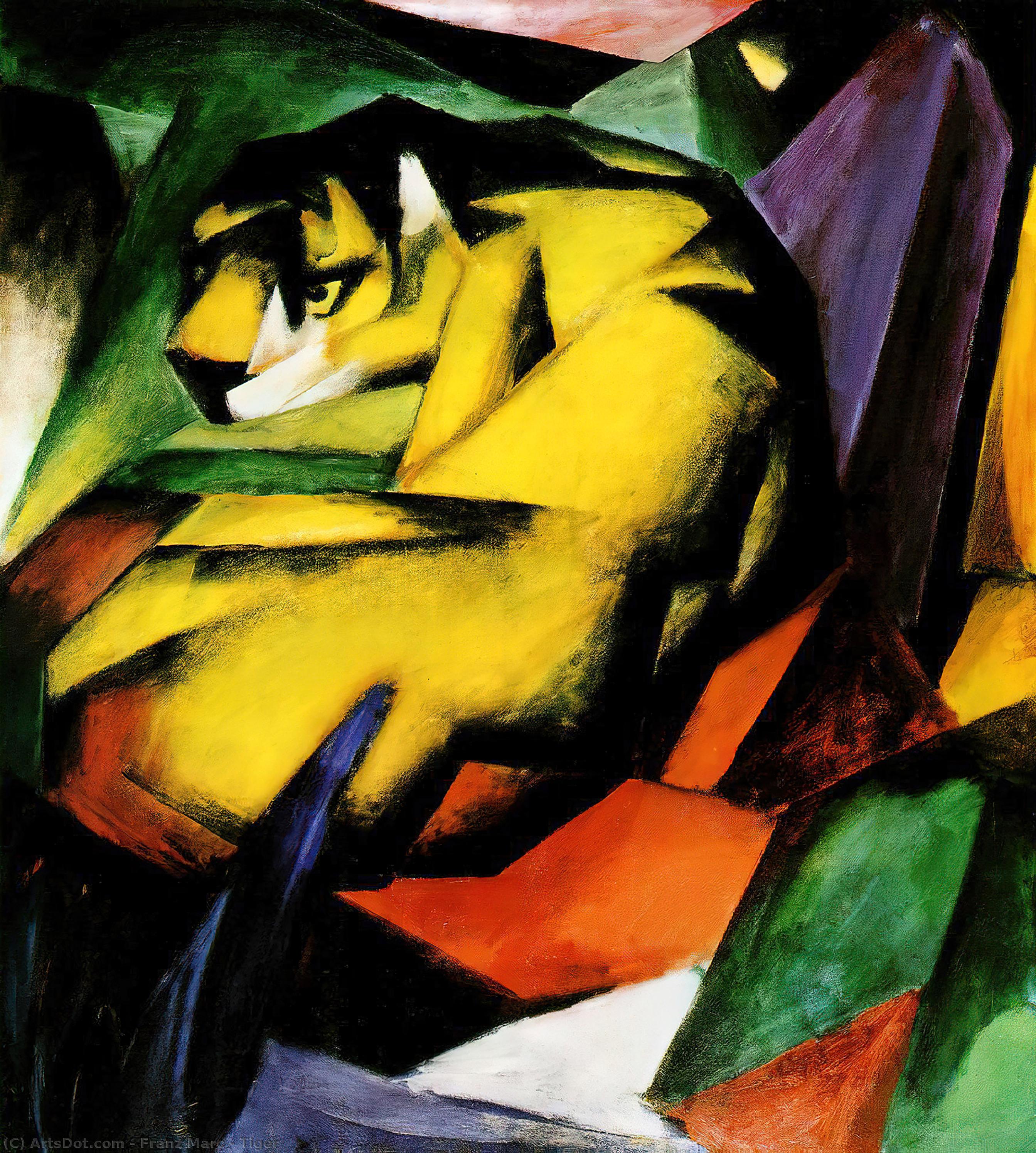
“Tiger” depicts a solitary yellow tiger resting peacefully amidst a rocky landscape punctuated by patches of green. Marc employed a distinctive technique characterized by simplified forms and bold, flattened colors—a deliberate rejection of academic conventions. The artist utilized tempera on canvas, applying pigment thickly to create textured surfaces that convey both visual richness and palpable emotion. Notice how the tiger’s form is reduced to its essential contours, emphasizing its presence without overwhelming detail. This stylistic choice aligns perfectly with Expressionist principles, prioritizing feeling over meticulous representation. The muted greens of the rocks serve as a counterpoint to the dominant yellow hue, creating a harmonious balance that underscores the painting's serene atmosphere.
Historical Context and Artistic Influences
Marc’s work flourished during a period of significant artistic upheaval—Proto-Expressionism paved the way for the movement’s full flowering. Artists like Edvard Munch and Vincent van Gogh had already begun exploring expressive color palettes and distorted perspectives, anticipating Marc’s groundbreaking approach. Like many Expressionist painters, Marc found inspiration in the natural world, believing that animals possessed a purity of spirit untouched by human anxieties. He saw them as symbols of freedom and harmony—a reflection of his own spiritual convictions.
Symbolism Beyond Representation
More than just a depiction of an animal, “Tiger” operates on multiple symbolic levels. The tiger itself represents strength and primal instinct, yet Marc portrays it in repose, suggesting a contemplation of these forces rather than aggressive dominance. This paradoxical image speaks to the Expressionist preoccupation with reconciling opposing impulses—the tension between rationality and emotion, order and chaos. The rocky landscape symbolizes resilience and permanence, grounding the tiger’s tranquility within a broader framework of natural stability. Ultimately, Marc invites viewers to consider not merely what is seen but what is felt—a profound engagement with the emotional core of existence.
A Legacy of Emotional Intensity
Franz Marc's "Tiger" remains an enduring testament to Expressionist art’s ability to communicate complex ideas through simple visual elements. Its luminous color palette and evocative imagery continue to captivate audiences today, serving as a reminder that true artistic achievement lies in capturing the essence of human experience—a quest for beauty and spiritual understanding that resonates across generations. For those seeking inspiration or considering commissioning a reproduction, this painting offers an unparalleled glimpse into the heart of Expressionist vision.
Vragen & Antwoorden
Bij welke kunststroming behoort "Tiger" door Franz Marc?
"Tiger" is een werk uit de German Expressionism. De stroming geeft de artistieke traditie aan waartoe het werk behoort.
Is "Tiger" een van de meest populaire werken van Franz Marc?
"Tiger" wordt geclassificeerd als Iconic.
Welke nationale herkomst ligt ten grondslag aan de German Expressionism van "Tiger"?
"Tiger" verbindt de German Expressionism-stroming met Duitsland via de geboorteplaats van de maker.
Wie is de kunstenaar achter "Tiger"?
De kunstenaar achter "Tiger" is Franz Marc. Het werk is gecatalogiseerd onder de naam van Franz Marc.
Kan ik een olieverfreproductie van "Tiger" bestellen?
Met de handgeschilderde reproducties van "Tiger" door Franz Marc kunt u terecht op deze website: een met de hand geschilderde olieverfreproductie op linnen canvas, te bestellen via deze pagina.
Is "Tiger" in zijn geheel eerder licht of donker?
De vastgestelde waarden voor "Tiger" door Franz Marc zijn: shadow helderheid, Soft Shadow luminantie.
Hoe kan ik een print van "Tiger" door Franz Marc verkrijgen?
Om een print van "Tiger" door Franz Marc te bemachtigen, kunt u deze eenvoudig bestellen op deze pagina: een fine art print op katoenen canvas of archiefwaardig canvaspapier.