


 Oil On CanvasWallArtDutch Golden Age
 1623Early Modern
 70.0 x 62.0 cm
 Louvre
Giclée- of canvasafdruk van museumkwaliteit met een snelle productie en flexibele afwerkingsmogelijkheden. ( Bestel handgeschilderde reproductie Koop afbeelding)





























Kies uit onze vooraf ingestelde maten die overeenkomen met de originele verhoudingen van het kunstwerk.

U kunt uw eigen afmetingen opgeven om in een specifieke lijst of ruimte te passen. Als de door u gekozen maat niet overeenkomt met de proporties van het originele kunstwerk, zullen wij de afbeelding bijsnijden of uitbreiden met een gespiegelde of effen rand. Een digitaal mockup wordt ter goedkeuring naar u verzonden voordat de productie begint.
Houd er rekening mee dat de preview op het scherm de werkelijke bijsneding of uitbreiding niet weergeeft. Alleen de mockup toont de uiteindelijke compositie nauwkeurig.
Hoewel aangepaste maten beschikbaar zijn, raden wij aan een afmeting uit de vooraf bepaalde lijst te kiezen om de originele proporties te behouden.
Wereldwijde levering () binnen 2 weken in plaats van de standaard 4/5 weken. (6 september)


Buffoon Playing a Lute
Afmetingen reproductie
In the heart of the seventeenth century, amidst the bustling prosperity of the Dutch Republic, there emerged a style of painting that breathed life into the mundane. Frans Hals I, a master of movement and emotion, achieved this feat most vibrantly in his 1623 masterpiece, Buffoon Playing a Lute. This work is far more than a mere portrait; it is a window into a fleeting moment of musical ecstasy. As you gaze upon the central figure, draped in a striking red and blue striped outfit, you are immediately drawn into his infectious smile. The musician is not simply performing; he is lost in the rhythm, his long hair cascading over his shoulders as he cradles his lute. This sense of spontaneous joy is mirrored by the subtle presence of onlookers in the background, whose attentive gazes complete a scene of shared human connection and communal delight.
For the discerning collector or interior designer, this painting offers a profound emotional resonance that transcends time. It captures the very essence of joie de vivre, making it an ideal centerpiece for spaces designed to inspire warmth, conversation, and vitality. Whether placed in a grand salon or a curated study, the piece serves as a reminder of the beauty found in life's unscripted, joyful interludes.
What sets this work apart from the more rigid, meticulous portraiture of its era is Hals’s revolutionary approach to technique. Moving away from the polished, almost porcelain-like finishes favored by many contemporaries, Hals embraced a loose, expressive brushstroke that would later influence the Impressionist movement. Upon closer inspection of a high-quality reproduction, one can truly appreciate the thick impasto and the energetic application of paint. This tactile quality allows light to dance across the canvas, creating a sense of atmospheric depth and shimmering realism.
Hals’s genius lies in his ability to use visible, bravura strokes to suggest texture and motion rather than defining every single thread of fabric or string of the lute. He skillfully blends colors to create soft shadows that recede into the background, ensuring that the luminous face of the buffoon remains the undisputed protagonist. This technique creates an incredible sense of immediacy; it feels as though the music is still vibrating through the air and the performer might break into song at any second. For those seeking art that possesses a "living" quality, Hals’s mastery of light and motion provides an unparalleled sensory experience.
To understand the Buffoon Playing a Lute is to understand the flourishing cultural landscape of Haarlem during the Dutch Golden Age. During this period, the Netherlands was experiencing unprecedented economic growth driven by maritime trade, which in turn fueled a massive demand for art that celebrated everyday life and middle-class values. Hals emerged from this environment as a pioneer of genre painting, elevating scenes of common folk to the level of high art through his psychological depth and technical innovation.
The painting serves as a testament to the era's shift toward realism and the celebration of the human condition. There is no heavy-handed symbolism here; instead, the symbolism lies in the music itself—a metaphor for harmony, vitality, and the fleeting nature of pleasure. Owning or displaying a reproduction of this work allows one to bring a piece of this historical brilliance into a modern setting, bridging the gap between the seventeenth-century Dutch Republic and the contemporary aesthetic. It is an investment in a legacy of creativity, capturing a timeless fragment of human happiness that continues to captivate audiences at the Musée du Louvre and beyond.


1580 - 1585 , België

Embark on a sophisticated journey through the Dutch Golden Age. Unveil the dramatic brilliance of Rembrandt’s chiaroscuro and the expressive landscapes of 17th-century masters in this authoritative exploration of light, shadow, and enduring artistic legacy.

Explore the breathtaking mastery of Dutch Golden Age landscapes. From Italianate light to atmospheric realism, discover the techniques of 17th-century masters and learn how to bring these timeless, museum-quality masterpieces into your home through expert oil reproductions.
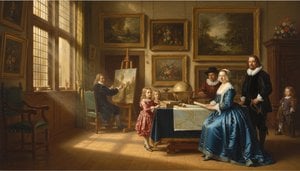
Embark on a journey through the Dutch Golden Age. Discover how masters like Rembrandt and Vermeer used chiaroscuro to manipulate light and shadow, creating timeless depth and spiritual resonance in art history's most captivating masterpieces.

 Voorvertoning
 Verstuur
 Delen
Delen
 Details bekijken

 Download
 Vergelijkbare items
 Röntgenonderzoek
 Diavoorstelling
 Lees meer







 De optie voor glas is alleen beschikbaar bij een formaat kleiner dan 110 cm.


