Ontvang een bestand dat klaar is voor drukwerk en de kwaliteit van het online voorbeeld ver overstijgt. Elke digitale afbeelding die wij verkopen, is afkomstig van een high-resolution master uit onze database — meestal tussen de 5.000 en 15.000 pixels breed — zodat u met vertrouwen groot kunt afdrukken, nauwkeurig kunt bijsnijden of fijne details kunt reproduceren.
Geen enkel bestand verlaat ons atelier onbewerkt. Een digitaal expert controleert de kleuren aan de hand van het originele schilderij en corrigeert deze indien nodig, om vervolgens de helderheid en details te verbeteren met professionele retoucheertechnieken — waarbij de penseelstreek en stijl van de kunstenaar altijd strikt worden gerespecteerd. Het resultaat is een afbeelding die oogt als het schilderij zelf, en niet als een gescande foto met een filter.
U keurt de afbeelding goed voordat de bestelling wordt afgerond: onze expert stuurt u binnen 72 uur een e-mail ter beoordeling. Niet tevreden? Vraag om aanpassingen of correcties, of vraag een terugbetaling aan als de kwaliteit niet aan de verwachtingen voldoet.
Dit is de kwaliteit waarop uitgevers, designstudio's, galeries en drukkerijen vertrouwen.
Download een bestand met hoge resolutie voor persoonlijke weergave, afdrukken en creatieve projecten. ( Schakel over naar print Bestel handgeschilderde reproductie)
Wanneer u kiest voor WahooArt.com, ontvangt u niet alleen een afbeelding – u krijgt een professioneel verbeterd digitaal kunstwerk, met precisie vervaardigd en voorzien van een tevredenheidsgarantie. Dit is alles wat automatisch bij uw bestelling is inbegrepen:
Uw hoogwaardige digitale afbeeldingsbestand wordt binnen 72 uur na bestelling naar u gemaild – klaar voor direct gebruik.
Uw kunstwerk wordt professioneel geoptimaliseerd met behulp van geavanceerde AI-tools en handmatige bewerkingen, waardoor maximale details, helderheid en kleurnauwkeurigheid worden gegarandeerd.
Je bestand per ongeluk verwijderd of kwijtgeraakt? Geen zorgen – we sturen het u op elk gewenst moment gratis opnieuw toe.
Geniet direct van uw kunstwerk zonder invoerrechten, belastingen of verzendkosten – digitale downloads zijn altijd belastingvrij.
Met behulp van professionele hulpmiddelen en kleurbeheer zorgen wij ervoor dat uw digitale afbeelding de originele kleuren zo nauwkeurig mogelijk weergeeft.
Mocht u niet tevreden zijn met uw digitale afbeelding, dan passen wij deze aan of storten wij 100% terug binnen 100 dagen – zonder vragen te stellen.
Niet tevreden? Ontvang een volledige terugbetaling binnen 100 dagen na ontvangst van uw digitale bestand – zonder vragen te stellen.
Koop 3 afbeeldingen, bespaar 10% - Koop 5, bespaar 15% - Koop 10+, bespaar 20%. Ideaal voor creatieve projecten, galerieën en bureaus.
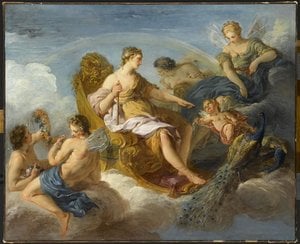
L'Olympe is a painting by the French artist François Lemoyne. Created about 1730, the work depicts mythological figures situated within a celestial setting. The subject matter focuses on scenes from Olympus, the traditional home of the Greek gods.
François Lemoyne was born in Paris in 1688 and died in Paris in 1737. This specific composition features numerous nude or partially clothed deities amidst swirling clouds and a pale blue sky. The arrangement of these figures creates a sense of movement across the canvas.
The artist's output includes several other notable works, such as:
The composition is characterized by a crowded and dynamic arrangement of figures. Numerous nude or partially clothed figures are positioned amidst swirling clouds, set against a pale blue sky. Rather than a single central focal point, the eye is drawn to various groupings of figures engaged in different actions. This lack of a central anchor creates a sense of overflowing abundance and celestial chaos throughout the canvas.
The arrangement of the figures follows a complex structure. Some figures appear to be flying, while others are reclining or gesturing. A banner containing text hangs at the top center of the scene. The organic shapes of the human bodies, billowing drapery, and clouds contrast with the rectangular format of the canvas. The perspective remains somewhat ambiguous, with figures appearing at varying distances to create a shallow depth of field. This layering of figures and clouds, combined with lighter colors for distant elements, establishes a sense of depth within the celestial setting.
This work is executed in oil on canvas. The application of pigment involves the layering of thin glazes of oil paint, a method used to maximize luminosity across the surface. These translucent layers allow light to penetrate the paint film, contributing to the luminous effect of the celestial setting. The color palette is composed of soft blues, creams, pinks, and golds, which coalesce to suggest a divine radiance.
The brushwork is characterized by a soft and blended quality. Lemoyne employs delicate brushstrokes to achieve seamless transitions between different shades, particularly in the rendering of flesh tones and the atmospheric clouds. This meticulous blending of pigments creates an illusion of volume and depth within the composition. The edges of the forms are not sharply defined but are instead integrated through these subtle tonal variations, contributing to the fluid movement of the figures within the sky.
This work originated as a ceiling project for the Royal Bank, painted in 1718. Its history involves several transfers of ownership and location. In 1797, the piece was acquired through saisie révolutionnaire. The painting later moved through various collections before being returned from Fontainebleau on April 24, 1928.
The physical condition of the oil on canvas was addressed in 1967. During that year, Henri Marie Linard performed restoration work on the piece. This intervention aimed to maintain the integrity of the pigments and the surface of the work.
The painting is held within the collections of the Musée du Louvre in Paris, France. It is situated in the Département des Peintures. Visitors can find the work in Salle 921, located in the Aile Sully on Niveau 2.
The museum maintains specific records for this piece. The inventory number is listed as INV 6718 and MR 1980. This work was acquired through a process of saisie révolutionnaire in 1797. It was previously part of the collection of Vialard de Saint-Maurice, who served as a counselor to the Parlement de Paris.
The object is an oil on canvas. It was originally a ceiling project for the Royal Bank, painted in 1718. The physical structure of the work includes an accessory that contributes to its total height and width.
Other compositions by this artist include Hercules and Omphale, which dates to 1724. This oil on canvas work is held at The Louvre in Paris. The painting depicts a mythological scene involving classical figures and a lion's pelt, utilizing a palette of warm ochres, earthy browns, and reds. The composition features a diagonal arrangement of figures and a red velvet canopy.
Another significant work is The Apotheosis of Hercules, created in 1736. This piece is located at the Château de Versailles. It is a large-scale work that reflects the artist's involvement with monumental ceiling paintings and the decorative requirements of the French court.
De kleur van "L'Olympe" heeft een verzadiging van Clear Color Presence en een intensiteit van Vivid.
Het Landscape-formaat van "L'Olympe" door François Le Moine wordt aanbevolen voor een Living Room. Formaat en ruimte samen bepalen de ideale plaatsing van een reproductie.
"L'Olympe" door François Le Moine heeft een Elegant atmosfeer en wordt aanbevolen voor de Living Room. De stemming bepaalt wat het werk toevoegt aan de omringende ruimte.


1688 - 1737 , Frankrijk
 Voorvertoning
 Verstuur
 Delen
Delen
 Details bekijken
 Gids
Gids

 Download
 Vergelijkbare items
 Röntgenonderzoek
 Diavoorstelling
 Vraag & antwoord
 Statistieken


 Lees meer