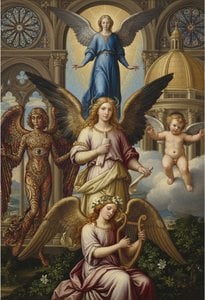
The Shadowed Canvas: Exploring the Life and Art of Jean-Baptiste Mongeau
Jean-Baptiste Mongeau, a name perhaps less familiar than his contemporaries, nevertheless stands as a pivotal figure in the late 18th and early 19th French art scene. Born in Lyon in 1785 – a city renowned for its silk weaving and burgeoning artistic community – Mongeau’s life was inextricably linked to the revolutionary fervor sweeping through France. While his contemporaries, like David and Géricault, grappled with grand historical narratives, Mongeau found his voice in the intimate portrayal of everyday life, particularly within the confines of domestic interiors and the quiet contemplation of rural landscapes. His work, characterized by a subtle yet profound use of light and shadow, offers a poignant glimpse into a world on the cusp of dramatic change.
Mongeau’s early artistic training was somewhat unconventional. He apprenticed not with a formal academy, but under his father, a skilled cabinet maker and miniature painter. This early exposure to meticulous craftsmanship instilled in him an appreciation for detail and a deep understanding of materials – qualities that would later inform his distinctive style. However, it was the vibrant salon culture of Lyon, filled with discussions of Neoclassicism, Romanticism, and the burgeoning ideals of the Enlightenment, that truly ignited his artistic passion. He initially experimented with historical subjects, producing several small-scale portraits reflecting the aristocratic clientele of the region, but quickly found himself drawn to a more personal and observational approach.
A defining moment in Mongeau’s career came during the tumultuous years of the French Revolution and its immediate aftermath. Witnessing firsthand the social upheaval and the subsequent rise of Napoleon, he began to incorporate themes of loss, memory, and the fragility of human existence into his work. This shift is particularly evident in his series of “Intérieurs” – interior scenes depicting ordinary families engaged in their daily routines. These paintings are not grand historical statements; rather, they offer a quiet meditation on the rhythms of domestic life, capturing fleeting moments of tenderness, sorrow, and contemplation. The use of muted colors, often dominated by browns, grays, and ochres, creates an atmosphere of melancholy and introspection – a deliberate departure from the brighter palettes favored by many of his contemporaries.
Mongeau’s artistic influences were diverse and complex. While he admired the technical mastery of Jacques-Louis David, he rejected his overtly heroic style, preferring to explore more subtle emotional resonances. He was also deeply affected by the Romantic movement, particularly the emphasis on subjective experience and the power of nature – though he tempered this influence with a distinctly French sensibility. The works of Jean-François Millet, known for his depictions of rural life, served as an important model, demonstrating the potential to find beauty and dignity in the lives of ordinary people. Furthermore, the meticulous detail evident in his work echoes the traditions of Flemish painting, particularly the genre of “tronies” – intimate portraits capturing a single moment of emotion.
Despite facing periods of financial hardship and struggling for recognition during his lifetime, Mongeau’s influence on subsequent generations of French artists is undeniable. His emphasis on realism, psychological depth, and the exploration of everyday subjects paved the way for later Impressionist painters like Renoir and Monet. His “Intérieurs” series, in particular, anticipated the focus on domestic interiors that would become a hallmark of 19th-century art. Mongeau’s work was exhibited sporadically throughout his career, primarily at smaller salons and private collections. He died in Lyon in 1847, leaving behind a modest but significant body of paintings – a testament to the quiet power of observation and the enduring beauty of the human experience.
Key Works
- La Famille au Repas (1815) - A quintessential “Intérieur” depicting a family gathered around a simple meal, capturing a moment of shared intimacy.
- Le Jardinier Solitaire (1820) – A study in solitude and the beauty of the natural world, showcasing Mongeau’s ability to evoke atmosphere through subtle color variations.
- Portrait de Madame Dubois (1830) - A remarkably intimate portrait capturing a moment of quiet contemplation by a woman reading.
- Le Choeur du Village (1835) – A depiction of villagers gathered for a religious service, highlighting the importance of community and faith in rural France.
Legacy and Historical Context
Mongeau’s art is inextricably linked to the broader historical context of post-revolutionary France. The period following the Napoleonic Wars was marked by social unrest, economic hardship, and a growing sense of disillusionment with grand political narratives. Mongeau's focus on the lives of ordinary people reflected this shift in sensibility – a move away from heroic ideals towards a more grounded and humanistic perspective. His work can be seen as a subtle critique of the excesses of the aristocracy and a celebration of the resilience and dignity of the common man. Furthermore, his exploration of memory and loss resonated with the collective trauma experienced by France following decades of war and upheaval. While not widely celebrated during his lifetime, Mongeau’s quiet yet profound contributions to French art continue to be recognized today as a vital expression of the era's complex social and emotional landscape.



 Bekijk op ware grootte
 Schakel over naar print
 Verstuur
 Delen
Delen
 Details bekijken
 Gids
Gids

 Download
 Vergelijkbare items
 Röntgenonderzoek
 Diavoorstelling
 Statistieken


 Lees meer






































 De optie voor glas is alleen beschikbaar bij een formaat kleiner dan 110 cm.