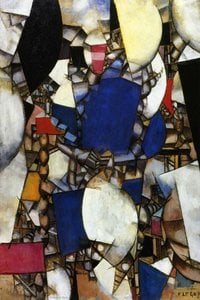
A Symphony of Geometric Forms: The Vibrancy of Fernand Léger
In the heart of the early twentieth century, as the world stood on the precipice of profound industrial transformation, Fernand Léger captured a moment of pure, rhythmic energy in his 1914 masterpiece, "The Tree Houses" (often associated with his Houses in the Trees Landscape series). This work is far more than a mere arrangement of shapes; it is a breathtaking exploration of how Cubism could breathe life into the mundane. At first glance, the viewer is met with a kaleidoscope of primary and secondary colors—vibrant reds, deep blues, sunny yellows, and lush greens—that dance across the canvas in a way that defies traditional perspective. Léger does not merely paint objects; he orchestrates a visual symphony where every bottle and geometric plane contributes to a larger, pulsating movement.
The technique employed here showcases Léger’s unique departure from the more fragmented approach of his contemporaries, Picasso and Braque. While others sought to shatter reality into unrecognizable shards, Léger maintained a sense of structural integrity. He utilizes interlocking planes and overlapping surfaces to create an illusionistic depth that feels both modern and architectural. The way the colorful forms—reminiscent of glassware and everyday vessels—are stacked and layered creates a fascinating tension between two-dimensional flatness and a reconstructed three-dimensional space. For the discerning collector or interior designer, this piece offers a sophisticated balance of bold abstraction and recognizable structure, making it a commanding focal point for any contemporary setting.
The Pulse of Modernity and Industrial Spirit
To understand the soul of this painting, one must look toward the historical dawn of mechanization. Painted at the cusp of World War I, the artwork reflects the burgeoning energy of an era defined by rapid technological advancement. Léger, deeply influenced by the precision of industrial design, saw beauty in the manufactured and the utilitarian. The geometric shapes within the composition mirror the steel, glass, and rhythmic machinery of the age. There is a deliberate juxtaposition here: the organic suggestion of "trees" or landscapes is replaced by the hard-edged, disciplined forms of man-made objects. This reflects Léger’s personal mission to integrate the dynamism of the machine age into the very fabric of fine art.
The emotional impact of the piece is one of profound optimism and structured chaos. There is a sense of organized vitality, as if the viewer is witnessing the heartbeat of a new, modern world being constructed in real-time. The inclusion of subtle elements, such as the clock-like forms, serves as a poignant reminder of the relentless march of time and progress. For those looking to adorn a space with art that inspires movement and intellectual curiosity, this reproduction offers an unparalleled opportunity. It is a piece that does not merely sit upon a wall; it interacts with the light and the architecture of a room, inviting contemplation on the beauty found within the structured precision of our modern existence.



 Bekijk op ware grootte
 Koop handgeschilderd kunstwerk
 Verstuur
 Delen
Delen
 Details bekijken
 Gids
Gids

 Download
 Vergelijkbare items
 Röntgenonderzoek
 Diavoorstelling
 Statistieken

 Lees meer






































 De optie voor glas is alleen beschikbaar bij een formaat kleiner dan 110 cm.