Fernand Léger: Embracing Modernity Through Geometric Form
Fernand Léger stands as a singular voice within the tumultuous landscape of early twentieth-century art, resisting the prevailing trend toward abstraction while simultaneously forging a path towards its expressive potential. Born Joseph Fernand Henri Léger in Argentan, Normandy, in 1881, his formative years amidst rural traditions provided a crucial counterpoint to the burgeoning industrial revolution that would irrevocably reshape European culture and profoundly influence his artistic vision.
- Early Influences: Léger’s initial training as an architect instilled a disciplined understanding of spatial relationships—a foundation he would later translate into his distinctive visual language. However, it was his encounter with Impressionism, particularly Gérôme's monumental paintings at the Salon d’Automne in 1905, that ignited his artistic curiosity and introduced him to the expressive power of color and light.
- The Birth of Tubism: Léger’s pivotal breakthrough arrived in 1909 with the formation of the Puteaux Group alongside fellow Cubists like Metzinger and Le Fauconnier. This collective experimentation yielded “Tubism,” a radical departure from traditional representation—a style characterized by simplified cylindrical forms that captured the essence of machinery and urban life. Léger’s tubular shapes weren't merely decorative; they embodied the dynamism and efficiency of the industrial age, reflecting his fascination with technological progress.
- World War I’s Impact: The horrors of World War I indelibly marked Léger’s artistic sensibility. His sketches documenting the battlefield—artillery pieces, airplanes, and soldiers—demonstrated a commitment to portraying reality with unflinching honesty while simultaneously distilling it into its most fundamental geometric elements. This period solidified his belief in art's ability to communicate profound truths about human experience.
- A Populist Vision: Unlike many of his contemporaries who pursued intellectual abstraction, Léger championed a style accessible to the masses—a deliberate rejection of elitism that aligns with his upbringing and humanist values. His bold simplification of subject matter foreshadowed Pop Art’s embrace of everyday imagery and challenged artistic conventions.
“The Part of Chart”: Decoding Geometric Abstraction
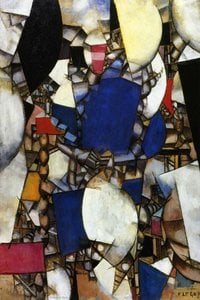
"The Part of Chart," completed in 1917, exemplifies Léger's Tubist aesthetic with remarkable clarity. The painting depicts a group of figures seated on the ground amidst bicycles—a scene deliberately devoid of realistic detail but brimming with symbolic significance. Léger’s masterful use of tubular forms dominates the composition, conveying a sense of movement and suggesting the relentless pace of industrial society.
The palette is restrained yet impactful, utilizing primary colors accented by green, black, and white—a deliberate choice that underscores Léger's commitment to reducing visual information to its most essential components. The fragmented geometric shapes create an illusion of depth and perspective without resorting to traditional techniques, reflecting Léger’s belief in the transformative power of abstraction.
Symbolism Beyond Representation
Beyond its formal qualities, “The Part of Chart” speaks to broader themes—community, interaction, and the human condition amidst technological advancement. Léger's simplification isn’t merely stylistic; it serves as a conduit for conveying emotional resonance. The figures are rendered with minimal anatomical detail, prioritizing expressive gesture and posture over precise representation.
Considered a forerunner of Pop Art, Léger’s work anticipates the movement’s fascination with commonplace subjects—the bicycle, in particular—and its rejection of academic conventions. He sought to capture not just what he saw but *how* it felt—a humanist impulse that distinguishes him from many abstract artists of his time.
Legacy and Influence
Fernand Léger’s unwavering dedication to geometric abstraction cemented his place as a pivotal figure in modern art history. His influence extended beyond painting into sculpture, filmmaking, and design—demonstrating the breadth of his artistic vision. Today, reproductions of “The Part of Chart” continue to inspire collectors and interior designers alike, offering a glimpse into Léger’s groundbreaking exploration of form and symbolism.



 Bekijk op ware grootte
 Schakel over naar print
 Verstuur
 Delen
Delen
 Details bekijken
 Gids voor studentenkunstwerken

 Download
 Vergelijkbare items
 Röntgenonderzoek
 Diavoorstelling
 Statistieken

 Lees meer






































 De optie voor glas is alleen beschikbaar bij een formaat kleiner dan 110 cm.