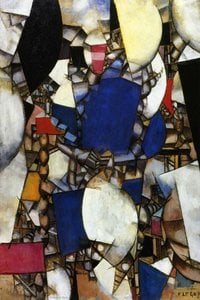
A Symphony of Geometry: Reimagining the Human Form
In the transformative landscape of early twentieth-century modernism, few works capture the rhythmic pulse of a changing world as vibrantly as Fernand Léger’s “The Man with the Pipe.” Painted in 1918, this masterpiece serves as a profound window into a period where the boundaries of traditional portraiture were being aggressively dismantled. Rather than offering a mere likeness of his subject, Léger invites us into a world where flesh and bone are reimagined through the lens of industrial precision. The painting presents a man, poised with a pipe in hand, accompanied by the loyal presence of a dog, yet both figures are distilled into a captivating arrangement of fragmented planes and intersecting lines. It is a work that does not simply depict a moment in time; it reconstructs reality itself.
The brilliance of this piece lies in its unique fusion of Cubist fragmentation and Futurist dynamism. While many of his contemporaries sought to deconstruct the subject into unrecognizable shards, Léger pioneered a style that celebrated the structural integrity of the machine age. He employs a technique of simplification, reducing the complexities of the human anatomy into fundamental geometric primitives—cylinders, spheres, and cubes. This approach creates a striking visual tension; there is a sense of monumental stability in the man’s form, yet the bold, primary palette of reds, yellows, and blues injects an undeniable energy that suggests constant motion. For the discerning collector or interior designer, this interplay of heavy structure and vivid color offers a sophisticated focal point that commands attention without overwhelming its surroundings.
The Pulse of Modernity and Historical Resonance
To gaze upon “The Man with a Pipe” is to feel the tremors of 1918 Europe. As the world emerged from the shadows of the Great War, Léger’s aesthetic reflected a society grappling with the rapid onset of mechanization and urban expansion. The inclusion of seemingly disparate elements—a clock, an umbrella, a bottle, and even a chair—creates a collage-like atmosphere that mirrors the fragmented experience of modern life. These objects are not merely incidental; they are integrated into the very fabric of the composition, suggesting that in the new age, the human experience is inextricably linked to the tools and rhythms of industry.
There is an emotional depth beneath the surface of these bold shapes. While the painting celebrates the strength and clarity of geometric abstraction, it also carries a subtle weight of wartime anxiety, translated through its structured, almost armored appearance. This duality makes the artwork particularly compelling for contemporary spaces; it possesses a timelessness that bridges the gap between historical significance and modern elegance. Whether placed in a minimalist gallery setting or as a bold statement piece in a curated living space, this reproduction brings with it the spirit of an era that dared to redefine what it means to see.
Veelgestelde vragen
Wanneer werd "The man with the pipe" gemaakt en tot welke stroming behoort het?
"The man with the pipe" werd in 1918 gecreëerd als een werk uit de Cubism-stroming. De datum en de stroming verankeren het kunstwerk in de kunstgeschiedenis.
Welke sfeer brengt een reproductie van "The man with the pipe" door Fernand Léger in een kamer?
"The man with the pipe" door Fernand Léger heeft een Elegant atmosfeer en wordt aanbevolen voor de Living Room. De stemming bepaalt wat het werk toevoegt aan de omringende ruimte.
Welke plaatsing past bij het formaat van "The man with the pipe" door Fernand Léger?
Formaat (Portrait) en aanbevolen ruimte (Living Room) zijn de twee plaatsingskenmerken vastgelegd voor "The man with the pipe" door Fernand Léger.



 Voorvertoning
 Schakel over naar print
 Verstuur
 Delen
Delen
 Details bekijken
 Gids
Gids

 Download
 Vergelijkbare items
 Röntgenonderzoek
 Diavoorstelling
 Q&A
Q&A Statistieken


 Lees meer