Ontvang een bestand dat klaar is voor drukwerk en de kwaliteit van het online voorbeeld ver overstijgt. Elke digitale afbeelding die wij verkopen, is afkomstig van een high-resolution master uit onze database — meestal tussen de 5.000 en 15.000 pixels breed — zodat u met vertrouwen groot kunt afdrukken, nauwkeurig kunt bijsnijden of fijne details kunt reproduceren.
Geen enkel bestand verlaat ons atelier onbewerkt. Een digitaal expert controleert de kleuren aan de hand van het originele schilderij en corrigeert deze indien nodig, om vervolgens de helderheid en details te verbeteren met professionele retoucheertechnieken — waarbij de penseelstreek en stijl van de kunstenaar altijd strikt worden gerespecteerd. Het resultaat is een afbeelding die oogt als het schilderij zelf, en niet als een gescande foto met een filter.
U keurt de afbeelding goed voordat de bestelling wordt afgerond: onze expert stuurt u binnen 72 uur een e-mail ter beoordeling. Niet tevreden? Vraag om aanpassingen of correcties, of vraag een terugbetaling aan als de kwaliteit niet aan de verwachtingen voldoet.
Dit is de kwaliteit waarop uitgevers, designstudio's, galeries en drukkerijen vertrouwen.
Download een bestand met hoge resolutie voor persoonlijke weergave, afdrukken en creatieve projecten. ( Schakel over naar print Bestel handgeschilderde reproductie)
Wanneer u kiest voor WahooArt.com, ontvangt u niet alleen een afbeelding – u krijgt een professioneel verbeterd digitaal kunstwerk, met precisie vervaardigd en voorzien van een tevredenheidsgarantie. Dit is alles wat automatisch bij uw bestelling is inbegrepen:
Uw hoogwaardige digitale afbeeldingsbestand wordt binnen 72 uur na bestelling naar u gemaild – klaar voor direct gebruik.
Uw kunstwerk wordt professioneel geoptimaliseerd met behulp van geavanceerde AI-tools en handmatige bewerkingen, waardoor maximale details, helderheid en kleurnauwkeurigheid worden gegarandeerd.
Je bestand per ongeluk verwijderd of kwijtgeraakt? Geen zorgen – we sturen het u op elk gewenst moment gratis opnieuw toe.
Geniet direct van uw kunstwerk zonder invoerrechten, belastingen of verzendkosten – digitale downloads zijn altijd belastingvrij.
Met behulp van professionele hulpmiddelen en kleurbeheer zorgen wij ervoor dat uw digitale afbeelding de originele kleuren zo nauwkeurig mogelijk weergeeft.
Mocht u niet tevreden zijn met uw digitale afbeelding, dan passen wij deze aan of storten wij 100% terug binnen 100 dagen – zonder vragen te stellen.
Niet tevreden? Ontvang een volledige terugbetaling binnen 100 dagen na ontvangst van uw digitale bestand – zonder vragen te stellen.
Koop 3 afbeeldingen, bespaar 10% - Koop 5, bespaar 15% - Koop 10+, bespaar 20%. Ideaal voor creatieve projecten, galerieën en bureaus.
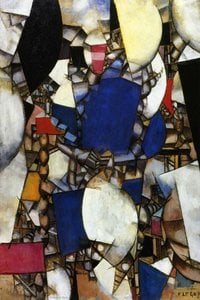
Fernand Léger's "Acrobats in the Circus," painted in 1918, isn’t merely a depiction of a circus performance; it’s a vibrant explosion of energy and a bold declaration of modernity. Emerging from the fertile artistic landscape of early 20th-century Paris, Léger sought to capture the dynamism of the machine age – its geometric forms, its rhythmic movement, and its inherent spectacle – within a distinctly personal visual language. This painting, created during a period of intense experimentation and marked by his development of “Tubism,” offers a captivating glimpse into this artistic vision.
The scene unfolds with an almost frenetic intensity. Léger abandons traditional representational techniques in favor of fractured forms and simplified shapes. The acrobats themselves are rendered as cylinders, cones, and angular blocks, their bodies dissolving into geometric patterns. This deliberate abstraction isn’t a retreat from reality but rather a way to distill the essence of movement and form – to capture the *feeling* of the circus, not just its appearance. Notice how the figures seem to vibrate with an internal energy, suggesting the thrilling rush of performance and the precarious balance inherent in their acts.
Léger’s work during this period is inextricably linked to the burgeoning field of Cubism, though he developed a unique approach. Unlike Picasso and Braque, who often employed collage techniques, Léger focused on pure geometric abstraction, drawing inspiration from the industrial world around him. The rhythmic repetition of shapes – the circular forms of the acrobats’ bodies, the angularity of the stage props, even the suggestion of machinery in the background – echoes the patterns found in factories and urban landscapes. This fascination with mechanics is evident not just in the visual style but also in Léger's broader artistic philosophy; he believed that art should reflect the realities of modern life.
The painting’s color palette further enhances this sense of dynamism. Bold primary colors – reds, yellows, and blues – dominate the composition, creating a visually arresting effect. Metallic tones are strategically employed to mimic the sheen of polished metal, reinforcing the mechanical aesthetic. The use of contrasting colors also contributes to the overall feeling of movement and excitement.
Beyond its formal innovations, “Acrobats in the Circus” is rich in symbolic meaning. The circus itself represents a world of illusion, spectacle, and escape – a realm where the ordinary becomes extraordinary. The acrobats, with their daring feats and precarious balance, embody themes of risk, skill, and human resilience. Léger’s choice to depict them in such an abstracted manner suggests that they are not simply performers but rather embodiments of modern energy and dynamism.
The inclusion of everyday objects – a clock, bowls, and vases – scattered throughout the scene adds another layer of complexity. These seemingly mundane items become integrated into the larger composition, blurring the boundaries between reality and abstraction. They serve as reminders of the world outside the circus tent, grounding the fantastical imagery in a recognizable context. The painting’s overall effect is one of joyful chaos—a celebration of life, movement, and the spirit of innovation.
WahooArt offers meticulously hand-painted reproductions of Fernand Léger's “Acrobats in the Circus,” capturing the artist’s unique style and vibrant energy with exceptional detail. Whether you are an art enthusiast, a collector seeking to expand your collection, or simply someone looking for a striking piece of décor, our reproductions provide a beautiful and authentic way to experience this iconic work of modern art. Choose from a range of sizes and canvas materials to perfectly complement your interior design.
"Acrobats in the circus" werd in 1918 gecreëerd door Fernand Léger.
De afbeelding van "Acrobats in the circus" door Fernand Léger is te downloaden op de Downloaden-pagina van het kunstwerk: een digitale afbeelding in hoge resolutie om te downloaden.
De onderwerpen van "Acrobats in the circus" zijn acrobats, circus, figures, geometric, modernity, dynamism, form.

1881 - 1955 , Frankrijk
 Voorvertoning
 Verstuur
 Delen
Delen
 Details bekijken
 Gids
Gids

 Download
 Vergelijkbare items
 Röntgenonderzoek
 Diavoorstelling
 Q&A
Q&A Statistieken

 Lees meer