VoorvertoningVoorvertoning Bekijk in ARBekijk in AR Switch to Print Switch to PrintBestel handgeschilderde reproductie Bestel handgeschilderde reproductie VerstuurVerstuur
Details bekijkenDetails bekijken Toevoegen aan favorieten Toevoegen aan favorieten DownloadDownload Vergelijkbare itemsVergelijkbare items RöntgenonderzoekRöntgenonderzoek DiavoorstellingDiavoorstelling StatsStats

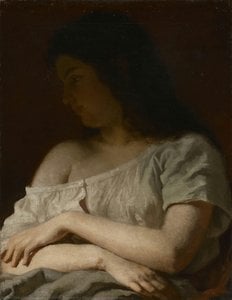
Meditation

Explore 'Meditation' by Eugène Carrière – a haunting 1893 portrait of Madame Carrière in muted tones. Impressionistic realism & poignant emotion. Discover this Symbolist masterpiece.

Eugène Anatole Carrière was een Frans Symbolist kunstenaar van de fin-de-siècle periode. Zijn schilderijen staan bekend om hun bijna monochrome bruine kleur en hun etherische kwaliteit. Carrière's stijl werd sterk beïnvloed door Rubens en hij gebruikte vaak een bijna monochrome bruine kleurpalette.

Koop een digitale afbeelding in hoge resolutie met verbeterde kwaliteit, die veel superieur is aan de online voorvertoning.

Elk bestand wordt met uiterste precisie voorbereid door onze interne specialisten, met behulp van geavanceerde tools en deskundige handmatige retouche. Wij garanderen dat elke afbeelding een uitzonderlijke helderheid, nauwkeurige kleurweergave en verfijnde details bezit.

Het uiteindelijke bestand wordt binnen 72 uur per e-mail geleverd, geoptimaliseerd voor direct gebruik in professionele, redactionele en printomgevingen. Dit is dezelfde kwaliteit waarop vooraanstaande designstudio's, uitgevers en galerieën vertrouwen.

Digitale afbeeldingen

Download een bestand met hoge resolutie voor persoonlijke weergave, afdrukken en creatieve projecten. (Switch to Print Switch to PrintBestel handgeschilderde reproductie Bestel handgeschilderde reproductie)

Totaalprijs

$ 24,90

Inbegrepen bij elke bestelling van een digitale afbeelding

Professionele digitale levering, gegarandeerd

Wanneer u kiest voor WahooArt.com, ontvangt u niet alleen een afbeelding – u krijgt een professioneel verbeterd digitaal kunstwerk, met precisie vervaardigd en voorzien van een tevredenheidsgarantie. Dit is alles wat automatisch bij uw bestelling is inbegrepen:

shipping_icon
Snelle levering per e-mail

Uw hoogwaardige digitale afbeeldingsbestand wordt binnen 72 uur na bestelling naar u gemaild – klaar voor direct gebruik.

canvas_icon
AI-verbeterd digitaal bestand

Uw kunstwerk wordt professioneel geoptimaliseerd met behulp van geavanceerde AI-tools en handmatige bewerkingen, waardoor maximale details, helderheid en kleurnauwkeurigheid worden gegarandeerd.

insurance_icon
Gratis levenslange herlevering van digitale afbeeldingen

Je bestand per ongeluk verwijderd of kwijtgeraakt? Geen zorgen – we sturen het u op elk gewenst moment gratis opnieuw toe.

tax_icon
Geen invoerkosten – nooit

Geniet direct van uw kunstwerk zonder invoerrechten, belastingen of verzendkosten – digitale downloads zijn altijd belastingvrij.

color_icon
Garantie op kleurgetrouwheid

Met behulp van professionele hulpmiddelen en kleurbeheer zorgen wij ervoor dat uw digitale afbeelding de originele kleuren zo nauwkeurig mogelijk weergeeft.

return_icon
100 dagen tevredenheidsgarantie

Als u niet tevreden bent met uw digitale afbeelding, passen wij deze aan of storten wij 100% terug binnen 100 dagen - zonder vragen te stellen.

guarantee_icon
100% Geld-terug-garantie

Niet tevreden? Ontvang een volledige terugbetaling binnen 100 dagen na ontvangst van uw digitale bestand - zonder vragen te stellen.

discount_icon
Korting bij grote bestellingen

Koop 3 afbeeldingen, bespaar 10% - Koop 5, bespaar 15% - Koop 10+, bespaar 20%. Ideaal voor creatieve projecten, galerieën en bureaus.

Snelle feiten

  • Movement: Symbolism
  • Subject or theme: Loneliness, introspection
  • Artist: Eugène Anatole Carrière
  • Dimensions: 48 x 65 cm
  • Title: Meditation
  • Artistic style: Impressionistic touch with realism
  • Influences: Peter Paul Rubens

Kunstquiz

Er is slechts één goed antwoord op elke vraag.

Vraag 1:
What is the predominant color palette used in Eugène Anatole Carrière’s painting ‘Meditation’?
Vraag 2:
The artist's style is described as 'impressionistic' due to:
Vraag 3:
Which artist influenced Carrière’s early work, particularly evident in the glowing colors of his paintings?
Vraag 4:
What is a key characteristic of Carrière's technique – specifically how he achieved texture in the painting?
Vraag 5:
The pose and expression of the woman depicted in ‘Meditation’ convey themes of:

Meditation

Eugène Anatole Carrière’s “Meditation” stands as a poignant testament to the Symbolist movement's preoccupation with psychological depth and emotional resonance. Painted in 1893, this oil on canvas portrait captures a young woman lost in contemplation—a figure instantly recognizable for its haunting stillness and subdued palette.

The artwork’s immediate impact is achieved through Carrière’s masterful use of color. Rejecting the vibrant hues favored by Impressionists, he opted for a deliberate monochrome scheme dominated by shades of brown and black, punctuated by subtle hints of muted reds and oranges. This restricted tonal range wasn't merely stylistic choice; it served as a crucial element in conveying the subject’s inner turmoil—a reflection of Rubensian influence evident in the luminous glow of his early canvases.

Technically, Carrière employed an ambitious layering process, meticulously blending oil paints to create a velvety texture that envelops the figure. Extensive glazing techniques were utilized to build up depth and luminosity, capturing the nuances of light and shadow with remarkable precision. The artist’s brushstrokes are loose yet controlled, conveying both spontaneity and deliberate artistic intention.

Beyond its aesthetic qualities, “Meditation” resonates deeply with Symbolist themes—specifically, the exploration of human emotion and subconscious experience. The woman's posture embodies vulnerability and introspection, mirroring the movement’s fascination with confronting inner anxieties and grappling with existential questions. Her gaze directs inward, suggesting a preoccupation with grief or melancholy – emotions central to the Symbolist canon.

The painting’s composition is deliberately flattened, prioritizing the figure against a hazy background—a technique designed to heighten emotional intensity and draw the viewer's eye directly to the subject’s face. Lines are organic and flowing, mirroring the contours of her body and emphasizing her stillness. The subtle use of warmer tones around her eyes lends warmth to the overall somber mood.

“Meditation” continues to captivate audiences today as a powerful example of Symbolist art—a piece that transcends mere visual representation to communicate profound psychological truths. Its enduring appeal lies in its ability to evoke empathy and contemplation, inviting viewers to consider themes of solitude, sorrow, and the complexities of human consciousness.


Kunstenaarsbiografie

**early life and training**

Eugène Anatole Carrière, a name synonymous with haunting monochrome landscapes and intimate domestic scenes, was born on January 16, 1849, in Gournay-sur-Marne, Seine-Saint-Denis. His upbringing, far from the bustling artistic centers of Paris, provided a grounding that would profoundly shape his distinctive style. Initially destined for a career in printing – a practical trade learned during his youth – Carrière’s passion for art ignited early, fueled by an encounter with the masterpieces of Peter Paul Rubens at the Louvre Museum. This pivotal experience irrevocably altered his course, leading him to pursue formal training at the École des Beaux-Arts in Paris and later under the tutelage of Alexandre Cabanel, a renowned academic painter. These formative years instilled within him both a deep respect for artistic tradition and the nascent desire to forge his own unique path.

**artistic style and influences**

Carrière’s oeuvre is instantly recognizable by its pervasive use of brown monochrome – a deliberate departure from the vibrant palettes favored by many of his contemporaries. This carefully constructed palette, often described as “almost porcelain-like,” creates an atmosphere of quiet contemplation and ethereal beauty. The influence of Rubens remains palpable in the luminous quality of Carrière’s early works, while the somber mood and psychological depth owe a debt to the Symbolist movement gaining momentum at the time. Notably, his experiences as a prisoner of war in Dresden during the Franco-Prussian War profoundly impacted his artistic sensibilities, contributing to the melancholic undertones that permeate many of his paintings. The artist’s ability to evoke emotion through subtle shifts in tone and texture is a testament to his exceptional technical skill and profound understanding of color theory.

**the young mother (1879) and other early works**

One of Carrière's most celebrated early pieces, *The Sick Child (Montargis)*, offers a poignant glimpse into the artist’s evolving artistic vision. This work, now housed at the Musée des Beaux-Arts de Rouen, marked a significant shift towards depicting scenes of domestic life – particularly those centered around motherhood and childhood. The painting captures a tender moment between a mother and child, rendered with remarkable sensitivity and realism. Similarly, *The First Communion (Toulon)* showcases Carrière’s ability to imbue seemingly ordinary subjects with profound emotional resonance. His portrait of Louis-Henri Devillez, a highly praised work from 1887, exemplifies his skill in capturing the essence of his subjects – their personalities, emotions, and inner lives. These early works established the foundation for Carrière's distinctive style and cemented his reputation as a master of psychological realism.

**influence and legacy**

Carrière’s monochrome aesthetic has resonated deeply with artists across generations. Notably, Pablo Picasso drew inspiration from Carrière’s work during his Blue Period, adopting a similar palette to convey themes of melancholy and despair. The artist's influence extends beyond individual painters; his innovative use of color and his exploration of intimate human experiences have had a lasting impact on the development of modern art. Eugène Carrière was also an influential teacher at Académie de la Palette, nurturing the talents of future artists such as Henri Matisse and André Derain. His legacy continues to inspire artists today, demonstrating the enduring power of simplicity, emotion, and artistic vision.

**notable works and exhibitions**

Beyond the pieces already mentioned, Carrière’s oeuvre includes a wealth of compelling paintings, each offering a unique perspective on the human condition. *The Sick Child (Montargis)*, *The Young Mother*, *First Communion (Toulon)*, and *Portrait of Louis-Henri Devillez* are among his most recognized works, exhibited at the Société Nationale des Beaux-Arts, which Carrière himself helped establish. His contributions to the art world extend beyond his paintings, as he also played an influential role as an art teacher at Académie de la Palette. His work is now displayed in museums across France and internationally, including the Musée d'Orsay in Paris, ensuring that his artistic legacy continues to be celebrated for generations to come.
Eugène Anatole Carrière

Eugène Anatole Carrière

1849 - 1906 , Frankrijk

Belangrijkste feiten

  • Artistic Movement Or Style: Symbolisme, Monochrome
  • Artists Or Movements Influenced By This Artist: ['Pablo Picasso']
  • Artists Who Influenced This Artist: ['Peter Paul Rubens']
  • Date Of Birth: 16 januari 1849
  • Date Of Death: 27 maart 1906
  • Full Name: Eugène Anatole Carrière
  • Nationality: Frans
  • Notable Artworks:
    • De Zieke Kind
    • Het Eerste Communie
  • Place Of Birth: Gournay-sur-Marne, Frankrijk