Giclée- of canvasafdruk van museumkwaliteit met een snelle productie en flexibele afwerkingsmogelijkheden. ( Bestel handgeschilderde reproductie Schakel over naar digitale afbeeldingen)





























Kies uit onze vooraf ingestelde maten die overeenkomen met de originele verhoudingen van het kunstwerk.

Voer de gewenste breedte en hoogte in, passend bij uw lijst of muur. Een afdruk kan alleen worden ingekort en nooit groter worden gemaakt dan het origineel; een formaat met andere verhoudingen zal daarom een deel van de afbeelding verliezen. Wij sturen u een digitaal mockup ter goedkeuring voordat we tot drukwerk overgaan. De afbeelding op deze pagina toont niet de werkelijke uitsnede — dit is alleen te zien op het mockup.
Wereldwijde levering () binnen 2 weken in plaats van de standaard 4/5 weken. (22 november)
Wendingen
Afmetingen reproductie
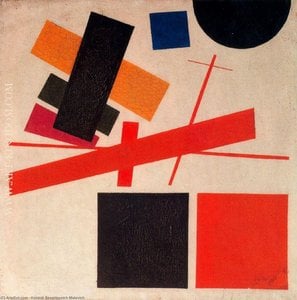
El Lissitzky’s “Wendingen,” created in 1921, is a striking example of early abstract art, deeply rooted in the Constructivist and Suprematist movements. This artwork isn't merely a painting but a cover design for the Dutch magazine "Wendingen," dedicated to modern architecture and design. It embodies Lissitzky’s vision of “Proun,” a concept aiming to synthesize architecture, engineering, and art into a dynamic visual language.
The artwork eschews representational imagery, instead presenting a purely abstract composition of geometric forms. Sharp angles, intersecting lines, and flat planes dominate the canvas, creating a sense of structured dynamism. Rectangles, circles, and diagonal lines interact to generate spatial tension and visual pathways.
“Wendingen” clearly reflects the principles of Constructivism, emphasizing functional design and geometric abstraction. It also draws from Suprematism, Malevich’s movement focused on pure artistic feeling through basic geometric forms. Lissitzky's unique approach integrates these influences, creating a style that is both rigorously structured and emotionally resonant.
The piece was designed as a cover for a magazine dedicated to modern architecture. This context highlights the artwork’s purpose: not just aesthetic beauty but also communication and visual impact within a design-focused publication. The stylized lettering of “WENDINGEN” integrated into the composition further emphasizes this functional aspect.
Lissitzky employed lithography, a printing technique that allows for precise lines and tonal variations. This method was ideal for reproducing the artwork’s sharp geometric forms and limited color palette.
The color scheme is deliberately restrained, featuring strong contrasts between red, gray, black, and beige against a neutral background. This simplicity enhances the clarity of the geometric shapes and prevents visual clutter. The texture appears smooth and flat, characteristic of a printed surface.
Created in 1921, “Wendingen” emerged from the aftermath of World War I and the Russian Revolution. It reflects the era’s desire for radical change and innovation across all fields – art, architecture, and society.
“Proun” concept aimed to transcend traditional artistic boundaries by uniting art, technology, and architecture. “Wendingen” serves as a visual manifestation of this ambition, suggesting a harmonious integration of these disciplines.
The artwork’s geometric forms can be interpreted as symbols of progress, order, and the potential for a new, rational world. The dynamic arrangement of shapes suggests movement and energy, reflecting the optimism and forward-looking spirit of the early 20th century.
Despite its abstract nature, “Wendingen” evokes a sense of visual harmony and balance. The carefully arranged geometric forms create a pleasing composition that is both intellectually stimulating and aesthetically satisfying.
Lissitzky’s work has had a lasting impact on graphic design, typography, and architectural aesthetics. “Wendingen” remains an iconic example of early modernism, inspiring generations of artists and designers.
Photo Description: --Overall Impression-- The artwork is a geometric abstract composition dominated by sharp angles and flat planes. It’s a square format painting with a predominantly beige background that serves as a neutral stage for the bold shapes and colors. The piece exemplifies Cubist and Constructivist influences, prioritizing form and structure over realistic representation. Compositionally, it's highly structured, utilizing intersecting lines and right angles to create a sense of dynamism and spatial tension. The subject matter is purely abstract; there are no recognizable objects or figures. Lines are used extensively – straight, diagonal, and slightly curved – defining the edges of the shapes and creating visual pathways across the canvas. Shapes are primarily rectangular and circular, with a strong emphasis on geometric precision. The texture appears smooth and flat, indicative of a printed surface rather than a sculpted one. Lighting is even and diffused, lacking any dramatic shadows or highlights. Perspective is deliberately flattened, eliminating traditional depth cues. Depth is achieved through overlapping planes and the suggestion of receding lines, but it’s not realistically rendered. The color palette is limited yet impactful, featuring strong contrasts between red, gray, black, and beige. The lettering ‘WENDINGEN’ in a stylized serif font is integrated into the composition on the left side. Symbolically, the artwork likely represents an exploration of form, structure, and spatial relationships – core tenets of early 20th-century abstraction. The technique appears to be primarily brushwork with a focus on clean lines and precise shapes. Materials used are likely oil paints on canvas. Size: Unknown Date: 1921 ARTIST INFORMATION: ================== Artist: El Lissitzky Birth Year: 1890 Death Year: 1941 Birth City: Pochinki Birth Country: Russia Biography:Het originele "Wendingen" bevindt zich in MoMA - Museum of Modern Art en het werk is bevindt zich in het publiek domein - de auteursrechten zijn verlopen.
"Wendingen" door El Lissitzky is vastgelegd met een Duidelijke kleurkracht verzadiging en een Levendig intensiteit.
Het formaat van "Wendingen" is Vierkant. Dit is handig bij het plannen van de plek waar een reproductie zal worden geplaatst.

Geboren als Lazar Markovich Lissitzky op 23 november 1890, betrad de man die later bekend zou worden als El Lissitzky een wereld van verstilde traditie in Pochinok. Deze kleine Joodse gemeenschap lag ongeveer 50 kilometer ten zuidoosten van Smolensk in het Russische Rijk. Zijn vader, Mordukh Zalmanovich Lissitzky, was een man van de letteren en van reizen, een hoogopgeleide agent die zich met een beheersing van het Engels en Duits door de wereld bewoog. Deze taalkundige breedte en de verbindingen van de familie met het bredere Europese landschap zouden uiteindelijk de expansieve, rusteloze energie van de kunstenaar zelf weerspiegelen. Of hij nu Elizar Lissitzky of Lasar Markowitsch Lissitzky werd genoemd, hij was een figuur van immense veelzijdigheid, die weigerde zich te laten beperken tot één enkel medium of één enkel doel.
Zijn creatieve nalatenschap was een weids en onvermoeibaar proces. Hij was een schilder en een illustrator, maar hij werkte ook als ontwerper, graficus en fotograaf. Zijn geest neigde naar het structurele, wat hem naar de domeinen van de architectuur en de precieze eisen van de typografie leidde. Hij was een man van het nieuwe tijdperk, een Russische en Sovjet-kunstenaar die probeerde iets tastbaars te bouwen uit de abstracte ideeën van zijn tijd. Zijn leven was een constante beweging tussen de rollen van een intellectuele ontdekkingsreiziger en een praktische vakman, een dualiteit die zijn vele bijdragen aan de visuele taal van de twintigste eeuw zou definiëren.
De fundamenten van zijn leven werden gelegd in het kleine Russische stadje Pochinok, maar zijn vroege jaren werden gekenmerkt door constante beweging. Tussen 1891 en 1898 maakte zijn familie deel uit van het leven in Vitebsk, een plek die later een diepe invloed zou uitoefenen op zijn begrip van culturele identiteit. Tegen 1899 was hij verhuisd naar Smolensk om bij zijn grootvader te wonen, waar hij de City School 1 bezocht. Juist tijdens deze vormende jaren kwam zijn aangeboren talent voor het eerst in aanraking met formele begeleiding; op dertienjarige leeftijd begon hij les te krijgen van Yury Pen, een leraar die het enorme potentieel in de jonge student herkende.
Ambitie stuit echter vaak op de weerstand van rigide systemen. In 1909 probeerde hij toegang te krijgen tot de Kunstacademie van Sint-Petersburg, maar zijn aanvraag werd afgewezen. Deze afwijzing was waarschijnlijk het gevolg van de restrictieve Joodse quota die door het tsaristische regime werden opgelegd, een barrière die zijn pad wegvoerde van de traditionele Russische academies. In plaats van toe te geven aan deze tegenslag, richtte hij zijn blik op Duitsland. Hij schreef zich in aan het Polytechnisch Instituut van Darmstadt om architectonisch ingenieur te studeren, een discipline die zijn latere visuele experimenten voor altijd een structurele logica zou verlenen. Hij bracht vijf jaar door in Duitsland, waarbij hij als metselaar werkte om in zijn levensonderhoud te voorzien en zijn vakanties doorbracht met het bezoeken van lokale Joodse historische locaties om hun vormen en decoraties te bestuderen.
Zijn tijd in Duitsland werd gedefinieerd door academische strengheid en een diepe betrokkenheid bij de fysieke wereld. Hij bestudeerde niet louter de theorie; hij doopte zichzelf in de praktische aspecten van constructie en ontwerp. Deze periode van intensieve training kwam tot een einde in 1914, toen hij cum laude afstudeerde aan het Polytechnisch Instituut van Darmstadt. Hij keerde terug naar Rusland, niet enkel als een kunststudent, maar als een opgeleid ingenieur, met een nauwkeurig begrip van ruimte en structuur dat uiteindelijk de grenzen van het moderne ontwerp zou herdefiniëren.
De koers van zijn creatieve leven veranderde ingrijpend toen hij Kazimir Malevich ontmoette. Deze ontmoeting trok hem in de baan van het Suprematisme, een beweging die streefde ernaar de kunst te ontdoen van alle representatieve ballast. In 1919 kwam er een uitnodiging van Marc Chagall, die hem vroeg om deel uit te maken van het docententeam van de Volkskunstschool in Vitebsk. Binnen deze educatieve setting werd hij lid van de Suprematistische groep UNovis, ook wel de 'Bevestigers van de Nieuwe Kunst' genoemd. Hij volgde echter niet simpelweg de gevestigde paden van zijn tijdgenoten; in plaats daarvan zocht hij de grenzen op van wat deze geometrische vormen konden bereiken.
Hij begon een eigenzinnige reeks werken te ontwikkelen die hij 'Proun' noemde, een term afgeleid van de Russische frase proyekt utverzhdenya novogo, wat staat voor 'project voor de bevestiging van het nieuwe'. Dit waren geen eenvoudige schilderijen, maar eerder diepgaande onderzoeken naar de interactie tussen ruimte en vorm. In 1919 voltooide hij zijn eerste Proun, wat het begin markeerde van een periode waarin hij de principes van de grafische kunsten versmolten met architecturaal denken. Zijn werk in deze jaren bewoog weg van de platte vlakken van de pure abstractie naar een complexer, driedimensionaal begrip van de wereld.
Tegen 1920 had El Lissitzky de puur spirituele zoektochten van zijn vroege jaren achter zich gelaten om de gestructureerde, doelgerichte energie van het Constructivisme te omarmen. Hij streefde ernaar de kunstenaar te transformeren van een eenzame dromer naar een actieve motor voor verandering, een concept dat hij begreep als das zielbewußte Schaffen, ofwel doelgerichte creatie. Deze overtuiging trok hem naar het hart van het Sovjet-onderwijssysteem, waar hij aan de Vkhutemas technische school lesgaf naast Vladimir Tatlin. Hier verschoof de focus naar de vraag hoe kunst zou kunnen functioneren binnen een moderne, industriële samenleving, waarbij de kunst zich verplaatste van het canvas naar het domein van de praktische, sociale bruikbaarheid.
Zijn werk raakte diep verweven met de politieke hartslag van die tijd. Hij wijdde een groot deel van zijn energie aan het ontwerpen van tentoonstellingsopstellingen en propagandawerken die probeerden de idealen van de nieuwe staat te communiceren. In een opvallend voorbeeld maakte hij in 1941 een poster die de bevolking opriep om meer tanks te bouwen in de strijd tegen nazi-Duitsland. Zelfs in zijn eerdere, meer abstracte composities was de politieke ondertoon vaak duidelijk aanwezig. Zijn werk uit 1920, Beat the Whites with the Red Wedge, maakte gebruik van scherpe geometrische vormen om in te gaan op de spanningen van die tijd, waarbij hij een visueel spel met een antisemitische slogan gebruikte om de revolutionaire zaak te steunen.
De hand van El Lissitzky bewoog voortdurend tussen de precisie van een ingenieur en de intuïtie van een schilder. Hij streefde ernaar de kloof tussen de fysieke wereld en het abstracte te overbruggen, waarbij hij vaak onderzocht hoe technologie en de menselijke ervaring elkaar konden ontmoeten via de visuele vorm. Dit kwam het duidelijkst naar voren in zijn Proun-werken, die fungeerden als een complexe versmelting van grafische kunst, architecturale vormen, fotografie en schilderkunst. Deze composities waren niet louter statische beelden, maar diepgaande onderzoeken naar ruimte en structuur. Hij maakte vaak gebruik van lithografie om zijn effecten te bereiken, een techniek die duurzame afdrukken en een breed scala aan tonale variaties mogelijk maakte, waardoor zijn geometrische vormen een tastbaar gevoel van diepte en gewicht kregen.
Zijn benadering van design werd gekenmerkt door een rusteloze experimenteerdrift met productietechnieken en stilistische middelen die uiteindelijk de visuele taal van de twintigste eeuw zouden definiëren. Hij bracht een scherp, innovatief oog naar typografie, boekontwerp en photomontage, waarbij hij de gedrukte pagina behandelde als een terrein voor architectonische constructie. Zelfs terwijl hij de radicale geometrie van de avant-garde omarmde, bleef zijn werk stilzwijgend verbonden met zijn wortels; hij verweefde elementen van de traditionele Joodse typografie, kunst en architectuur in zijn moderne composities. Deze versmelting van het eeuwenoude en het industriële stelde hem in staat om te navigeren door de spanning tussen culturele herinnering en het razendsnelle tempo van een veranderende samenleving.
De grenzen van de Russische avant-garde konden zijn rusteloze geest niet in toom houden. Tussen 1921 en 1925 trok hij door het hart van Europa, dwalend door Parijs, België, Italië en Zwitserland. Tijdens deze jaren in het buitenland fungeerde hij als een culturele ambassadeur voor de Weimarrepubliek, waarbij hij de radicale ideeën van zijn moederland naar het Westen bracht. Hij observeerde deze vreemde landschappen niet slechts; hij vormde hun visuele discours actief door bij te dragen aan kunsttijdschriften en boeken te publiceren die de traditionele manier van kijken uitdaagden. Zijn aanwezigheid in deze intellectuele centra zorgde ervoor dat de energie van de revolutie voelbaar was ver voorbij de grenzen van de Sovjet-Unie.
Zijn werk in Berlijn was van bijzonder grote betekenis. In 1922 ontwierp hij de Constructivistische tentoonstelling in de Galerie van Diemen, een onderneming die de structurele logica van zijn beweging introduceerde bij een nieuw publiek. Deze periode van intense uitwisseling werd gekenmerkt door samenwerkingen die verschillende artistieke kringen met elkaar verbonden. In 1924 werkte hij samen met Kurt Schwitters aan het periodiek Merz, een partnerschap dat uiteenlopende benaderingen van grafisch ontwerp en compositie met elkaar versmolten. Door deze connecties begon zijn invloed nog verder te reizen. Hij ontmoette Lászlo Moholy-Nagy, een ontmoeting die van cruciaal belang bleek, aangezien Moholy-Nagy hielp zijn concepten over West-Europa en naar de Verenigde Staten te verspreiden, waardoor zijn ideeën wortel konden schieten in het opkomende modernisme van het Westen.
De laatste jaren van het leven van El Lissitzky werden getekend door de zware schaduwen van wereldwijde conflicten en persoonlijke kwetsbaarheid. Terwijl de wereld wegzakte in de chaos van de oorlog, bleef zijn focus onlosmakelijk verbonden met de sociale en politieke realiteit van zijn tijd. Zelfs toen zijn gezondheid begon te bezwijken, bleef hij werken creëren die ingingen op de dringende behoeften van de staat. In 1941 maakte hij een Sovjet-propagandaposter die opriep tot de constructie van meer tanks om de nazi-invasie van Rusland te bestrijden. Deze laatste inspanning weerspiegelde een toewijding aan de praktische toepassing van kunst, zelfs op het moment dat de maatschappelijke structuren die hij juist wilde herontwerpen, werden bedreigd door de oorlog.
De strijd tegen de ziekte eiste uiteindelijk zijn tol. El Lissitzky overleed op 30 december 1941 in Moskou aan tuberculose. Hij was 51 jaar oud op het moment van zijn overlijden. Zijn dood vond plaats kort na de invasie van zijn land, een periode van immense omwenteling die samenviel met het einde van zijn creatieve levensloop. Hij liet een nalatenschap na van ontwerp en abstractie die al vele grenzen had overschreden, maar zijn eigen leven werd voortijdig afgebroken door het kruispunt van biologische en historische krachten.
De rimpelingen van zijn creatieve energie reikten veel verder dan de grenzen van de Sovjet-Unie en raakten de fundamenten van het Bauhaus en de constructivistische bewegingen. Hij schilderde niet louter; hij herdefinieerde de manier waarop mensen interageren met de ruimte om hen heen en de boodschappen die zij consumeren. Zijn experimenten met typografie en reclame transformeerden de wijze waarop informatie werd gestructureerd, waardoor de gedrukte pagina veranderde in een dynamisch krachtveld. Door zijn tentoonstellingsontwerpen leerde hij de toeschouwer dat een omgeving een gestructureerde ervaring kan zijn, in plaats van een statische verzameling objecten in een kamer.
Deze visie op kunst als een instrument voor sociale en visuele transformatie blijft tot op de dag van vandaag onze kijk op communicatie vormgeven. Zijn vermogen om de kloof tussen het abstracte en het functionele te overbruggen, liet een blauwdruk achter voor generaties ontwerpers. Om te waarborgen dat deze geschiedenis intact blijft, werd in 2014 de Lissitzky Foundation opgericht door de erfgenamen van de kunstenaar, het Van Abbemuseum en diverse wetenschappers. Deze inspanning bewaart zijn complexe geschiedenis en zorgt ervoor dat zijn onderzoek naar vorm en ruimte toegankelijk blijft voor hen die de evolutie van het moderne design bestuderen.
De fysieke sporen van zijn visie zijn verspreid over vele continenten, bewaard gebleven in instellingen die de radicale energie van het vroege twintigste eeuw wilden conserveren. In Lissabon is de aanwezigheid van zijn oeuvre aanzienlijk in het Museu Coleção Berardo, dat zes van zijn werken herbergt. Aan de andere kant van de Atlantische Oceaan bieden de collecties in New York twee verschillende manieren om zijn nalatenschap te ontmoeten; het Museum of Modern Art bezit twee stukken, terwijl The Jewish Museum er vijf in zijn collectie heeft. Deze werken bieden de toeschouwer de unieke kans om de evolutie van zijn grafische en abstracte taal te bestuderen binnen de context van grote internationale collecties.
Zijn invloed is tevens diep geworteld in Europa en Rusland. Het Museum Folkwang in Essen herbergt een enkel werk, een verstilde herinnering aan zijn reikwijdte binnen het Duitse kunstlandschap. In Rusland is zijn aanwezigheid voelbaar in het Taganrog Art Museum en het Novokuznetsk Art Museum, waar zijn bijdragen aan de avant-garde worden bewaard. Deze diverse bewaarplaatsen garanderen dat zijn experimenten met ruimte en vorm voortdurend worden bestudeerd door hen die de geschiedenis van het moderne design in kaart brengen.

1890 - 1941 , Rusland

Discover the sophisticated world of lithography. Explore the alchemy of stone and ink, the history of this master printmaking technique, and expert insights for discerning collectors seeking authentic, museum-quality art reproductions and bespoke commissions.

Explore 25 iconic Suprematist masterpieces by Kazimir Malevich. Discover the power of abstraction on WahooArt.com.

Explore 25 iconic Wassily Kandinsky masterpieces and the birth of abstraction. Discover the full collection online at WahooArt.com.

Explore the profound psychological depth of Roy Lichtenstein's color theory. An expert analysis for art collectors on how bold palettes and Ben-Day dots redefine modern aesthetics and luxury interior curation.

Elevate hospitality interiors with expert guidance on curating abstract art. Discover how to balance color, scale, and texture to create harmonious, luxurious spaces through bespoke oil reproductions and large-scale architectural masterpieces.
 Voorvertoning
 Verstuur
 Delen
Delen
 Details bekijken
 Gids
Gids

 Download
 Vergelijkbare items
 Röntgenonderzoek
 Diavoorstelling
 Vraag & antwoord
 Statistieken


 Lees meer









 De optie voor glas is alleen beschikbaar bij een formaat kleiner dan 110 cm.