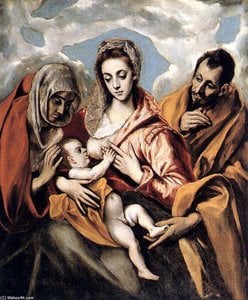
A Study in Monochrome: Exploring El Greco’s Quiet Intensity
Doménikos Theotokópoulos, universally known as El Greco – “The Greek” – stands apart from his contemporaries not merely through nationality but through a singular artistic vision that anticipates movements centuries ahead of its time. Born in Crete in 1541, under Venetian rule, his journey encompassed Venice and Rome before finding its definitive expression in the spiritual landscape of Spain: Toledo. El Greco wasn’t simply absorbing influences; he synthesized them into an aesthetic utterly his own—a Mannerist style characterized by elongated figures, dramatic lighting, and a palpable emotional resonance.
The Sketch's Essence: Technique and Composition
This monochrome sketch offers a glimpse into El Greco’s creative process. Rendered primarily in shades of brown and beige on aged paper—a testament to its provenance—the artwork speaks volumes about the artist’s approach. Loose, gestural lines dominate the surface, conveying immediacy rather than meticulous detail. Shapes are simplified by contour lines, minimizing shading and modeling; this deliberate restraint emphasizes form and posture above realistic representation.
- Technique: Charcoal or graphite sketch on paper – a hallmark of Renaissance drawing practice emphasizing observation and expressive line work.
- Composition: The figure occupies the vertical space, positioned slightly off-center to the left, creating visual balance while directing the viewer’s gaze.
Historical Context & Influences
El Greco's artistic development was profoundly shaped by Byzantine iconography and Venetian Renaissance ideals. However, he transcended these traditions, forging a path toward stylistic innovation. His signature “Krḗs” – Cretan – served as a proud declaration of his roots, mirroring the broader humanist spirit of the era.
Notably, this sketch echoes the monumental sculpture Laocoön and His Sons in Rome—a work that captivated El Greco’s imagination and influenced his compositional choices. The style anticipates Expressionism's emotive intensity and Cubism's fragmented forms, demonstrating El Greco’s visionary grasp of artistic trends.
Symbolic Resonance & Emotional Impact
At this stage, the sketch prioritizes conveying the figure’s posture and drapery—minimal symbolic elements serve to heighten the emotional impact. The aged paper texture adds depth and authenticity, inviting contemplation on themes of faith, spirituality, and human vulnerability. Like many of El Greco's paintings, it embodies a profound sense of melancholy and introspection.
Further Exploration
To delve deeper into El Greco’s artistic legacy, consider visiting the Museo de El Greco in Toledo, Spain—a meticulously recreated 16th-century home housing an impressive collection of his masterpieces. Admire ‘Christ on the Cross Adored by Donors,’ ‘Christ,’ and explore the Cathedral of Toledo, where you can witness El Greco's monumental paintings alongside Gothic grandeur.
Veelgestelde vragen
In welke ruimte wordt het tonen van "not identified" aanbevolen, gezien het kleurenpalet?
Met zijn Neutrals palet wordt "not identified" door El Greco aanbevolen voor een Hotel Lobby. De kleuren zijn een van de redenen voor dit advies.
Zijn de kleuren van "not identified" levendig of gedempt?
"not identified" door El Greco is vastgelegd met een Balanced Soft verzadiging en een Balanced intensiteit.
Welk kleurenpalet wordt gebruikt in "not identified" door El Greco?
De kleuren van "not identified" vormen een Neutrals palet. Deze classificatie beschrijft de dominante kleurfamilies.



 Voorvertoning
 Bestel handgeschilderde reproductie
 Verstuur
 Delen
Delen
 Details bekijken
 Gids
Gids

 Download
 Vergelijkbare items
 Röntgenonderzoek
 Diavoorstelling
 Q&A
Q&A Statistieken
 Lees meer






































 De optie voor glas is alleen beschikbaar bij een formaat kleiner dan 110 cm.