Koop een digitale afbeelding in hoge resolutie met verbeterde kwaliteit, die veel superieur is aan de online voorvertoning.
Elk bestand wordt met uiterste precisie voorbereid door onze interne specialisten, met behulp van geavanceerde tools en deskundige handmatige retouche. Wij garanderen dat elke afbeelding een uitzonderlijke helderheid, nauwkeurige kleurweergave en verfijnde details bezit.
Het uiteindelijke bestand wordt binnen 72 uur per e-mail geleverd, geoptimaliseerd voor direct gebruik in professionele, redactionele en printomgevingen. Dit is dezelfde kwaliteit waarop vooraanstaande designstudio's, uitgevers en galerieën vertrouwen.
Download een bestand met hoge resolutie voor persoonlijke weergave, afdrukken en creatieve projecten. ( Bestel print Bestel handgeschilderde reproductie)
Wanneer u kiest voor WahooArt.com, ontvangt u niet alleen een afbeelding – u krijgt een professioneel verbeterd digitaal kunstwerk, met precisie vervaardigd en voorzien van een tevredenheidsgarantie. Dit is alles wat automatisch bij uw bestelling is inbegrepen:

Uw hoogwaardige digitale afbeeldingsbestand wordt binnen 72 uur na bestelling naar u gemaild – klaar voor direct gebruik.

Uw kunstwerk wordt professioneel geoptimaliseerd met behulp van geavanceerde AI-tools en handmatige bewerkingen, waardoor maximale details, helderheid en kleurnauwkeurigheid worden gegarandeerd.

Je bestand per ongeluk verwijderd of kwijtgeraakt? Geen zorgen – we sturen het u op elk gewenst moment gratis opnieuw toe.

Geniet direct van uw kunstwerk zonder invoerrechten, belastingen of verzendkosten – digitale downloads zijn altijd belastingvrij.

Met behulp van professionele hulpmiddelen en kleurbeheer zorgen wij ervoor dat uw digitale afbeelding de originele kleuren zo nauwkeurig mogelijk weergeeft.

Als u niet tevreden bent met uw digitale afbeelding, passen wij deze aan of storten wij 100% terug binnen 100 dagen - zonder vragen te stellen.

Niet tevreden? Ontvang een volledige terugbetaling binnen 100 dagen na ontvangst van uw digitale bestand - zonder vragen te stellen.

Koop 3 afbeeldingen, bespaar 10% - Koop 5, bespaar 15% - Koop 10+, bespaar 20%. Ideaal voor creatieve projecten, galerieën en bureaus.
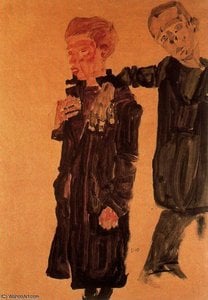
Egon Schiele's “Child in Black,” painted in 1911, isn’t merely a portrait; it’s a distilled essence of anxiety and nascent sexuality, a haunting glimpse into the artist’s intensely personal world. Created during a period of profound upheaval – both personally and within European art – this watercolor captures a young figure, likely a girl, rendered with an unsettling directness that speaks volumes about Schiele's fascination with vulnerability and the darker aspects of human experience. The painting immediately draws the viewer in with its muted palette—a symphony of grays, blacks, and subtle blues—creating an atmosphere of quiet contemplation tinged with unease. It’s a visual embodiment of Expressionism’s core tenets: prioritizing emotional impact over realistic representation.
To truly appreciate “Child in Black,” one must understand the turbulent backdrop against which it was created. Born in 1890 in Tulln an der Donau, Austria, Egon Schiele’s life was tragically shaped by illness and loss from a young age. The death of his father, a railway station master, due to syphilis at just fourteen profoundly impacted him, fueling a lifelong preoccupation with mortality and the fragility of existence. This early trauma, coupled with the subsequent loss of his sister Elvira, instilled in Schiele a deep-seated sense of melancholy and an unflinching gaze upon the human condition. His uncle’s guardianship, marked by control and disapproval of his artistic pursuits, further contributed to his independent spirit and rebellious nature – qualities that would become hallmarks of his work. The painting can be seen as a direct reflection of this internal struggle, a visual manifestation of grief and uncertainty.
Schiele’s mastery lies in his distinctive technique—a raw, almost violent application of watercolor. Notice the loose, gestural lines that define the child's form; they aren’t precise or idealized but rather convey a sense of immediacy and emotional intensity. The figure is rendered with an unsettling lack of detail, emphasizing its vulnerability and drawing attention to the subtle shifts in expression—a slight tilt of the head, a downward gaze – that hint at inner turmoil. The use of color is equally deliberate: the dominant blacks and grays create a somber mood, while small touches of blue suggest a melancholic longing. The background, with its indistinct wall and cryptic writing (likely a title or description), further isolates the child, intensifying the sense of loneliness and introspection. It’s a technique that prioritizes feeling over form, echoing the core principles of Expressionism.
“Child in Black” is rich with symbolic potential. The child herself represents innocence—a fleeting, vulnerable state threatened by the encroaching realities of life and death. The black clothing could symbolize mourning or a sense of impending doom, while the hat adds an element of defiance, suggesting a quiet resistance to the forces that seek to diminish her spirit. The painting’s overall atmosphere evokes a sense of unease, prompting viewers to contemplate themes of mortality, loss, and the complexities of human emotion. It's not a cheerful portrait; it’s a poignant meditation on the darker aspects of existence—a subject Schiele explored relentlessly throughout his tragically short career. The ambiguity surrounding the child’s identity further enhances the painting’s power, inviting viewers to project their own anxieties and interpretations onto the scene.
WahooArt offers meticulously crafted hand-painted reproductions of “Child in Black,” allowing you to bring this powerful work of art into your home or office. Each reproduction is created by skilled artists using archival-quality materials, ensuring that it captures the essence and emotional depth of Schiele’s original masterpiece. Explore our collection today and experience the haunting beauty of “Child in Black” firsthand.


1890 - 1918 , Oostenrijk

 Voorvertoning
 Verstuur
 Delen
Delen
 Details bekijken

 Download
 Vergelijkbare items
 Röntgenonderzoek
 Diavoorstelling

 Lees meer