GRATIS KUNSTADVIES

x
Print kopen Print kopenKoop afbeelding in hoge resolutie Koop afbeelding in hoge resolutie VerstuurVerstuur
DetailsDetails Toevoegen aan favorieten Toevoegen aan favorieten DownloadDownload Vergelijkbare werkenVergelijkbare werken RöntgenfotoRöntgenfoto DiavoorstellingDiavoorstelling

Evening Wind

Experience the haunting beauty of Edward Hopper’s ‘Evening Wind,’ a masterful depiction of quiet contemplation and urban isolation rendered in striking black and white drypoint etching.

Edward Hopper: Een meester van Amerikaanse realisme, vangt eenzaamheid en stedelijk leven met evocatieve licht & schaduw. Ontdek iconische schilderijen zoals Nighthawks.

Handgemaakte olieverfreproductie

Met de hand geschilderd in olieverf op canvas in uw gewenste maat en lijst, op bestelling gemaakt door onze kunstenaars.

Standard
custom
CM
INCH

Kies uit onze vooraf ingestelde maten die overeenkomen met de originele verhoudingen van het kunstwerk.

breedte
hoogte

U kunt uw eigen afmetingen invoeren om in een specifieke lijst of ruimte te passen. Als de door u gekozen maat niet overeenkomt met de verhoudingen van het originele beeld, zullen we het kunstwerk bijsnijden of het schilderij uitbreiden met extra handgeschilderde elementen. Een digitale mockup wordt ter goedkeuring naar u verzonden voordat de productie begint.
Houd er rekening mee dat de preview op het scherm niet de werkelijke uitsnede of uitbreiding weergeeft. Alleen de mockup toont de uiteindelijke compositie nauwkeurig.
Hoewel aangepaste afmetingen mogelijk zijn, raden we aan een maat uit de vooraf gedefinieerde lijst te selecteren om de originele verhoudingen te behouden.

Voorbeelden van aanpassingen: Vervang het gezicht met een eigen foto; Voeg een huisdier toe (bijv. vervang de kat door een hond); Verwerk een verborgen boodschap in de achtergrond; Wijzig het landschap of andere elementen in de achtergrond.
Na de bestelling zal het team van WahooArt.com per e-mail contact opnemen voor instructies en een mockup-voorbeeld sturen.

Wereldwijde levering () binnen 3/4 weken in plaats van de standaard 5 weken. (2 juli). Geen concessies aan de kwaliteit.

why_choose_icon
Gratis wereldwijde expressverzending
why_choose_icon
Hoogwaardig linnen canvas
why_choose_icon
Volledige verzendverzekering
why_choose_icon
Garantie op terugbetaling van invoerrechten
why_choose_icon
Garantie op exacte kleurweergave
why_choose_icon
60 dagen retourbeleid (alleen bij defecten)
why_choose_icon
100% Geld-terug-garantie
why_choose_icon
Korting bij meerdere afnames

Totaalprijs

-

reproduction

Evening Wind

Techniek reproductie

Afmetingen reproductie

-

Eindtotaal

-

Snelle feiten

  • Influences: Romanticism
  • Subject or theme: Solitude; Introspection
  • Title: Evening Wind
  • Artistic style: Expressionist tendencies
  • Movement: Realism
  • Artist: Edward Hopper

Kunstquiz

Er is slechts één correct antwoord op elke vraag.

Vraag 1:
What artistic style is predominantly associated with Edward Hopper’s ‘Evening Wind’?
Vraag 2:
The image description highlights the use of hatching and crosshatching techniques. What is the primary purpose of these techniques in this artwork?
Vraag 3:
According to the description, what is the dominant mood evoked by ‘Evening Wind’?
Vraag 4:
What compositional element contributes to the feeling of voyeurism or observation in ‘Evening Wind’?
Vraag 5:
What material was likely used to create ‘Evening Wind’?

Beschrijving kunstwerk

Evening Wind: A Portrait of Quiet Contemplation

Edward Hopper’s “Evening Wind,” executed in 1930, stands as a quintessential emblem of American Modernism—a deceptively simple image brimming with psychological depth and masterful artistic execution. More than just a depiction of a woman kneeling beside a bed, it's an exploration of solitude, vulnerability, and the unspoken narratives that reside within domestic spaces during the Jazz Age.

  • Composition & Perspective: The photograph’s central focus is undeniably the figure seated near the bed. Hopper employs a slightly elevated viewpoint, subtly inviting the viewer into a voyeuristic gaze upon this intimate scene. This perspective emphasizes the woman's isolation and reinforces the feeling of observation—a hallmark of Hopper’s signature style.
  • Technique & Material: Crafted primarily through drypoint etching or engraving, “Evening Wind” showcases Hopper’s meticulous attention to detail. The process involved meticulously transferring an image onto a metal plate (typically copper or zinc), etching lines with needle tools, and subsequently applying ink before printing onto paper—a technique that guarantees exceptional tonal control and textural nuance.
  • Color Palette & Lighting: Stripped down to a monochrome grayscale scheme, the artwork prioritizes form and tonal contrast. Shades of gray ranging from deep blacks to pale whites dominate the canvas, mirroring the subdued atmosphere of the scene and highlighting Hopper’s masterful manipulation of light and shadow. The unseen source of illumination casts dramatic shadows, accentuating contours and creating a palpable sense of depth.
  • Symbolism & Emotional Impact: Beyond its formal qualities, “Evening Wind” resonates with profound symbolic significance. The billowing sheets serve as potent metaphors for emotional turbulence—representing unrest and perhaps hinting at inner turmoil. Simultaneously, the woman’s posture embodies vulnerability and contemplation, prompting viewers to ponder themes of introspection and longing.
  • Historical Context: Produced during a period marked by rapid urbanization and societal shifts, “Evening Wind” reflects the anxieties and uncertainties inherent in the burgeoning modern world. Hopper's work aligns with Expressionist tendencies, prioritizing emotional resonance over literal representation—a deliberate choice that captures the essence of human experience amidst the impersonal backdrop of urban life.

“Evening Wind” transcends mere visual aesthetics; it’s a window into Hopper’s artistic vision and his ability to distill complex emotions into a single, unforgettable image. Its enduring appeal lies in its capacity to evoke contemplation and resonate with viewers who appreciate the subtle beauty of understated realism.


Biografie van de kunstenaar

A Solitude Observed: The Life and Art of Edward Hopper

Edward Hopper, a name inextricably linked to the quietude and subtle melancholy that permeated 20th-century American life, wasn’t simply a painter of scenes; he was a poet of light and shadow, a chronicler of modern isolation. Born in Nyack, New York, in 1882, to middle-class parents of Dutch ancestry, Hopper's early years provided a stable upbringing that nurtured his artistic inclinations. From childhood sketches meticulously dated and signed, it became evident that keen observation and an innate talent for drawing were central to his being. Though initially encouraged towards commercial illustration – a pragmatic suggestion from his parents – Hopper’s ambitions leaned toward fine art, leading him to the New York School of Art where he studied under William Merritt Chase and Robert Henri. These formative years instilled not only technical skill but also an appreciation for realism and a commitment to depicting the world as he saw it—unvarnished and honest. The writings of Ralph Waldo Emerson resonated deeply with Hopper, reinforcing his sense of individualism and acute observation – qualities that would become hallmarks of his artistic vision. Early travels to Paris exposed him to Impressionism, yet Hopper quickly diverged from its fleeting brushstrokes, forging a path uniquely his own.

Finding His Voice: Realism and the American Scene

Hopper’s artistic journey wasn't immediate or effortless. He grappled with discovering his distinctive voice, experimenting with various styles before settling into the realism that would define his career. This wasn’t mere replication of reality; it was a distillation of its essence, stripping away extraneous detail to reveal underlying emotional truths. His paintings began to focus on everyday scenes – houses, diners, offices, hotel rooms – imbued with a sense of stillness and often, loneliness. He possessed an extraordinary ability to capture the psychological states of his subjects, hinting at narratives without explicitly stating them. The precise rendering of light and shadow became crucial, not merely as descriptive elements but as emotional cues, creating atmospheres that were both captivating and unsettling. House by the Railroad (1925), an early masterpiece, exemplifies this approach—a seemingly simple composition radiating a profound sense of isolation and mystery. Hopper’s printmaking, often overlooked, ran parallel to his painting, sharing similar themes and stylistic qualities, demonstrating his mastery across mediums. He wasn't interested in grand historical narratives or allegorical symbolism; he focused on the mundane, elevating it through careful observation and emotional resonance.

Iconic Visions: Nighthawks and Beyond

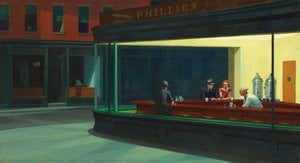
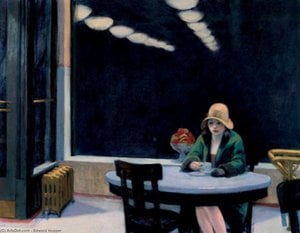
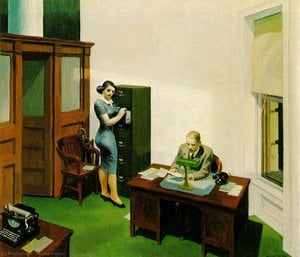
While Hopper’s career unfolded gradually, certain works catapulted him to widespread recognition. Nighthawks (1942), arguably his most famous painting, became an instant icon of American culture. The late-night diner scene, bathed in stark fluorescent light, perfectly encapsulates the alienation and anonymity of modern urban life. The figures within are lost in their own thoughts, disconnected from one another despite their proximity—a poignant commentary on the human condition. Gas (1940), with its striking portrayal of a roadside gas station, showcases Hopper’s fascination with American landscapes and the burgeoning automobile culture. Other notable works like *Automat*, *Office in a Small City*, and *Summertime* each offer unique insights into the complexities of 20th-century American society. These paintings weren't merely depictions of places; they were explorations of mood, psychology, and the subtle dramas unfolding within ordinary settings. His wife, Josephine Nivison Hopper, played a vital role not only as his lifelong companion but also as a frequent model, contributing significantly to the characterization of his female figures.

Themes and Legacy: A Lasting Influence

Several recurring themes permeate Hopper’s oeuvre. Urban isolation is perhaps the most prominent—the sense of loneliness experienced by individuals even amidst crowds. He explored the American landscape, both rural and urban, often emphasizing its starkness and emptiness. His work delves into psychological realism, probing the inner lives of his subjects with a sensitivity that transcends mere representation. There’s also an undercurrent of nostalgia for a simpler past, juxtaposed with an acknowledgement of the complexities and anxieties of modern life. Hopper's influence on subsequent artists is undeniable. His unique style has inspired countless painters, including Pierre Sanford Ross, and continues to resonate with contemporary artists seeking to capture the essence of human experience. His paintings remain highly sought after by collectors and are exhibited in major museums worldwide, solidifying his place as a pivotal figure in American art history. More than just an artist, Edward Hopper was a visual philosopher, offering profound insights into the human condition through his masterful use of light, shadow, and composition.
  • His legacy lies not only in the beauty of his paintings but also in their enduring ability to provoke thought, evoke emotion, and remind us of the quiet solitude that often defines our lives.
  • Hopper’s work continues to captivate audiences because it speaks to universal themes of loneliness, isolation, and the search for meaning in a rapidly changing world.
  • His paintings have become iconic representations of American culture, often used to symbolize the anxieties and aspirations of the 20th century—and beyond.
  • Hopper’s aesthetic has profoundly influenced filmmakers (like Alfred Hitchcock) and writers, inspiring countless works that explore similar themes of alienation and psychological tension.
Edward Hopper's ability to capture the essence of modern American life with honesty, sensitivity, and a distinctive artistic vision ensures his place as one of the most important artists of the 20th century.
Edward Hopper

Edward Hopper

1931 - 1967 , Verenigde Staten van Amerika

Belangrijkste feiten

  • Artistic Movement Or Style: Realisme
  • Artists Or Movements Influenced By This Artist: ['Ross']
  • Artists Who Influenced This Artist:
    • Chase
    • Henri
  • Date Of Birth: 22 juli 1882
  • Date Of Death: 15 mei 1967
  • Full Name: Edward Hopper
  • Nationality: Amerikaans
  • Notable Artworks:
    • Nighthawks
    • House
    • Gas
  • Place Of Birth: Nyack, USA
Ontdek kunstwerken georganiseerd op thema's, stijlen en kenmerken.