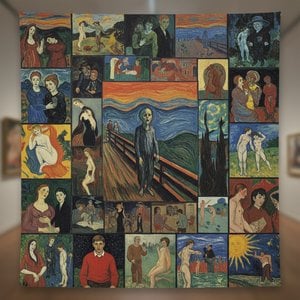
A Study in Silent Anguish: Unpacking Edvard Munch’s ‘Untitled (8227)’
Before us lies a profoundly unsettling portrait, an image that immediately evokes the shadowed depths of the human psyche. This black and white rendition of a man – identified only as “Untitled (8227)” – isn't merely a likeness; it’s a carefully constructed embodiment of anxiety, isolation, and perhaps even a premonition of mortality. The painting, executed by the Norwegian Expressionist master Edvard Munch, transcends simple representation, plunging the viewer directly into the artist’s intensely personal world of emotional experience. The stark contrast between light and shadow, the deliberate flatness of the composition, and the subject's impassive yet subtly troubled gaze all contribute to a palpable sense of unease – a feeling that resonates deeply with the spirit of Munch’s oeuvre.

The Artist’s Burden: Contextualizing a Life of Loss
To truly appreciate ‘Untitled (8227)’, one must understand the formative experiences that shaped Edvard Munch's artistic vision. Born in 1863 amidst a landscape scarred by illness and premature death – his mother succumbed to tuberculosis when he was five, followed tragically by his sister Johanne Sophie just two years later – Munch’s childhood was steeped in grief and a pervasive awareness of fragility. His father, a strict religious man, instilled within him a sense of dread and an acute sensitivity to the darker aspects of human existence. These early traumas weren't simply biographical details; they became the bedrock upon which he built his artistic language, fueling a relentless exploration of themes like death, anxiety, and the struggle for connection in a world seemingly indifferent to suffering. As Munch himself famously stated, “I have tried to depict the workings of my soul.” This painting is a potent manifestation of that very endeavor.
The influence of his father’s beliefs, combined with his own struggles with mental health and the unsettling atmosphere of his family life, created an environment ripe for artistic expression. Munch's exploration of these themes extended beyond personal experience; he was deeply influenced by contemporary philosophical currents, particularly those questioning traditional religious dogma and exploring the nature of human consciousness.
Deconstructing the Image: Symbolism and Technique
The composition itself is deliberately unsettling. The man’s posture – seated rigidly in a chair positioned behind him – creates an immediate sense of detachment and introspection. His expression, though seemingly neutral, hints at a profound inner turmoil; the slight furrow of his brow, the downward turn of his mouth, all contribute to this feeling of suppressed anguish. The inclusion of books scattered around him suggests a mind grappling with ideas, perhaps seeking solace or understanding in knowledge, yet ultimately unable to escape the weight of his emotions. The two additional chairs further emphasize his isolation and the difficulty he has connecting with others.
Munch’s masterful use of black and white photography lends the image an almost photographic realism, intensifying its emotional impact. The stark contrasts heighten the sense of drama and underscore the subject's vulnerability. The deliberate lack of color forces the viewer to focus entirely on the figure’s expression and posture, amplifying the feeling of unease. This technique is characteristic of Munch’s approach – he sought to capture not just appearances but the very essence of human emotion.
A Legacy of Anxiety: ‘Untitled (8227)’ in the 20th Century
‘Untitled (8227)’ stands as a powerful testament to Munch’s ability to translate personal suffering into universal themes. It resonates with viewers today precisely because it taps into our own anxieties about mortality, isolation, and the complexities of human relationships. The painting's exploration of psychological states anticipated many of the concerns that would dominate 20th-century art and literature – particularly the rise of Expressionism and its focus on subjective experience. Reproductions of this work continue to be studied and admired for their ability to evoke a profound emotional response, cementing Munch’s place as one of the most important artists in modern history. WahooArt offers exceptional hand-painted reproductions that capture the essence of this iconic image, allowing you to bring its haunting beauty into your own space.



 Bestel schilderij
 Verstuur
 Delen
Delen
 Details

 Download
 Vergelijkbare werken
 Röntgenfoto
 Diavoorstelling

 Lees meer






































 De optie voor glas is alleen beschikbaar bij een formaat kleiner dan 110 cm.