The Architect of Vision: The Life and Legacy of David Loggan
In the grand tapestry of seventeenth-century English art, few names evoke the meticulous precision and architectural splendor of David Loggan. A master of the Baroque era, Loggan possessed a rare ability to translate the heavy, stone-bound majesty of academic institutions into the delicate, flowing lines of engraving. His journey began far from the spires of Oxford, in the vibrant, maritime atmosphere of Danzig. Born in 1634, his early years were shaped by the rich artistic currents of Northern Europe. Under the guidance of masters such as Willem Hondius in Amsterdam and Crispin van de Passe II, Loggan developed a technical virtuosity that would later allow him to capture the very soul of English architecture through the medium of print.
Loggan’s migration to London in the late 1650s marked a transformative chapter in his career. Navigating a city often gripped by the shadows of plague and political upheaval, he established himself not merely as an engraver, but as a vital figure within the artistic and social fabric of the capital. His talent for miniature portraits—specifically his exquisite plumbago drawings—endeared him to the aristocratic circles of Leicester Fields. By acting as both an artist and an agent for wealthy patrons in their acquisition of fine works, Loggan positioned himself at the intersection of commerce and high culture, a role that required both aesthetic sensitivity and shrewd social navigation.
A Monumental Documentation of Oxford and Cambridge
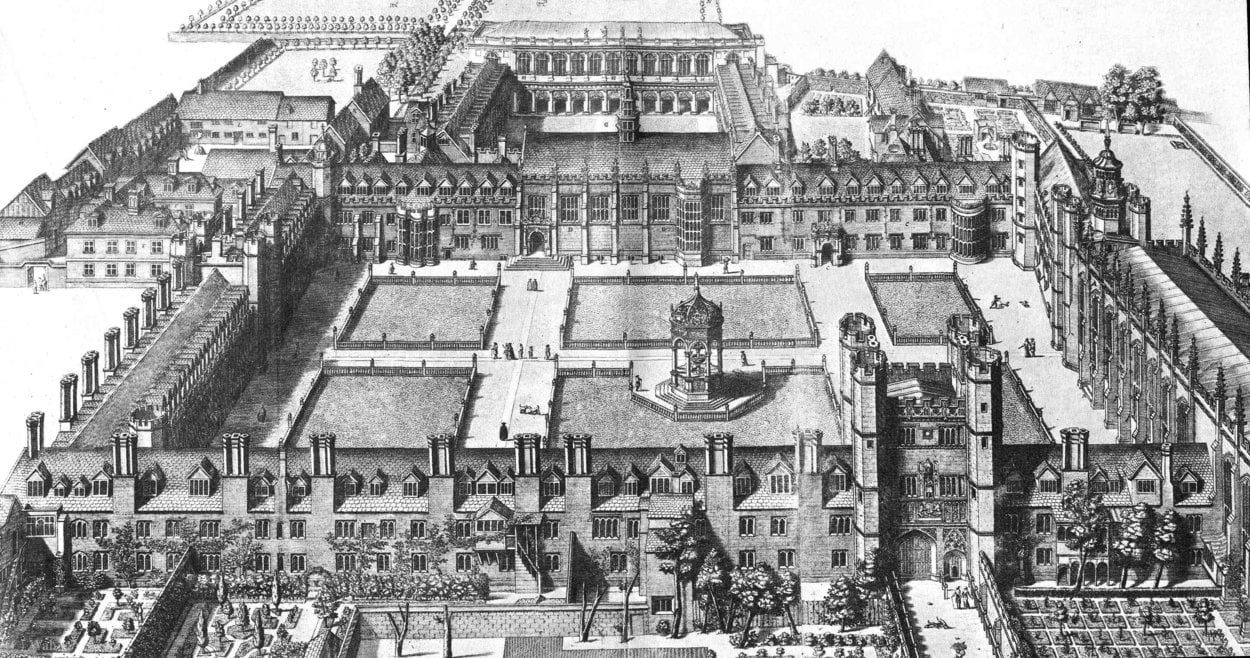
The true zenith of Loggan’s contribution to art history lies in his monumental topographical achievements. His appointment as the "Public Sculptor" to the University of Oxford provided him with the ultimate canvas: the storied colleges of the realm. This period of intense scholarly and artistic devotion culminated in the publication of Oxonia Illustrata in 1675. This breathtaking folio, produced with the assistance of Robert White, offered the world unparalleled bird’s-eye views of Oxford’s collegiate landscape. Through his engraver's burin, Loggan did more than map buildings; he captured the atmosphere of intellectual sanctuary, rendering Gothic grandeur and urban life with a clarity that remains historically indispensable.
His ambition did not rest solely with the spires of Oxford. Loggan turned his gaze toward Cambridge, embarking on an equally rigorous undertaking. The resulting Cantabrigia Illustrata, published in 1690, stands as a companion piece to his earlier masterpiece, documenting the colleges and even Eton College with the same unwavering commitment to accuracy and artistic subtlety. His work serves as a visual bridge between the medieval past and the burgeoning scientific precision of the late seventeenth century, ensuring that the architectural heritage of these great universities was preserved for posterity in a form that was both beautiful and scientifically rigorous.
Artistic Mastery and Historical Significance
To study the works of David Loggan is to witness the marriage of draughtsmanship and topography. His technique allowed him to navigate the complexities of light and shadow, giving depth to stone facades and life to the bustling streets beneath them. His legacy is defined by several key pillars of achievement:
- Technical Precision: The ability to render intricate Gothic details and complex architectural perspectives with mathematical accuracy.
- Topographical Legacy: Creating the definitive visual record of England's most prestigious academic institutions during the Baroque period.
- Versatility of Medium: Excelling in diverse forms, from the delicate intimacy of miniature portraits to the large-scale grandeur of monumental folios.
- Cultural Documentation: Providing a window into the social and architectural landscape of 17th-century England, capturing an era of profound transition.
Ultimately, David Loggan was much more than a mere chronicler of buildings; he was an artist who understood that architecture is the stage upon which history unfolds. Through his engravings, the stone walls of King’s College Chapel or Emmanuel College became living entities, frozen in a moment of eternal grace. His work remains a cornerstone of British printmaking, inviting every generation to rediscover the enduring majesty of the academic world through his incomparable vision.



 Voorvertoning
 Bestel print
 Verstuur
 Delen
Delen
 Details bekijken

 Download
 Vergelijkbare items
 Röntgenonderzoek
 Diavoorstelling
 Lees meer





