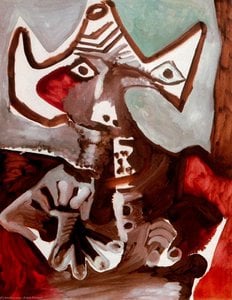
Ontvang een bestand dat klaar is voor drukwerk en de kwaliteit van het online voorbeeld ver overstijgt. Elke digitale afbeelding die wij verkopen, is afkomstig van een high-resolution master uit onze database — meestal tussen de 5.000 en 15.000 pixels breed — zodat u met vertrouwen groot kunt afdrukken, nauwkeurig kunt bijsnijden of fijne details kunt reproduceren.
Geen enkel bestand verlaat ons atelier onbewerkt. Een digitaal expert controleert de kleuren aan de hand van het originele schilderij en corrigeert deze indien nodig, om vervolgens de helderheid en details te verbeteren met professionele retoucheertechnieken — waarbij de penseelstreek en stijl van de kunstenaar altijd strikt worden gerespecteerd. Het resultaat is een afbeelding die oogt als het schilderij zelf, en niet als een gescande foto met een filter.
U keurt de afbeelding goed voordat de bestelling wordt afgerond: onze expert stuurt u binnen 72 uur een e-mail ter beoordeling. Niet tevreden? Vraag om aanpassingen of correcties, of vraag een terugbetaling aan als de kwaliteit niet aan de verwachtingen voldoet.
Dit is de kwaliteit waarop uitgevers, designstudio's, galeries en drukkerijen vertrouwen.
Download een bestand met hoge resolutie voor persoonlijke weergave, afdrukken en creatieve projecten. ( Schakel over naar print Bestel handgeschilderde reproductie)
Wanneer u kiest voor WahooArt.com, ontvangt u niet alleen een afbeelding – u krijgt een professioneel verbeterd digitaal kunstwerk, met precisie vervaardigd en voorzien van een tevredenheidsgarantie. Dit is alles wat automatisch bij uw bestelling is inbegrepen:
Uw hoogwaardige digitale afbeeldingsbestand wordt binnen 72 uur na bestelling naar u gemaild – klaar voor direct gebruik.
Uw kunstwerk wordt professioneel geoptimaliseerd met behulp van geavanceerde AI-tools en handmatige bewerkingen, waardoor maximale details, helderheid en kleurnauwkeurigheid worden gegarandeerd.
Je bestand per ongeluk verwijderd of kwijtgeraakt? Geen zorgen – we sturen het u op elk gewenst moment gratis opnieuw toe.
Geniet direct van uw kunstwerk zonder invoerrechten, belastingen of verzendkosten – digitale downloads zijn altijd belastingvrij.
Met behulp van professionele hulpmiddelen en kleurbeheer zorgen wij ervoor dat uw digitale afbeelding de originele kleuren zo nauwkeurig mogelijk weergeeft.
Mocht u niet tevreden zijn met uw digitale afbeelding, dan passen wij deze aan of storten wij 100% terug binnen 100 dagen – zonder vragen te stellen.
Niet tevreden? Ontvang een volledige terugbetaling binnen 100 dagen na ontvangst van uw digitale bestand – zonder vragen te stellen.
Koop 3 afbeeldingen, bespaar 10% - Koop 5, bespaar 15% - Koop 10+, bespaar 20%. Ideaal voor creatieve projecten, galerieën en bureaus.

In the vibrant, often jarring landscape of late twentieth-century American art, few voices resonated with as much psychological depth and formal precision as Christina Ramberg. Born in 1946 on the Kentucky military base of Camp Campbell, Ramberg’s early years were defined by a nomadic existence, shaped by her father’s service in the United States Army. This transient childhood, which saw her living in diverse locales such as Yokohama, Japan, and various regions of Germany, instilled in her an international perspective that would later inform the layered, culturally complex imagery of her work. Her journey eventually led her to the School of the Art Institute of Chicago (SAIC), a destination that would become the crucible for her artistic identity.
It was within the halls of SAIC that Ramberg encountered the transformative influence of Ray Yoshida. A mentor of profound significance, Yoshida encouraged his students to look beyond the traditional canons of fine art, urging them to find inspiration in the ubiquitous textures of popular culture—from the gritty lines of underground comic books to the glossy surfaces of commercial magazines. This pedagogical freedom allowed Ramseb to develop a visual language that was simultaneously high-art and pop-inflected, blending the meticulousness of classical draftsmanship with the subversive energy of Pop Art and Surrealism.
Ramberg’s oeuvre is most famously associated with the Chicago Imagists, a group of artists who rejected the prevailing trends of Minimalism and Conceptualism in favor of a more representational, often visceral, approach to painting. Her work became a profound interrogation of the female form, yet she avoided the clichés of traditional portraiture. Instead, she focused on partial bodies—heads, torsos, and hands—often presented in states of tension or compression. Through her use of bold geometric shapes and a highly controlled, almost clinical technique, she depicted figures encased in mid-century undergarments, such as corsets and girdles.
These garments were not merely clothing; they functioned as architectural metaphors for societal expectations. The way the fabric pressed against the skin or constrained the limbs served to illustrate a sense of female vulnerability and the psychological weight of gendered norms. Her compositions often possessed an eerie, dreamlike quality, where the boundaries between the organic body and the rigid, manufactured object became blurred. This tension created a unique brand of Pop Surrealism, where the familiar objects of domesticity were reimagined as instruments of both adornment and entrapment.
The significance of Christina Ramberg lies in her ability to navigate the intersection of the personal and the political without sacrificing aesthetic beauty. While her work touched upon the burgeoning feminist discourses of the 1970s, it did so through a sophisticated lens of abstraction and formal experimentation. She did not merely depict struggle; she sculpted it into the very fabric of her compositions.
Throughout her career, Ramberg achieved remarkable milestones that cemented her place in art history:
Though her life was tragically cut short in 1995, Ramberg’s impact remains indelible. Her paintings continue to challenge viewers to contemplate the structures—both physical and social—that shape our identities. In every meticulously rendered line and every compressed silhouette, her work stands as a testament to the enduring power of art to expose the complexities of the human condition.

1946 - 1995 , United States of America
 Voorvertoning
 Verstuur
 Delen
Delen
 Details bekijken
 Gids
Gids

 Download
 Vergelijkbare items
 Röntgenonderzoek
 Diavoorstelling
 Vraag & antwoord
 Statistieken

 Lees meer