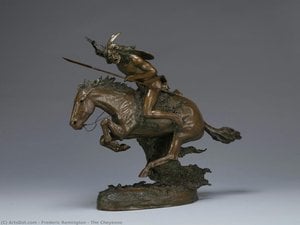
Biografie van de kunstenaar
A Life Etched in the West
Charles Marion Russell, affectionately known as “C.M.” or “Kid” Russell, was far more than just an artist; he was a product of the American West itself – a living embodiment of its rugged spirit and untamed beauty. Born in St. Louis, Missouri, in 1864, his early life wasn’t steeped in formal artistic training but rather fueled by an almost primal yearning for the vast open spaces and freedom of the frontier. This deep-seated fascination would ultimately lead him west, abandoning a conventional education at sixteen to embrace the challenging life of a working cowboy in Montana's Judith Basin. It was a deliberate act of immersion, a conscious decision to *live* the West he so passionately envisioned – an experience that profoundly shaped his artistic vision and became the very foundation of his enduring legacy. For eleven years, Russell dedicated himself to the demanding existence of a ranch hand, hunter, and cowboy, absorbing the landscape’s rhythms, understanding its people—the cowboys, Native Americans, and trappers whose lives he would later immortalize on canvas and in bronze.
From Wrangler to Chronicler: The Birth of an Artistic Voice
Russell's artistic journey wasn’t a carefully planned progression through art academies; it was instead an organic unfolding born from necessity and keen observation. While working as a cowboy, his initial sketches weren’t intended for galleries or collectors – they were personal records, visual diaries documenting the daily realities of life on the range. These early works—depicting branding cattle, rounding up horses, encounters with wildlife—were characterized by an astonishing naturalism, honed through years spent meticulously observing the subtle nuances of his surroundings. He wasn’t interested in romanticizing or idealizing the West; he sought to capture it as it *was*, warts and all – a commitment that distinguished him from many of his contemporaries. A pivotal moment arrived after illustrating a postcard depicting cattle struggling against a harsh winter—a scene so powerfully rendered that it sparked immediate demand for his work, providing the impetus for him to transition from ranch hand to full-time artist in 1893. This marked the beginning of a prolific career spanning painting, sculpture, and writing, all unified by his unwavering dedication to portraying the authentic spirit of the American West.
Capturing a Vanishing World: Themes and Techniques
Russell’s art is profoundly imbued with narrative – each canvas tells a story, often steeped in the mythology and realities of frontier life. His subjects are remarkably diverse, yet consistently focused on the complex interactions between cowboys, Native Americans, and the vast, untamed landscape. He didn't shy away from depicting conflict, but his portrayals were rarely sensationalized; instead, they conveyed a sense of respect for all involved, acknowledging the intricate dynamics of a rapidly changing world. “A Bad Hoss” (1904), exemplifies this – a dynamic scene capturing the struggle between cowboy and bucking bronco, embodying both the skill and inherent danger of the cowboy lifestyle. Similarly, “Battle of Belly River” (1905) showcases his ability to depict dramatic historical events with precision and emotional depth. His artistic technique evolved over time, moving from a more illustrative style towards looser brushwork and bolder color palettes. He was a master storyteller, skillfully employing composition, light, and shadow to create compelling narratives that resonated deeply with audiences eager to connect with the romance and ruggedness of the West. His later works often featured a heightened sense of drama and emotional intensity, reflecting his growing maturity as an artist and his deepening understanding of the human condition. He understood that the true beauty of the West lay not just in its landscapes but also in the resilience and spirit of those who called it home.
Influences and Evolution: A Western Vision
Russell’s artistic vision wasn't solely rooted in his experiences as a cowboy; he was deeply influenced by the stories, legends, and traditions of the American West. He devoured tales of frontier heroes, Native American folklore, and the vast landscapes that shaped the region’s identity. His early exposure to Native American culture during his time near the Blackfoot, Piegan, and Blood tribes in Alberta, Canada, profoundly impacted his work, leading him to depict their customs, ceremonies, and spiritual beliefs with remarkable sensitivity and respect. He wasn't simply a recorder of events; he was an interpreter—translating the experiences of the West into a visual language that resonated with both Native Americans and settlers alike. His travels to New York City in the early 1900s provided him with exposure to European artistic techniques, particularly Impressionism, which influenced his use of color and brushwork. This fusion of Western experience and artistic influences resulted in a uniquely powerful and evocative style that defined his legacy.
Legacy and Enduring Influence
Charles Marion Russell’s impact on American art is undeniable. He wasn't merely a painter of Western scenes; he *defined* them for generations. His work helped to shape the popular image of the cowboy, the Native American, and the vast landscapes of the West, influencing countless artists who followed in his footsteps. He became known as “the cowboy artist” not just for his subject matter but also for his authentic portrayal of Western life—a portrayal rooted in personal experience rather than romanticized fantasy. Today, his paintings and sculptures are highly sought after by collectors and museums worldwide. The C.M. Russell Museum Complex in Great Falls, Montana, stands as a testament to his enduring legacy, housing an extensive collection of his work and preserving the spirit of the West he so passionately captured. His murals, like “Lewis and Clark Meeting Indians at Ross’ Hole”, continue to inspire awe and admiration, serving as powerful reminders of a pivotal moment in American history. Russell's art transcends mere representation; it is a celebration of courage, resilience, and the enduring power of the human spirit—a legacy that continues to captivate audiences more than a century after his death. Beyond his artistic achievements, Russell’s advocacy for Native Americans – particularly his support for the establishment of the Rocky Boy Reservation – underscores his commitment to social justice and cultural preservation, adding another layer to his complex and compelling story.


![[saddled Horse] — Charles Marion Russell (c.m. Russell)](/media/artworks/images-full/68/27/6827922d0dc40d0dc2bc7bfca9410b06.jpg)
 Koop handgeschilderd kunstwerk
 Verstuur
 Delen
Delen
 Details bekijken
 Gids
Gids

 Download
 Vergelijkbare items
 Diavoorstelling
 Statistieken


 Lees meer






































 De optie voor glas is alleen beschikbaar bij een formaat kleiner dan 110 cm.