Bekijk op ware grootte Bekijk in AR Schakel over naar print Koop handgeschilderd kunstwerk Verstuur
Details bekijken Toevoegen aan favorieten Download Vergelijkbare items Röntgenonderzoek Diavoorstelling Statistieken

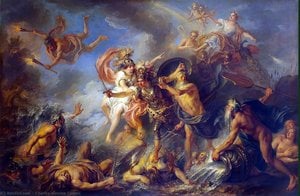
Death on a Pale Horse

Benjamin West's 'Death on the Pale Horse' (1796) is a dramatic oil painting depicting an apocalyptic battle, showcasing sublime horror and complex symbolism from Revelation.

Ontdek Benjamin West (1738-1820), een baanbrekende Amerikaanse kunstenaar & president van de Koninklijke Academie! Bekijk zijn historische schilderijen, neoklassieke stijl en blijvende nalatenschap.

Koop een digitale afbeelding in hoge resolutie met verbeterde kwaliteit, die veel superieur is aan de online voorvertoning.

Elk bestand wordt met uiterste precisie voorbereid door onze interne specialisten, met behulp van geavanceerde tools en deskundige handmatige retouche. Wij garanderen dat elke afbeelding een uitzonderlijke helderheid, nauwkeurige kleurweergave en verfijnde details bezit.

Het uiteindelijke bestand wordt binnen 72 uur per e-mail geleverd, geoptimaliseerd voor direct gebruik in professionele, redactionele en printomgevingen. Dit is dezelfde kwaliteit waarop vooraanstaande designstudio's, uitgevers en galerieën vertrouwen.

Digitale afbeeldingen

Download een bestand met hoge resolutie voor persoonlijke weergave, afdrukken en creatieve projecten. ( Schakel over naar print Koop handgeschilderd kunstwerk)

Totaalbedrag

$ 24,90

Inbegrepen bij elke bestelling van een digitale afbeelding

Professionele digitale levering, gegarandeerd

Wanneer u kiest voor WahooArt.com, ontvangt u niet alleen een afbeelding – u krijgt een professioneel verbeterd digitaal kunstwerk, met precisie vervaardigd en voorzien van een tevredenheidsgarantie. Dit is alles wat automatisch bij uw bestelling is inbegrepen:

shipping_icon
Directe levering per e-mail

Uw hoogwaardige digitale afbeeldingsbestand wordt binnen 72 uur na bestelling naar u gemaild – klaar voor direct gebruik.

canvas_icon
AI-geoptimaliseerd digitaal bestand

Uw kunstwerk wordt professioneel geoptimaliseerd met behulp van geavanceerde AI-tools en handmatige bewerkingen, waardoor maximale details, helderheid en kleurnauwkeurigheid worden gegarandeerd.

insurance_icon
Gratis levenslange herlevering

Je bestand per ongeluk verwijderd of kwijtgeraakt? Geen zorgen – we sturen het u op elk gewenst moment gratis opnieuw toe.

tax_icon
Geen invoerkosten – nooit

Geniet direct van uw kunstwerk zonder invoerrechten, belastingen of verzendkosten – digitale downloads zijn altijd belastingvrij.

color_icon
Garantie op kleurgetrouwheid

Met behulp van professionele hulpmiddelen en kleurbeheer zorgen wij ervoor dat uw digitale afbeelding de originele kleuren zo nauwkeurig mogelijk weergeeft.

return_icon
100 dagen tevredenheidsgarantie

Als u niet tevreden bent met uw digitale afbeelding, passen wij deze aan of storten wij 100% terug binnen 100 dagen - zonder vragen te stellen.

guarantee_icon
100% Geld-terug-garantie

Niet tevreden? Ontvang een volledige terugbetaling binnen 100 dagen na ontvangst van uw digitale bestand – zonder vragen te stellen.

discount_icon
Korting bij grote bestellingen

Koop 3 afbeeldingen, bespaar 10% - Koop 5, bespaar 15% - Koop 10+, bespaar 20%. Ideaal voor creatieve projecten, galerieën en bureaus.

Belangrijkste kenmerken

  • Artistic style: Sublime, Dramatic lighting
  • Subject or theme: Death and Apocalypse
  • Title: Death on a Pale Horse
  • Movement: Neoclassicism
  • Year: 1796
  • Artist: Benjamin West
  • Influences: Dürer engraving

Kunstquiz

Er is slechts één goed antwoord op elke vraag.

Vraag 1:
What biblical book inspired Benjamin West’s ‘Death on a Pale Horse’?
Vraag 2:
In what year was ‘Death on a Pale Horse’ originally created (the first version)?
Vraag 3:
The pale horse in the painting symbolizes:
Vraag 4:
Benjamin West was known for his work in which artistic style?
Vraag 5:
Where is the original ‘Death on a Pale Horse’ painting currently housed?

The Genesis of Despair – Benjamin West’s “Death on the Pale Horse”

Benjamin West's "Death on a Pale Horse," painted in 1796, isn't merely a depiction of a biblical scene; it’s an immersive plunge into the heart of human anxiety and the sublime terror of impending doom. Born amidst the burgeoning intellectual currents of colonial America, West was a painter who defied easy categorization, seamlessly blending Neoclassical restraint with Romantic fervor. This particular work, one of three versions created around the same time, stands as a testament to his ability to capture not just outward appearances but also the profound emotional weight of historical and religious narratives. The painting’s genesis lies in the chilling verses of Revelation 6:7-8 – “And when he opened the fourth seal, I heard the voice of the fourth beast say, Come and see. And I looked, and behold a pale horse; and his name that sat on him was Death, and Hell followed with him.” West wasn’t simply illustrating scripture; he was grappling with the anxieties of his era – the turbulent political landscape of Europe, marked by revolution and war, and a growing sense of uncertainty about the future. The composition itself is deliberately chaotic, reflecting the apocalyptic imagery it portrays, yet grounded in a carefully constructed arrangement that draws the viewer into the maelstrom.

A Symphony of Darkness and Light – Technique and Style

West’s masterful technique elevates “Death on a Pale Horse” beyond a simple illustration. He employs a dramatic chiaroscuro—a stark contrast between light and shadow—to create an atmosphere thick with foreboding. The palette is dominated by deep, bruised purples, somber browns, and the sickly yellow of the pale horse itself, evoking a sense of decay and impending mortality. The figures are rendered with meticulous detail, their faces contorted in expressions of agony and despair, yet imbued with a haunting beauty. Notice particularly the angel on the left, his face etched with sorrow as he witnesses the carnage; his posture conveys both helplessness and profound grief. The use of loose brushstrokes in the background adds to the sense of movement and chaos, while more controlled strokes define the central figures, anchoring the scene within a framework of dramatic intensity. The painting’s scale—a monumental 447 cm x 764.5 cm—further amplifies its impact, enveloping the viewer in the horrifying spectacle.

Symbolism Woven into the Apocalypse – Horses, Angels, and Humanity

Beyond the immediate depiction of a battle between good and evil, “Death on a Pale Horse” is rich with symbolic meaning. The pale horse itself, ridden by Death, is the most potent symbol—a harbinger of destruction and decay. The accompanying figure of Hell, often depicted as a winged demon, reinforces this theme of ultimate annihilation. However, West doesn’t simply portray a passive victimhood; the painting also features angels engaged in fierce combat, representing the struggle between divine forces. The human figures scattered across the battlefield—some falling, some fleeing—represent humanity caught in the crossfire of cosmic conflict. The inclusion of various animals – horses, birds, and even a lion – adds layers of complexity to the symbolism, suggesting the indiscriminate nature of death and destruction. The overall effect is not merely a depiction of a single event but an exploration of universal themes of mortality, suffering, and the fragility of human existence.

A Legacy of Vision – Historical Context and Artistic Significance

“Death on the Pale Horse” emerged during a period of profound social and political upheaval in Europe. The French Revolution was raging, Napoleon’s armies were conquering vast territories, and anxieties about the future were widespread. West's painting reflects this atmosphere of uncertainty and fear, capturing the sense that order was collapsing and chaos reigned supreme. Furthermore, the work aligns with the broader artistic trends of the late 18th century, particularly the rise of the “Sublime”—a concept emphasizing awe-inspiring beauty combined with a sense of terror or dread. West’s painting exemplifies this aesthetic, evoking feelings of both fascination and horror in the viewer. It's considered one of his most significant works, alongside "The Death of General Wolfe" and "Benjamin Franklin Drawing Electricity from the Sky," solidifying his position as a pivotal figure in American art history. Reproductions of this powerful image continue to resonate with audiences today, reminding us of our shared vulnerability in the face of mortality.


Biografie van de kunstenaar

A Pioneer Bridging Worlds: The Life and Legacy of Benjamin West

Born in 1738 amidst the burgeoning landscape of colonial Pennsylvania, Benjamin West emerged as a pivotal figure in the transatlantic art world, a painter who skillfully navigated the currents of Neoclassicism and Romanticism while forging a uniquely American artistic identity. His story is one of remarkable self-education, unwavering ambition, and an extraordinary ability to connect with both aristocratic patrons and revolutionary ideals. From humble beginnings—his father an innkeeper in Springfield—West’s innate talent was nurtured by early exposure to the arts, reportedly learning rudimentary techniques from Native Americans before receiving any formal training. This unconventional start instilled within him a spirit of innovation that would characterize his entire career. He quickly established himself as a sought-after portraitist in Philadelphia and New York, but a thirst for deeper artistic knowledge propelled him towards Europe in 1760, embarking on a journey that would irrevocably alter the course of American art.

From Italy to London: Forging a Path to Recognition

West’s arrival in Italy marked a turning point. Immersing himself in the artistic heartland of Europe, he studied the masters—Titian, Raphael—and engaged with contemporary Neoclassical thinkers like Anton Rafael Mengs and Angelica Kauffman. This period was crucial in shaping his aesthetic sensibilities, instilling within him an appreciation for classical form and historical narrative. He spent years meticulously copying works by these giants, absorbing their techniques and developing a profound understanding of composition and color theory. However, it was London that ultimately became his adopted home and artistic center. Arriving in 1763, West swiftly ascended the ranks of the British art scene, captivating audiences with his ambitious canvases and securing the patronage of King George III. This royal endorsement not only provided financial stability but also cemented his position as a leading figure within the establishment. A defining moment came with his election to the Royal Academy in 1769, an institution he would later preside over as President from 1792 until his death. His influence extended beyond his own artistic production; West became a champion for American artists seeking training abroad, offering guidance and support to generations of aspiring painters like Allston, Copley, and Morse.

Revolutionizing Historical Painting: Technique and Controversy

West’s impact on the art world wasn't merely about achieving technical mastery; it was about challenging conventions. He dared to reimagine historical painting, moving away from rigid adherence to classical precedent and embracing a more contemporary sensibility. The Death of General Wolfe (1770), arguably his most famous work, exemplifies this revolutionary approach. By depicting the fallen general surrounded by figures in *contemporary* military attire rather than traditional Roman garb, West sparked considerable debate. Critics questioned the historical accuracy, but audiences were captivated by the immediacy and emotional resonance of the scene. It was a bold move, a departure from the idealized depictions prevalent at the time, and it signaled a shift towards greater realism and narrative power in history painting, influencing countless artists who followed. His style evolved over time, incorporating elements of Romanticism into his later works, yet always retaining a commitment to ambitious composition and detailed execution. Other notable pieces like Thetis Bringing the Armor to Achilles, The Three Sisters, The Fright of Astyanax, and The Cave of Despair demonstrate his versatility and mastery across a range of mythological and historical themes. The meticulous detail in his brushwork, combined with dramatic lighting and carefully rendered figures, created works that were both visually stunning and emotionally engaging.

A Lasting Legacy: Shaping Artistic Identity

Benjamin West’s legacy extends far beyond the canvases he created. He fundamentally altered the landscape of American art, establishing history painting as a viable genre for American artists and fostering a sense of national artistic identity. His presidency of the Royal Academy solidified his influence on British art, promoting innovation and supporting emerging talent.
  • He championed a more accessible and emotionally engaging style of historical representation.
  • His studio became a haven for American artists seeking training in Europe.
  • He bridged the gap between Neoclassical ideals and the burgeoning Romantic movement.
West’s innovative spirit, coupled with his diplomatic skills and unwavering dedication to his craft, earned him lasting recognition as “the American Raphael.” He died in London in 1820, leaving behind a body of work that continues to inspire awe and admiration. His story serves as a testament to the power of artistic vision, the importance of cultural exchange, and the enduring legacy of an artist who dared to challenge conventions and forge his own path.

Personal Life and Connections

Beyond his artistic achievements, West’s life was marked by significant personal connections. He maintained close friendships with prominent figures in both American and British society, including Benjamin Franklin, whose portrait he painted, and members of the Royal Family. His marriage to Elizabeth Shewell, an American woman he had met in Philadelphia, further cemented his ties to his homeland. West’s home became a gathering place for artists, intellectuals, and diplomats, fostering a vibrant cultural exchange. He was known for his generosity and hospitality, offering support and encouragement to aspiring artists and contributing significantly to the intellectual life of London. His influence extended beyond the art world, shaping perceptions of American identity and promoting transatlantic understanding.

Benjamin West

Benjamin West

1738 - 1820 , Verenigde Staten van Amerika

Kerngegevens

  • Artistic Movement Or Style: Neoklassiek, Romantisch
  • Artists Or Movements Influenced By This Artist:
    • Allston
    • Copley
    • Morse
  • Artists Who Influenced This Artist:
    • Titian
    • Raphael
    • Mengs
  • Date Of Birth: 1738-10-10
  • Date Of Death: 1820-03-11
  • Full Name: Benjamin West
  • Nationality: Amerikaans
  • Notable Artworks:
    • De dood van Wolfe
    • Thetis
    • Drie zusters
  • Place Of Birth: Springfield, USA