Schakel over naar print Schakel over naar printBestel handgeschilderde reproductie Bestel handgeschilderde reproductie VerstuurVerstuur
Details bekijkenDetails bekijken Toevoegen aan favorieten Toevoegen aan favorieten DownloadDownload Vergelijkbare itemsVergelijkbare items DiavoorstellingDiavoorstelling StatistiekenStatistieken

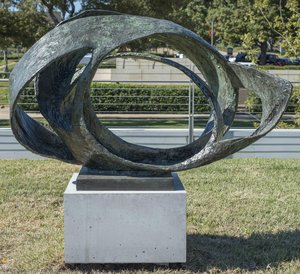
Shaft and Circle

Admire Barbara Hepworth's iconic 'Shaft and Circle' sculpture – a striking abstract form embodying balance & harmony through clean lines and organic shapes, reflecting modernist principles.

Ontdek de modernistal beeldhouwkunst van Dame Barbara Hepworth (1903-1975). Een pionier van abstracte kunst, Hepworth's werk – waaronder 'Oval Form' & 'Two Forms' – combineert surrealisme en abstractie. Laat je inspireren bij het Hepworth Wakefield.

Koop een digitale afbeelding in hoge resolutie met verbeterde kwaliteit, die veel superieur is aan de online voorvertoning.

Elk bestand wordt met uiterste precisie voorbereid door onze interne specialisten, met behulp van geavanceerde tools en deskundige handmatige retouche. Wij garanderen dat elke afbeelding een uitzonderlijke helderheid, nauwkeurige kleurweergave en verfijnde details bezit.

Het uiteindelijke bestand wordt binnen 72 uur per e-mail geleverd, geoptimaliseerd voor direct gebruik in professionele, redactionele en printomgevingen. Dit is dezelfde kwaliteit waarop vooraanstaande designstudio's, uitgevers en galerieën vertrouwen.

Digitale afbeeldingen

Download een bestand met hoge resolutie voor persoonlijke weergave, afdrukken en creatieve projecten. (Schakel over naar print Schakel over naar printBestel handgeschilderde reproductie Bestel handgeschilderde reproductie)

Totaalprijs

$ 24,90

Inbegrepen bij elke bestelling van een digitale afbeelding

Professionele digitale levering, gegarandeerd

Wanneer u kiest voor WahooArt.com, ontvangt u niet alleen een afbeelding – u krijgt een professioneel verbeterd digitaal kunstwerk, met precisie vervaardigd en voorzien van een tevredenheidsgarantie. Dit is alles wat automatisch bij uw bestelling is inbegrepen:

shipping_icon
Snelle levering per e-mail

Uw hoogwaardige digitale afbeeldingsbestand wordt binnen 72 uur na bestelling naar u gemaild – klaar voor direct gebruik.

canvas_icon
AI-verbeterd digitaal bestand

Uw kunstwerk wordt professioneel geoptimaliseerd met behulp van geavanceerde AI-tools en handmatige bewerkingen, waardoor maximale details, helderheid en kleurnauwkeurigheid worden gegarandeerd.

insurance_icon
Gratis levenslange herlevering van digitale afbeeldingen

Je bestand per ongeluk verwijderd of kwijtgeraakt? Geen zorgen – we sturen het u op elk gewenst moment gratis opnieuw toe.

tax_icon
Geen invoerkosten – nooit

Geniet direct van uw kunstwerk zonder invoerrechten, belastingen of verzendkosten – digitale downloads zijn altijd belastingvrij.

color_icon
Garantie op kleurgetrouwheid

Met behulp van professionele hulpmiddelen en kleurbeheer zorgen wij ervoor dat uw digitale afbeelding de originele kleuren zo nauwkeurig mogelijk weergeeft.

return_icon
100 dagen tevredenheidsgarantie

Als u niet tevreden bent met uw digitale afbeelding, passen wij deze aan of storten wij 100% terug binnen 100 dagen - zonder vragen te stellen.

guarantee_icon
100% Geld-terug-garantie

Niet tevreden? Ontvang een volledige terugbetaling binnen 100 dagen na ontvangst van uw digitale bestand - zonder vragen te stellen.

discount_icon
Korting bij grote bestellingen

Koop 3 afbeeldingen, bespaar 10% - Koop 5, bespaar 15% - Koop 10+, bespaar 20%. Ideaal voor creatieve projecten, galerieën en bureaus.

Snelle feiten

  • Subject or theme: Balance, Harmony
  • Movement: Modernism
  • Title: Shaft and Circle
  • Year: 1972
  • Influences:
    • Surrealism
    • Abstraction
  • Location: Google Arts & Culture
  • Medium: Concrete/Marble

Kunstquiz

Er is slechts één goed antwoord op elke vraag.

Vraag 1:
What is the primary material used in Barbara Hepworth’s sculpture, ‘Shaft and Circle’?
Vraag 2:
The circular opening in 'Shaft and Circle' is most likely intended to represent:
Vraag 3:
In what decade was ‘Shaft and Circle’ created?
Vraag 4:
Barbara Hepworth was a prominent figure in which art movement?
Vraag 5:
What is the background color of the photograph depicting ‘Shaft and Circle’?

A Vertical Echo: Barbara Hepworth’s “Shaft and Circle”

Barbara Hepworth's "Shaft and Circle," created in 1972, isn’t merely a sculpture; it’s an invitation to quiet contemplation. Standing before this arresting form – a towering shaft of polished concrete punctuated by a perfectly circular aperture – is akin to entering a sacred space. The piece immediately commands attention with its stark simplicity and the profound sense of upward movement it evokes. Hepworth, a pivotal figure in 20th-century British sculpture, masterfully distilled her signature style into this work: an exploration of form’s inherent qualities, divorced from representational concerns. It's a testament to her belief that sculpture could be experienced not just visually, but through touch and the subtle shifts in light and shadow.

The material itself – likely cast concrete, though Hepworth often worked with stone as well – is treated with an almost reverent attention. The surface is flawlessly smooth, reflecting the surrounding environment while simultaneously maintaining a sense of contained solidity. This deliberate contrast between smoothness and mass speaks to the core of Hepworth’s philosophy: she sought to capture the essence of materials themselves, revealing their inherent textures and geometries. The scale of the sculpture – approximately six feet tall – further amplifies this effect, drawing the viewer upwards into its embrace.

Roots in Epirus and Mycenaean Tradition

To fully appreciate “Shaft and Circle,” it’s crucial to understand Hepworth's artistic lineage. Her early influences stemmed from her travels through Italy and Greece, particularly a deep immersion in the archaeological sites of Mycenae. The shaft tomb tradition prevalent in Bronze Age Greece – elaborate burial chambers dug vertically into the earth, often containing grave goods – provided a foundational inspiration for her work. These tombs, built by elite societies, weren’t simply markers of death; they were statements of power and belief, reflecting a complex cosmology centered around ancestry and the afterlife. Hepworth's sculpture echoes this spirit, suggesting an upward journey towards something beyond the material world.

Interestingly, similar shaft tombs have been found in Bronze Age China, demonstrating a surprisingly widespread cultural practice across Eurasia. This shared heritage underscores the universal human impulse to create enduring monuments and explore questions of mortality and transcendence. Hepworth’s work can be seen as a contemporary reimagining of these ancient traditions, translated into the language of abstract form.

The Language of Form: Circularity and Verticality

The composition of “Shaft and Circle” is meticulously balanced between two fundamental principles: verticality and circularity. The shaft itself rises directly upwards, creating a powerful sense of momentum and aspiration. This upward thrust is counterbalanced by the perfectly formed circle cut into its midsection – an element that introduces ambiguity and invites interpretation. The circle can be seen as representing wholeness, continuity, or perhaps even a portal to another dimension. It’s a subtle yet potent symbol that adds layers of meaning to the sculpture's overall impact.

Hepworth was deeply interested in exploring the relationship between form and space. She believed that sculpture should not simply occupy physical space but also create an emotional resonance within the viewer. “Shaft and Circle” achieves this beautifully, prompting a sense of stillness and introspection. The negative space created by the circular aperture is just as important as the solid mass of the shaft itself, contributing to the sculpture’s dynamic balance.

A Legacy of Minimalism and Emotional Resonance

“Shaft and Circle” exemplifies Hepworth's commitment to minimalism and her profound understanding of materials. It’s a work that rewards careful observation and invites repeated contemplation. Her sculptures, often described as “non-objective,” are nonetheless deeply expressive, communicating complex ideas about form, space, and the human condition. Today, "Shaft and Circle" remains a powerful testament to Hepworth's artistic vision – a timeless exploration of fundamental geometric principles and their capacity to evoke profound emotional responses.


Kunstenaarsbiografie

Early Life and Education

Barbara Hepworth (née Jocelyn Barbara Hepworth) was born on January 10, 1903, in Wakefield, Yorkshire, the eldest child of Herbert and Gertrude Johnson Hepworth. Her father, a civil engineer for the West Riding County Council, instilled in her a fascination with landscapes and structures—a passion that would profoundly shape her artistic vision. Growing up in rural Yorkshire provided Hepworth with formative experiences that contrasted sharply with the urban environment of London where she later pursued her studies. From an early age, Hepworth demonstrated musical talent, earning music prizes at Wakefield Girls’ High School, a testament to her innate creativity and dedication. This scholarship enabled her to attend Leeds School of Art in 1920, where she encountered Henry Moore—a fellow student who would become a lifelong friend and collaborator. Their shared artistic sensibilities fostered a dynamic creative partnership that spanned decades. Hepworth's formative years instilled within her an appreciation for both natural beauty and formal experimentation, laying the groundwork for her groundbreaking contributions to modern sculpture.

Academic Career

Hepworth’s pursuit of artistic excellence continued at the Royal College of Art in London from 1921 until she graduated in 1924 with a diploma. The RCA's emphasis on abstraction and exploration of new materials proved instrumental in shaping her artistic trajectory. Notably, Hepworth secured a prestigious West Riding Travel Scholarship, allowing her to immerse herself in the Italian Renaissance—a pivotal experience that exposed her to monumental sculpture and influenced her aesthetic sensibilities. Her studies at the RCA coincided with the burgeoning modernist movement, where she honed her skills alongside influential figures like Moore and Nicholson, fostering an environment of intellectual exchange and artistic innovation. Hepworth’s dedication to mastering sculptural techniques cemented her position as one of Britain's foremost artists during this period.

Early Career and Influences

Following her graduation, Hepworth embarked on a collaborative project with John Skeaping, whom she married in 1925. Together they established a studio in Hampstead, London—a hub for avant-garde artistic activity—where they championed “direct carving”—a technique that prioritized working directly into raw materials like wood and stone rather than modeling sculptures from clay. This approach reflected Hepworth’s belief in honoring the inherent qualities of the material itself, aligning her practice with the principles of Cubism and Surrealism. Skeaping's influence on Hepworth extended beyond their partnership; he encouraged her to embrace experimentation and challenge conventional artistic conventions. Hepworth’s early work was characterized by simplified forms inspired by Egyptian sculpture—a fascination that would endure throughout her career.

Mid-Career Achievements

Hepworth’s artistic breakthrough arrived during the Second World War when she relocated to St Ives, Cornwall, alongside Ben Nicholson—a fellow artist and collaborator who had become her romantic partner. The Cornish landscape profoundly impacted Hepworth's creative output, informing her sculptures with references to geological formations and organic shapes. Her distinctive style—characterized by a sensual blend of abstraction and naturalism—became synonymous with the St Ives School of Art movement, attracting artists from across Europe. Hepworth’s monumental sculpture *Winged Figure* (1961–3), commissioned for John Lewis department store in Oxford Street, London, stands as a testament to her artistic ambition and technical prowess. It exemplifies her masterful manipulation of bronze—a material she embraced wholeheartedly throughout her later years.

Legacy and Recognition

Barbara Hepworth’s enduring legacy rests on her pioneering contributions to modern sculpture and her unwavering commitment to exploring the relationship between form and space. Her sculptures—including *Two Forms*, *Totem*, and numerous smaller pieces—are housed in museums worldwide, demonstrating their universal appeal and artistic significance. Hepworth was awarded the Dame Commander of the Order of the British Empire (DCE) in 1958—a recognition of her distinguished artistic achievements—and she received the rank of Dame in 1965—honoring her lifetime dedication to art and creativity. Hepworth’s influence continues to inspire artists today, cementing her place as one of Britain's most celebrated sculptors and a pivotal figure in the history of modern art.
Barbara Hepworth

Barbara Hepworth

1903 - 1975 , Verenigd Koninkrijk

Belangrijkste feiten

  • Artistic Movement Or Style: Modernisme
  • Artists Or Movements Influenced By This Artist: ['Unit One']
  • Artists Who Influenced This Artist: ['Henry Moore']
  • Date Of Birth: 10 januari 1903
  • Full Name: Jocelyn Barbara Hepworth
  • Nationality: Engels
  • Notable Artworks:
    • Oval Form
    • Two Forms
    • Totem
  • Place Of Birth: Wakefield, Yorkshire