Schakel over naar print Koop handgeschilderd kunstwerk Verstuur
Details bekijken Gids voor studentenkunstwerken Toevoegen aan favorieten Download Vergelijkbare items Diavoorstelling Statistieken

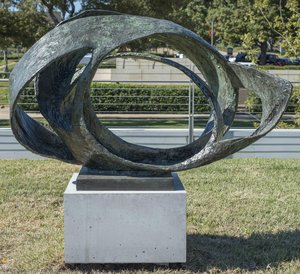
Prototype for Maquette, Three Forms in Echelon

Barbara Hepworth's 'Prototype for Maquette, Three Forms in Echelon' is an iconic abstract sculpture embodying modernism’s elegance and exploration of form & space. Discover its layered composition & artistic significance.

Ontdek de modernistal beeldhouwkunst van Dame Barbara Hepworth (1903-1975). Een pionier van abstracte kunst, Hepworth's werk – waaronder 'Oval Form' & 'Two Forms' – combineert surrealisme en abstractie. Laat je inspireren bij het Hepworth Wakefield.

Koop een digitale afbeelding in hoge resolutie met verbeterde kwaliteit, die veel superieur is aan de online voorvertoning.

Elk bestand wordt met uiterste precisie voorbereid door onze interne specialisten, met behulp van geavanceerde tools en deskundige handmatige retouche. Wij garanderen dat elke afbeelding een uitzonderlijke helderheid, nauwkeurige kleurweergave en verfijnde details bezit.

Het uiteindelijke bestand wordt binnen 72 uur per e-mail geleverd, geoptimaliseerd voor direct gebruik in professionele, redactionele en printomgevingen. Dit is dezelfde kwaliteit waarop vooraanstaande designstudio's, uitgevers en galerieën vertrouwen.

Digitale afbeeldingen

Download een bestand met hoge resolutie voor persoonlijke weergave, afdrukken en creatieve projecten. ( Schakel over naar print Koop handgeschilderd kunstwerk)

Totaalbedrag

$ 24,90

Inbegrepen bij elke bestelling van een digitale afbeelding

Professionele digitale levering, gegarandeerd

Wanneer u kiest voor WahooArt.com, ontvangt u niet alleen een afbeelding – u krijgt een professioneel verbeterd digitaal kunstwerk, met precisie vervaardigd en voorzien van een tevredenheidsgarantie. Dit is alles wat automatisch bij uw bestelling is inbegrepen:

shipping_icon
Directe levering per e-mail

Uw hoogwaardige digitale afbeeldingsbestand wordt binnen 72 uur na bestelling naar u gemaild – klaar voor direct gebruik.

canvas_icon
AI-geoptimaliseerd digitaal bestand

Uw kunstwerk wordt professioneel geoptimaliseerd met behulp van geavanceerde AI-tools en handmatige bewerkingen, waardoor maximale details, helderheid en kleurnauwkeurigheid worden gegarandeerd.

insurance_icon
Gratis levenslange herlevering

Je bestand per ongeluk verwijderd of kwijtgeraakt? Geen zorgen – we sturen het u op elk gewenst moment gratis opnieuw toe.

tax_icon
Geen invoerkosten – nooit

Geniet direct van uw kunstwerk zonder invoerrechten, belastingen of verzendkosten – digitale downloads zijn altijd belastingvrij.

color_icon
Garantie op kleurgetrouwheid

Met behulp van professionele hulpmiddelen en kleurbeheer zorgen wij ervoor dat uw digitale afbeelding de originele kleuren zo nauwkeurig mogelijk weergeeft.

return_icon
100 dagen tevredenheidsgarantie

Als u niet tevreden bent met uw digitale afbeelding, passen wij deze aan of storten wij 100% terug binnen 100 dagen - zonder vragen te stellen.

guarantee_icon
100% Geld-terug-garantie

Niet tevreden? Ontvang een volledige terugbetaling binnen 100 dagen na ontvangst van uw digitale bestand – zonder vragen te stellen.

discount_icon
Korting bij grote bestellingen

Koop 3 afbeeldingen, bespaar 10% - Koop 5, bespaar 15% - Koop 10+, bespaar 20%. Ideaal voor creatieve projecten, galerieën en bureaus.

Belangrijkste kenmerken

  • Subject or theme: Organic shapes, balance
  • Location: Tate St Ives
  • Notable elements: Echelon arrangement, curved forms
  • Movement: Modernism
  • Artist: Barbara Hepworth
  • Influences: Abstraction-Création
  • Medium: Wood/Stone Sculpture

Kunstquiz

Er is slechts één goed antwoord op elke vraag.

Vraag 1:
What is the primary material used in Barbara Hepworth’s sculpture, ‘Prototype for Maquette, Three Forms in Echelon’?
Vraag 2:
The sculpture's arrangement follows which compositional principle?
Vraag 3:
What artistic movement is Barbara Hepworth most closely associated with?
Vraag 4:
The photograph’s lighting appears to be...
Vraag 5:
Based on the description, what is a possible symbolic interpretation of the sculpture’s forms?

A Sculptural Meditation on Form and Space

Barbara Hepworth’s “Prototype for Maquette, Three Forms in Echelon,” a deceptively simple yet profoundly resonant sculpture, stands as a testament to the artist's pioneering approach to modern abstraction. Created in 1961 during a period of intense experimentation and exploration within her studio at St Ives, Cornwall, this piece isn’t merely a collection of shapes; it’s an invitation to contemplate the relationship between form, space, and the inherent qualities of materials – specifically, the cool, tactile embrace of stone or wood.

The sculpture presents three distinct, organically curved forms arranged vertically on a stark white background. These aren't representational figures; instead, they embody an elemental language, suggesting echoes of natural forms—waves, rocks, or perhaps even the contours of the human body—without ever explicitly depicting them. The arrangement follows an echelon pattern, each form subtly offset from the one below, creating a dynamic sense of upward movement and spatial depth. This deliberate asymmetry is key to Hepworth’s aesthetic; she sought to disrupt traditional notions of balance and harmony, favoring instead a more intuitive and expressive approach.

Materiality and Technique: A Dance Between Hand and Stone

Hepworth's process was deeply rooted in the materiality of her chosen medium. She rarely used preparatory sketches, preferring to work directly from intuition and feeling, allowing the stone or wood to guide the form. The “Prototype” itself is a crucial stage in this process – a preliminary model intended to refine the composition and explore the interplay of light and shadow before committing to a larger-scale version. The matte texture of the sculpture, achieved through careful carving and polishing, invites tactile engagement; one can almost feel the cool smoothness of the stone beneath their fingertips.

Her technique involved a subtractive approach – carefully removing material to reveal the underlying form—combined with an understanding of how light interacts with different surfaces. The subtle tonal shifts within the sculpture’s surface, achieved through meticulous polishing and manipulation of the grain, create a sense of depth and volume, drawing the eye upwards and inviting contemplation. The stark white background serves not as a distraction but as a crucial element in highlighting the forms' inherent qualities, emphasizing their purity and simplicity.

Symbolism and Emotional Resonance

Hepworth’s work consistently explores themes of human connection to nature and the inner self. These three abstract forms can be interpreted as representing interconnectedness—a visual metaphor for the flow of life forces or perhaps a meditation on the fundamental building blocks of existence. The vertical arrangement evokes a sense of aspiration, reaching towards something beyond the immediate, while the subtle curves suggest fluidity and movement.

Considering Hepworth’s broader body of work, this “Prototype” shares affinities with her earlier explorations of ‘Form and Function,’ where she sought to create sculptures that were both aesthetically pleasing and responsive to their environment. It's a piece that speaks to the enduring power of abstraction—its ability to evoke profound emotions and ideas through purely visual means. The sculpture’s quiet intensity invites viewers to engage in a personal dialogue with its forms, prompting reflection on the nature of beauty, space, and our relationship to the world around us.

Further Exploration


Biografie van de kunstenaar

Early Life and Education

Barbara Hepworth (née Jocelyn Barbara Hepworth) was born on January 10, 1903, in Wakefield, Yorkshire, the eldest child of Herbert and Gertrude Johnson Hepworth. Her father, a civil engineer for the West Riding County Council, instilled in her a fascination with landscapes and structures—a passion that would profoundly shape her artistic vision. Growing up in rural Yorkshire provided Hepworth with formative experiences that contrasted sharply with the urban environment of London where she later pursued her studies. From an early age, Hepworth demonstrated musical talent, earning music prizes at Wakefield Girls’ High School, a testament to her innate creativity and dedication. This scholarship enabled her to attend Leeds School of Art in 1920, where she encountered Henry Moore—a fellow student who would become a lifelong friend and collaborator. Their shared artistic sensibilities fostered a dynamic creative partnership that spanned decades. Hepworth's formative years instilled within her an appreciation for both natural beauty and formal experimentation, laying the groundwork for her groundbreaking contributions to modern sculpture.

Academic Career

Hepworth’s pursuit of artistic excellence continued at the Royal College of Art in London from 1921 until she graduated in 1924 with a diploma. The RCA's emphasis on abstraction and exploration of new materials proved instrumental in shaping her artistic trajectory. Notably, Hepworth secured a prestigious West Riding Travel Scholarship, allowing her to immerse herself in the Italian Renaissance—a pivotal experience that exposed her to monumental sculpture and influenced her aesthetic sensibilities. Her studies at the RCA coincided with the burgeoning modernist movement, where she honed her skills alongside influential figures like Moore and Nicholson, fostering an environment of intellectual exchange and artistic innovation. Hepworth’s dedication to mastering sculptural techniques cemented her position as one of Britain's foremost artists during this period.

Early Career and Influences

Following her graduation, Hepworth embarked on a collaborative project with John Skeaping, whom she married in 1925. Together they established a studio in Hampstead, London—a hub for avant-garde artistic activity—where they championed “direct carving”—a technique that prioritized working directly into raw materials like wood and stone rather than modeling sculptures from clay. This approach reflected Hepworth’s belief in honoring the inherent qualities of the material itself, aligning her practice with the principles of Cubism and Surrealism. Skeaping's influence on Hepworth extended beyond their partnership; he encouraged her to embrace experimentation and challenge conventional artistic conventions. Hepworth’s early work was characterized by simplified forms inspired by Egyptian sculpture—a fascination that would endure throughout her career.

Mid-Career Achievements

Hepworth’s artistic breakthrough arrived during the Second World War when she relocated to St Ives, Cornwall, alongside Ben Nicholson—a fellow artist and collaborator who had become her romantic partner. The Cornish landscape profoundly impacted Hepworth's creative output, informing her sculptures with references to geological formations and organic shapes. Her distinctive style—characterized by a sensual blend of abstraction and naturalism—became synonymous with the St Ives School of Art movement, attracting artists from across Europe. Hepworth’s monumental sculpture *Winged Figure* (1961–3), commissioned for John Lewis department store in Oxford Street, London, stands as a testament to her artistic ambition and technical prowess. It exemplifies her masterful manipulation of bronze—a material she embraced wholeheartedly throughout her later years.

Legacy and Recognition

Barbara Hepworth’s enduring legacy rests on her pioneering contributions to modern sculpture and her unwavering commitment to exploring the relationship between form and space. Her sculptures—including *Two Forms*, *Totem*, and numerous smaller pieces—are housed in museums worldwide, demonstrating their universal appeal and artistic significance. Hepworth was awarded the Dame Commander of the Order of the British Empire (DCE) in 1958—a recognition of her distinguished artistic achievements—and she received the rank of Dame in 1965—honoring her lifetime dedication to art and creativity. Hepworth’s influence continues to inspire artists today, cementing her place as one of Britain's most celebrated sculptors and a pivotal figure in the history of modern art.
Barbara Hepworth

Barbara Hepworth

1903 - 1975 , Verenigd Koninkrijk

Kerngegevens

  • Artistic Movement Or Style: Modernisme
  • Artists Or Movements Influenced By This Artist: ['Unit One']
  • Artists Who Influenced This Artist: ['Henry Moore']
  • Date Of Birth: 10 januari 1903
  • Full Name: Jocelyn Barbara Hepworth
  • Nationality: Engels
  • Notable Artworks:
    • Oval Form
    • Two Forms
    • Totem
  • Place Of Birth: Wakefield, Yorkshire