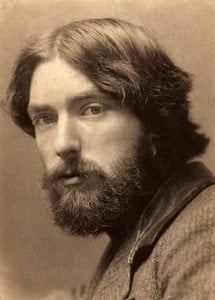
The Subject: An Intimate Gaze
“ Villiers David,” painted in 1932 by Augustus Edwin John, isn’t a grand historical portrait or a flamboyant depiction of celebrity. Instead, it offers a remarkably intimate glimpse into the face and demeanor of an unknown gentleman. The subject, dressed in the restrained elegance of a well-tailored suit – a dark grey wool that speaks to both wealth and understated taste – is seated with his hands resting thoughtfully on his chin. His gaze, direct yet not confrontational, holds a quiet confidence, a subtle suggestion of intelligence and perhaps even melancholy. John’s masterful observation captures the nuances of human expression, revealing more than just physical features; he conveys a sense of personality, a hint of inner life.
- The man's attire – the tie, the jacket, the overall cut – speaks to a period of relative prosperity and formality.
- His posture, relaxed yet attentive, invites the viewer into his world.
- Notice the subtle lines around his eyes and mouth; these are not signs of age but rather evidence of a life lived with contemplation.
The Style: A Welsh Bohemian’s Vision
Augustus Edwin John was, by nature, an artist who defied easy categorization. Born in Wales, he cultivated a distinctly bohemian lifestyle, flitting between London and the French Riviera, always seeking inspiration and challenging conventional artistic norms. His style is characterized by a remarkable sensitivity to light and color, combined with a loose, expressive brushstroke that imbues his paintings with a palpable sense of movement and emotion. “ Villiers David” exemplifies this approach perfectly – it’s not a meticulously rendered likeness but rather an impression, a feeling captured on canvas.
John's work is often described as ‘impressionistic,’ though he deliberately avoided strict adherence to the style, preferring instead to develop his own unique visual language.
Technique and Composition: A Dance of Light and Shadow
The painting’s strength lies in John’s skillful manipulation of light and shadow. He employs a broken brushstroke technique, layering colors rather than blending them smoothly, creating a shimmering effect that seems to emanate from within the canvas. The background is deliberately muted – a simple chair provides minimal distraction – allowing the viewer's attention to remain firmly focused on the subject’s face. The use of warm tones in his clothing contrasts with the cooler shades of the background, further emphasizing his presence and drawing us into his gaze. John’s meticulous attention to detail, particularly in rendering the textures of the fabric and the subtle nuances of light reflecting off the man's glasses, is truly remarkable.
Historical Context and Symbolism: A Window into a Changing World
Painted in 1932, “ Villiers David” reflects a period of significant social and cultural change. Britain was emerging from the austerity of the Great Depression, and there was a growing sense of uncertainty about the future. John’s portrait can be interpreted as a meditation on these anxieties – the man's quiet confidence suggests resilience in the face of adversity, while his contemplative gaze hints at the complexities of human experience. The inclusion of the glasses is particularly noteworthy; they symbolize intellect and observation, suggesting that this individual possesses both wisdom and a critical eye. The portrait also speaks to John’s lifelong fascination with the Romani people, whom he often depicted in his work, capturing their vibrant spirit and unique perspective.
Emotional Impact: A Moment of Quiet Reflection
Ultimately, “ Villiers David” is a profoundly moving painting. It's not merely a portrait; it’s an invitation to connect with another human being, to share in his thoughts and feelings. The man’s gaze holds a quiet dignity and a hint of melancholy, prompting us to consider our own place in the world. It’s a reminder that even in the midst of uncertainty, there is beauty and meaning to be found in simple moments of reflection. Reproductions of this piece offer a chance to bring this intimate portrait into your home, inviting contemplation and adding a touch of understated elegance to any space.
Veelgestelde vragen
Welk palet en welke hoofdkleur bepalen "Villiers David"?
"Villiers David" wordt gekenmerkt door een Earthy palet met Phthalo Green (#2a211f) als dominante kleur.
Welk kleurenpalet wordt gebruikt in "Villiers David"?
Het kleurenpalet van "Villiers David" door Augustus Edwin John wordt beschreven als Earthy. Het is een beknopte beschrijving van de kleuren in het werk.
Hoe verhoudt "Villiers David" zich tot de terugkerende thema's van Augustus Edwin John?
De terugkerende thema's van Augustus Edwin John omvatten welsh bohemian, john singer sargent, portraiture, victorian era, british society, head injury, artistic transformation, resilience; "Villiers David" richt zich op portrait, man, glasses, mustache, suit, victorian, 1932.



 Voorvertoning
 Bestel handgeschilderde reproductie
 Verstuur
 Delen
Delen
 Details bekijken
 Gids
Gids

 Download
 Vergelijkbare items
 Röntgenonderzoek
 Diavoorstelling
 Q&A
Q&A Statistieken


 Lees meer






































 De optie voor glas is alleen beschikbaar bij een formaat kleiner dan 110 cm.